Get Full Government Meeting Transcripts, Videos, & Alerts Forever!
Get email alerts on the Human Rights Council Session Outcomes topic
No spam. Unsubscribe anytime.
Human Rights Council president highlights mandate renewals, new working group on older persons
Summary
Ambassador Jörg Lauber summarized outcomes of the council's recent regular session in New York, including mandate renewals, UPR adoptions and creation of an open-ended working group to draft a legally binding instrument on the human rights of older persons.
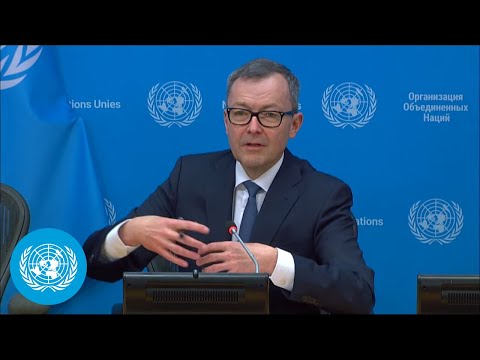
Ambassador Jörg Lauber, president of the United Nations Human Rights Council, on Friday summarized outcomes of the council’s recent regular session and highlighted a priority to strengthen the council’s role within the global human rights architecture.
Lauber told reporters in New York that the council extended 16 thematic and country-specific mandates, adopted universal periodic review (UPR) reports for 13 states, and appointed three members to the Expert Mechanism on the Rights of Indigenous Peoples. He said, for the first time since 2011, there was consensus to renew the mandate of the commission of inquiry on Syria.
Lauber said the council also passed resolutions relating to mandates or situations in Belarus, the Democratic People’s Republic of Korea, the Islamic Republic of Iran, Myanmar, Nicaragua, the occupied Palestinian territory, South Sudan and Ukraine. The council adopted measures on a range of thematic issues, he said — including cultural rights, the right to food, freedom of religion or belief, the right to a clean, healthy and sustainable environment, and neurotechnology.
Why it matters: Lauber framed the session’s outcomes as part of a broader effort to keep human rights central to peace and development. He cited the late UN Secretary-General Kofi Annan, saying there is “no peace without development, no development without peace, and neither peace nor development without human rights.”
Among other actions from the session, Lauber highlighted a major step on the rights of older persons: the establishment of an open-ended intergovernmental working group to draft a legally binding international instrument to ensure protection and enjoyment of their human rights. He described that move as the council’s role in norm-building and as an example of cooperation between Geneva and New York.
Lauber also noted that the council took action to address emerging issues, including protections for human rights defenders in the digital age, promoting women’s participation in diplomacy, assessing the human-rights impact of anti-personnel mines, and measures on repatriation of illicit funds.
The president said the session’s high-level segment (Feb. 24–26) drew 121 dignitaries and that the council’s exchanges during the session were “very constructive” despite a “changing and challenging political environment” and a looming liquidity crisis that he said has worsened since the session ended.
Lauber invited reporters and civil-society participants to follow the council’s next regular session, which he said would begin on 16 June.