Get email alerts on the Traffic Safety School Zones topic
No spam. Unsubscribe anytime.
Boca Raton approves pilot speed‑camera program for school zones
Summary
The City Council approved a pilot agreement with Red Speed Florida LLC to deploy speed‑detection cameras in school zones, directing staff to begin a phased rollout on city roads while coordinating county permitting and an initial public education/warning period.
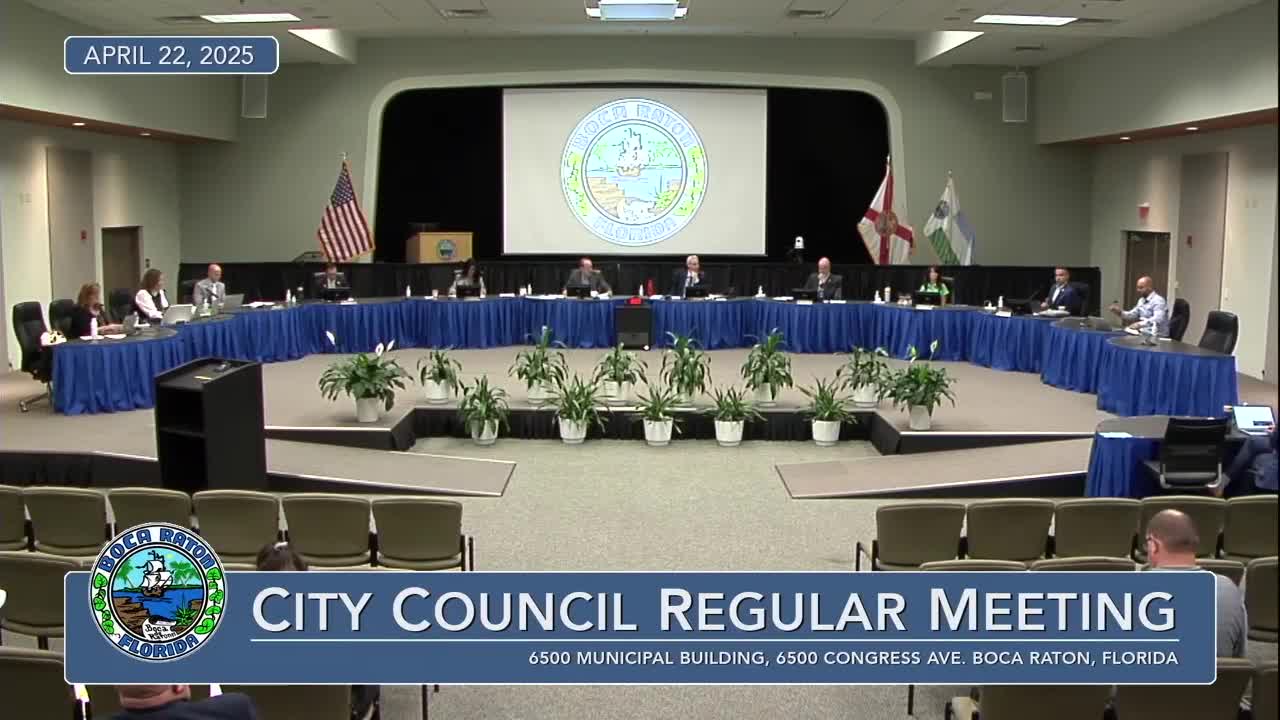
The Boca Raton City Council voted 5–0 April 22 to authorize a pilot agreement with Red Speed Florida LLC to install speed‑detection cameras in school zones and begin a phased deployment on city roadways.
City staff described the early deployment as a pilot meant to change driver behavior near schools rather than to raise revenue. Public Works and Engineering Director Zach Beer told the council the city used an intergovernmental cooperative procurement to accelerate deployment and that staff evaluated several vendors before recommending Red Speed. “This evening before you…is to approve the vendor contract with Red Speed and move forward with the phase 1 locations,” Beer said.
The pilot will start on city roads where permitting is directly controlled by Boca Raton; staff stressed that county‑owned roads could require separate county permits and may delay installations. Beer told the council that staff will deploy the cameras in stages, use a warning and education period before issuing fines, and train law enforcement officers to review violations.
Council members pressed staff on vendor selection and operational details. Council Member Drucker asked how many vendors staff spoke with; Beer said staff analyzed four to six vendors in depth, reviewed contract terms and field performance, and relied on a cooperative solicitation to speed procurement. He said a key contract differentiator was fee structure (fixed monthly fee versus per‑ticket sharing) and operational readiness. Council Member Thompson said an RFP after the pilot might be appropriate to compare vendors once more operational data are available.
Three vendors and an industry representative spoke at the public hearing. Greg Parks, speaking for Red Speed, said his company operates the largest program in the Southeast and cited data from other jurisdictions showing large reductions in speeding after camera deployment. Steven Abrams of LSED Partners and Ron Klein, representing other vendors, recommended alternate piggyback contracts and asked the council to consider other available contracts that could be executed quickly. Abrams said some piggyback contracts could be active immediately; Klein urged staff to consider local firms and to use a full RFP if the program expands.
City staff outlined next steps: focus the pilot on city‑controlled school zones, conduct a public outreach and warning period before citations, evaluate operational performance over several months, and then report back to council. The council directed staff to proceed with the pilot and to continue coordinating with county authorities for sites on county roads.
Votes at the meeting: the motion to approve the Red Speed agreement passed 5–0.
Why it matters: Council members framed the system as a public‑safety measure intended to reduce speeding in school zones and protect children at drop‑off and pick‑up periods. The pilot approach preserves the council’s option to revisit vendor selection after operational data are collected.
What’s next: Staff will begin the phase‑1 deployment on city roads, run a public education/warning period, track operational metrics and enforcement impacts for several months, and report findings to the council for a decision about broader roll‑out or an RFP.
AI generated
The text on this page is AI generated. Summaries, highlights, analysis, and video transcripts are all produced from the original source material.
AI can make mistakes, so if you spot one, and we will fix it for everyone.
Note: the source content is unaltered by us. Any content source we link to, be it a video, an audio recording, or a document, is presented exactly as its publisher released it. That publisher is usually a government body, sometimes an individual official or another organisation.