Get Full Government Meeting Transcripts, Videos, & Alerts Forever!
Get email alerts on the Broad Street Market topic
No spam. Unsubscribe anytime.
Council reviews $14.4 million reallocation to fund Broad Street Market rebuild; vote moved to later session
Summary
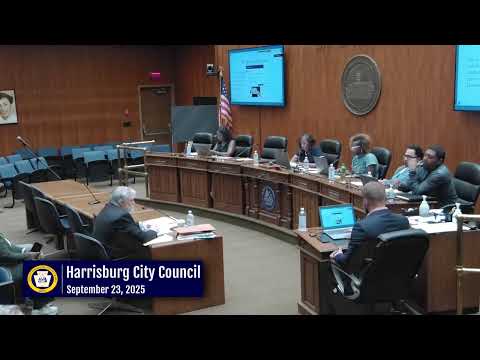
City officials presented the public bidding process and a proposed $14.4 million 2025 budget amendment to fund Broad Street Market construction contracts. Councilers asked for more detail; the resolution was read and moved to the next legislative agenda for formal action.
City officials outlined how public bidding and contract approvals work and presented a proposed $14.4 million amendment to the 2025 budget to fund construction contracts for the Broad Street Market rebuild.
The presentation began with City Solicitor Veil Grover explaining the procurement framework, noting that "the third class city code says we must" and describing why the Broad Street Market project was split into multiple bid packages. Accounting manager Brian McCutchen said the amendment would raise the general-fund expense line by $14,400,000 to help the city reach an estimated overall project cost in the roughly $23.1 million range. McCutchen said insurance reimbursements are projected but not guaranteed and that the amendment relies on a mix of reimbursements and transfers from other city funds, including a proposed $1 million CDBG transfer and smaller draws from hotel tax and street-cut fee receipts.
Why it matters: the Broad Street Market building is a National Register historic structure and was damaged by a July 2023 fire. The city must both follow state procurement rules and secure appropriations before signing construction contracts. Solicitor Grover emphasized that public bidding, bonding and insurance requirements protect the city and that changes to scope or delays can increase costs.
Key details: McCutchen said the city has already paid about $3.3 million on the project and that the facilities group projects a total cost near $23.1 million. The revenue-side assumptions on the budget schedule include an estimated $11.7 million in potential insurance reimbursement (of which $4.93 million has already been received), a $1 million set‑aside for a temporary structure, $1 million from CDBG for design fees, $450,000 from hotel tax and $375,000 from street-cut fees, and a $100,000 transfer from the blight remediation fund. McCutchen described the insurance figure as an estimate that will depend on the insurer's line‑by‑line forensic review.
Council discussion focused on transparency and timing. Council members asked for an itemized cost breakdown, a timeline for construction and clarification about how insurance reimbursements will be handled. Director David Baker said much of the project work so far has been design, sampling, testing and other preparatory work required for a historic restoration, and that visible construction activity will increase once bids are awarded and contracts are signed. Baker estimated an 18‑month construction period for the brick building and said the white tent (a temporary market structure) would likely be used for roughly 18–20 months while work proceeds.
Action and next steps: Resolution 63 (approving the proposed reallocation tied to the Broad Street Market rebuild) was read into the record. Council members asked for more written detail before voting; McCutchen offered to circulate a summary of the payment schedule and the status of the 11 bid packages. Vice President Green moved to place the item on the next legislative agenda; the council agreed to move the resolution to a future legislative session and discussed the possibility of a special session to act earlier so contracts can be signed while bid prices remain valid.
The presentation also reviewed procurement mechanics: the city used a PenBid posting, held public walk‑throughs, divided work into 11 trade packages (10 had bids; site‑prep did not and was being re‑advertised), and used scoring committees to identify the "lowest responsible bidder." Grover reminded council that contracts over state thresholds must be publicly bid, that bidders must provide bonds and insurance, and that the law bureau must review contracts before the mayor and controller sign them.
Council members requested: a written summary of the total project cost and a line‑item breakdown showing what the requested funds will pay for, a construction timeline, a note on which bid packages have responsible bidders, and material on insurance reimbursement assumptions. McCutcheon agreed to provide the summary to the clerk for distribution before the legislative vote.
The council did not vote on the reallocation during the September 23 session; formal action will be scheduled for a future legislative meeting or a special session.
Ending: The council signaled support for moving the appropriation to a forthcoming legislative agenda but withheld a final vote pending the additional documentation requested by council members.