Get Full Government Meeting Transcripts, Videos, & Alerts Forever!
Get email alerts on the County Budget topic
No spam. Unsubscribe anytime.
Sarpy County holds public hearing on $314.2 million FY2026 budget; levy unchanged
Summary
County finance staff presented the fiscal year 2026 budget at a public hearing, outlining $314.2 million in spending, a maintained property-tax levy, planned capital projects including a 911 center and road work, and an unchanged reserve policy of 2.6 months.
Daniel Tlaikis, Sarpy County chief financial officer, presented the county’s proposed fiscal year 2026 budget during a public hearing Tuesday, saying the plan continues current services while funding board priorities and preserving fiscal health.
“If I could summarize the fiscal year 26 budget sort of in one sentence, it would be that we are continuing to provide quality services to the residents of Sarpy County while addressing the priorities of this Board and maintaining the fiscal integrity of the County,” Tlaikis said.
Tlaikis told the Board of Commissioners that the FY2026 expense budget totals $314,200,000, backed by $112,400,000 in cash and $201,800,000 in expected revenue. He described capital and operating priorities that include remodeling the 1200 Building into a new 911 communication center, opening a new west precinct for the sheriff’s office (targeted for September), radio upgrades to improve public-safety communications, major road work focused on the South Sarpy Expressway, and sanitary sewer repairs.
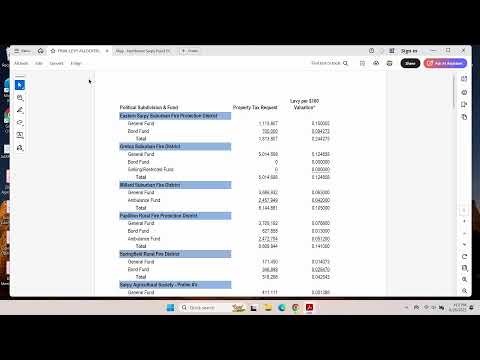
The county plans no new full-time equivalents in the budget and will continue its self-funded insurance plan for employees. Tlaikis said the county will maintain its current property-tax levy; because assessed value rose, that results in higher tax revenue. “The levy, in this 2026 budget is maintained. It is the same levy as last year,” he said.
Tlaikis gave a breakdown of key numbers cited in the presentation: county valuation for 2025 is $29,604,000,000, up from $27,637,000,000 the prior year (a 7.11% valuation change composed of 2.53% growth and 4.85% reappraisal). The budget anticipates $84,359,000 in property-tax revenue in FY2026 compared with $78,757,000 last year, a difference Tlaikis described as “new property tax revenue” rather than a levy increase.
He detailed other budget components: $69,800,000 in capital outlay (road and sewer infrastructure, and the 911 remodel), $100,300,000 in personnel services, $28,100,000 in transfers between funds, and $10,600,000 budgeted for debt service. Tlaikis said the county will repay $9,300,000 of principal and incur $4,500,000 in interest in FY2026.
Tlaikis also reviewed Sarpy County’s reserve policy, pointing to a board resolution that sets a minimum two-month reserve and the Government Finance Officers Association guidance of two to three months. He said the county’s budget keeps a 2.6-month reserve, within the GFOA best-practice range, and noted that reserve levels affect the county’s AAA bond rating and the interest rates on future bond issuances.
The public hearing was opened and no members of the public addressed the board on the budget. Tlaikis outlined the next steps: the board is scheduled to consider three resolutions on Sept. 9 — adopting the FY2026 budget, creating fund 5259 for the wastewater agency loan reserve, and authorizing the transfers in the budget — and will appear at a joint public hearing on LB644 on Sept. 19 at Bellevue University as required by the levy-maintenance process. A resolution setting the tax levy is scheduled for Sept. 23, after which county staff will file budget forms with the Nebraska Auditor of Public Accounts.
Commissioners asked clarifying questions during the hearing about debt, transfers among funds, and the practical meaning of the 2.6-month reserve; Tlaikis and staff supplied the figures and described how transfers fund operations in separate enterprise funds (public works, 911, stadium) and reserve accounts for loans.
The public hearing closed with no public comments and no formal action taken at the meeting; the items described above will return as formal resolutions for board consideration in September.