Get Full Government Meeting Transcripts, Videos, & Alerts Forever!
Get email alerts on the Public Health topic
No spam. Unsubscribe anytime.
Panhandle Health board chair says he lacks access to data; board introduces new medical director
Summary
Bonner County commissioners heard a contentious update from Panhandle Health Board Chair Thomas Fletcher, who said he has been obstructed from getting operational and clinical data; the board introduced Dr. Greg Pinnock as Panhandle Health’s new medical director and members of the public pressed for environmental and substance-use monitoring.
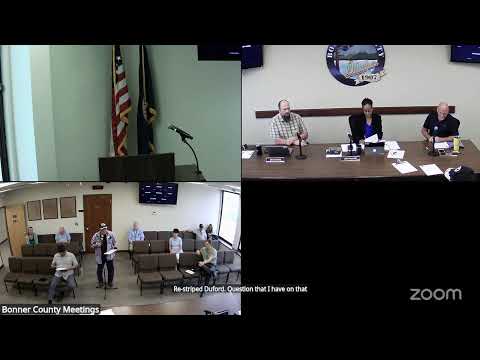
Thomas Fletcher, chair of the Panhandle Health board, told the Bonner County Board of Commissioners on Aug. 26 that he has been unable to obtain basic operational and clinical information from Panhandle Health and said institutional and legal obstacles have blocked board oversight. "I don't know what the hell is going on at Panhandle Health, and I'm the chairman of the board," Fletcher said.
Fletcher introduced the district's new medical director, Dr. Greg Pinnock, who told commissioners he will “do a deep dive with Panhandle Health” to review clinical services, efficiency and whether the district’s services meet community needs. Pinnock said he plans to review how many people the district sees, what clinical services it provides and how those services align with community needs.
Why it matters: Bonner County contributes local tax dollars to Panhandle Health and commissioners said they need county-specific reporting showing what services and clinical time the district provides in Bonner County. Failure to get that data has prompted the county to press for quarterly, county-specific updates from Panhandle Health board members representing Bonner County.
Fletcher and several commissioners criticized Panhandle Health administration and legal counsel for denying board access to meeting content and requested greater transparency. Fletcher said he was excluded from director-level meetings after requesting to attend and that legal counsel told him to "sit down and shut up," language he read into the public record as evidence of obstruction.
Public comment at the meeting covered several topics that commissioners asked the district to address, including potential educational materials and monitoring related to kratom — an over‑the‑counter herbal product used for stimulant and pain relief that county officials said they have seen increasingly in court cases — and calls from residents for environmental testing for chemicals in rain and food monitoring programs.
Commissioners and public commenters asked Panhandle Health to clarify how much of local tax contributions are directed to clinical services versus other statutory functions such as septic, restaurant inspections and water testing. Fletcher said the district’s original budget request presented to the five northern counties asked for more than $500,000 from Bonner County; after county pushback, that contribution was reduced to roughly $430,000.
Fletcher said he wants Panhandle Health board members who represent Bonner County to provide regular, county‑specific reports so county commissioners and residents can see what services the county is effectively buying. Dr. Pinnock said he has not yet had time in the role to review internal operations but will report back.
Public commenters pressed for Panhandle Health activity on kratom and environmental monitoring. Theresa Heisner and others urged the district to perform or coordinate sampling (for example rainwater or food testing) and to provide public education. Fletcher said he supports environmental monitoring in principle but acknowledged funding and political will are barriers.
The board did not take formal action but several commissioners said they will follow up with Panhandle Health leadership to resolve access and reporting issues and to determine whether county-level requests should be formalized.
Ending: Commissioners asked Fletcher and the county's Panhandle Health representatives to return with a plan for regular county-specific updates and identified kratom education and clearer accounting of clinical services as near-term priorities.