Get Full Government Meeting Transcripts, Videos, & Alerts Forever!
Get email alerts on the Education Grants topic
No spam. Unsubscribe anytime.
Shenendehowa outlines $2.9M in federal and state grants and describes expanded summer programs
Summary
District officials reviewed consolidated federal and state grant allocations just over $2.9 million for 2025–26 and summarized summer academic and enrichment programs, including literacy, math, ESY, new sixth-grade orientation and expanded camps.
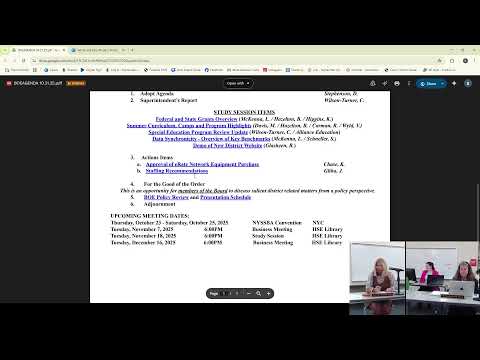
District administrators reviewed the Shenendehowa Central School District's federal and state grant allocations for the 2025–26 school year and presented highlights of the district's summer programs at Tuesday's study session.
McKenna (presenting as the district grants coordinator) told the board the consolidated federal and state grants for 2025–26 total just over $2.9 million and fund a range of supports including Title I tutors and STEM instructors, Title II professional learning, Title III ENL (English as a New Language) summer literacy programs, and Title IV social-emotional learning and equity programs. She said an additional Title III immigrant allocation arrived late and the district is in the process of applying to the New York State Education Department for that award.
Special education grants 611 and 619 were also detailed. Presenters said the 611 grant funds special-education staffing, professional development, materials and mandated set-asides; the 619 grant supports preschool CPSE services and early intervention. Administrators noted nearly $90,000 of 611 funds were allocated for PPE, curriculum materials and instructional resources for students with disabilities.
District staff described several competitive and discretionary grants and how funds were used:
- A mental-health grant of roughly $249,000 required local matching funds; the district used a mix of general fund dollars, expired ARPA funds and in-kind staffing to meet the match. The grant paid for a districtwide student support counselor, a K–8 attendance teacher who conducts home visits and transportation as needed, a sixth-grade health teacher and professional development on mental-health topics.
- A learning-technology grant of about $300,000 funded building-level AI coordinators (22 teachers districtwide), teacher coaching, Magic School software and Google Gemini Pro subscriptions, plus student-facing curriculum on ethical AI use. The district will publish its work publicly for other New York State teachers.
- A Department of Labor teacher-residency grant reimburses the district for stipends (district-paid stipends of $30,000) for up to eight residents; four residents were serving year-long placements.
- A mentor-teacher internship grant of approximately $51,000 covers substitute time and professional learning for mentors and instructional coaches; the program runs on a multiyear cycle.
Presenters also summarized summer program scale and outcomes. Matt Davis and colleagues said the district sustained a range of summer offerings that had previously been funded by federal grants by using a combination of title grants and the general fund. Programs included district-run summer literacy (roughly 272 Grade 1–5 students plus 47 incoming kindergartners for Jump Start), math enrichment (more than 120 students in Grades 1–5), math bridge (82 students preparing to accelerate), ENL summer programs (92 elementary ENL students, 27 secondary-level ENL students, and 12 Jump Start ENL students), extended school year (ESY) special-education programming (225 recommended, 182 attended), Shen summer adventures and a new sixth-grade orientation that drew more students than signed up.
Administrators said the district provided free breakfast for participants in academic summer programs, continued the jump-start program for kindergarten ENL students and expanded camp offerings, with scholarships provided by the educational foundation. Presenters also noted strong participation in high-school summer school and expanded arts and credit-bearing opportunities; roughly 731 secondary students participated in summer offerings that included academic and enrichment options.
Several educators who run summer programs presented classroom- and program-level details. Kathleen Strandis described literacy instruction strategies and family supports; Emily Patterson summarized math's "math and motion" enrichment approach; Jennifer Lealden reviewed secondary summer school participation and free meals data; and Tamara Dorsey and administrative interns described ESY themes and staffing.
Board members asked several clarifying questions about eligibility, program identification, and how survey and attendance data were being tracked; presenters said program selection uses screening benchmarks and spring assessments and that staff monitor and report outcomes.