Get Full Government Meeting Transcripts, Videos, & Alerts Forever!
Get email alerts on the Transportation Safety topic
No spam. Unsubscribe anytime.
Public works adopts Towards 0 Deaths action plan and ADA transition plan for county roadways
Summary
Hennepin County Public Works adopted a Towards 0 Deaths (TZD) action plan identifying a high‑injury network and data-driven strategies, and an Americans with Disabilities Act (ADA) transition plan mapping curb ramps, sidewalks and accessible pedestrian signals; both will guide safety and accessibility investments.
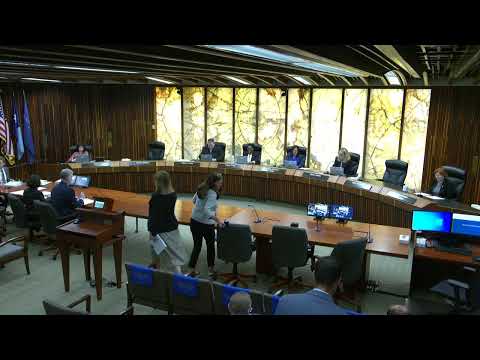
Hennepin County Public Works presented and the board adopted two major transportation plans on Sept. 16: the county's Towards 0 Deaths (TZD) action plan and an updated Americans with Disabilities Act (ADA) transition plan covering county-owned transportation facilities.
The TZD action plan sets a long-term goal of zero fatalities on county roadways and uses recent crash data to create a countywide High Injury Network (HIN) concentrated in urban and first-ring suburban areas. Staff described trends showing a rise in fatal and serious injury crashes over the last decade and said fatal/serious crashes in the county are distributed roughly 69% urban, 24% suburban and 7% rural; the HIN is similarly concentrated in urban and suburban contexts. The plan combines engineering, education, enforcement, emergency response and engagement strategies (the “five E's”) and prioritizes data-driven investments along the HIN. Staff said they will build a public dashboard with fatal and severe crash data, continue community engagement and seek safety funding to implement engineering countermeasures on priority corridors.
The ADA transition plan documents the county's pedestrian inventory (curb ramps, sidewalks, trails and accessible pedestrian signals), sets a goal for full compliance by 2040, and identifies gaps: roughly 60% of curb ramps currently meet standards and about 30% of traffic signals have accessible pedestrian signals. Staff described public outreach (multilingual online survey and community engagement) and said the inventory will be updated regularly and used to guide ADA upgrades as part of ongoing preservation, rehabilitation and reconstruction projects.
Commissioners asked questions about dashboards, data breakdowns by trip proportions, enforcement partnerships for speed reduction and pilot treatments such as experimental crosswalks or refuge islands to address high-risk locations. Staff said they will continue engagement with law enforcement and community stakeholders, pursue funding for engineering improvements, and provide updates on specific pilot projects and data analyses.
Motion and outcome: The board voted to adopt both the Towards 0 Deaths action plan and the ADA transition plan.