Get Full Government Meeting Transcripts, Videos, & Alerts Forever!
Get email alerts on the Governance Bylaws topic
No spam. Unsubscribe anytime.
Imperial County retirement board adopts revised bylaws; adds ban on retired plan members in certain appointed seats
Summary
The board approved a broad set of bylaw revisions covering definitions, quorum rules, electronic signatures and public‑comment time limits and adopted language barring retired or deferred plan members from occupying four specified appointed seats; the changes will be forwarded to the Board of Supervisors for ratification.
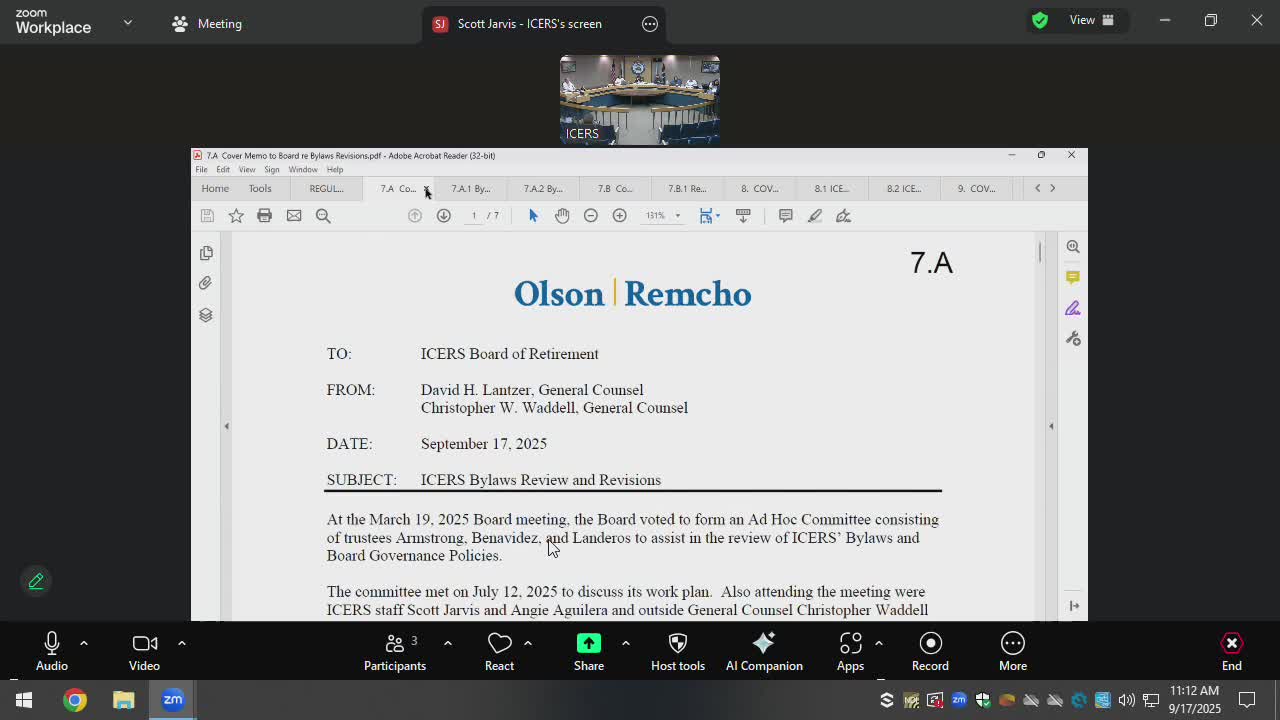
The Imperial County Employees' Retirement System Board of Retirement voted on Sept. 17 to adopt a revised set of bylaws that update definitions, clarify meeting and quorum rules, add permissive authority for electronic signatures and tighten eligibility language for appointed seats.
The board's ad hoc bylaws committee presented the draft revisions and recommended a specific, and contested, provision that a "retired or deferred member of ISERS may not serve as, or in the fourth, fifth, sixth, or ninth member of the board because a retired or deferred member has connections with the county due to membership in ISERS." The board adopted that language and directed staff to forward the amended bylaws to the Board of Supervisors for ratification.
The changes are intended to modernize administrative language and close perceived gaps in governance. Committee counsel said the draft edits remove obsolete definitions, add a definition for PEPRA, standardize terms such as "compensation earnable," and remove references to positions that no longer appear elsewhere in the bylaws. The revised document also gives the board chair greater discretion to limit or extend public‑comment time and allows staff to accept employer‑supplied electronic enrollment data when the system determines that data is reliable.
On quorum and voting, the bylaws now state that five members constitute a quorum, but when only five members are present motions must pass by a 4–1 vote; the language was adopted after board members raised concerns about decisions with too narrow a majority when attendance is low. The bylaws retain existing practice that tie votes on disability retirement applications result in denial.
Board members debated the proposed restriction on retirees occupying appointed seats. Committee counsel reviewed three implementation options: (1) take no action and leave appointments to the Board of Supervisors, (2) pass a board resolution stating a preference, or (3) adopt binding bylaw language and send the bylaws to the Board of Supervisors for ratification. The board chose the third approach. Supporters said the change would avoid conflicts arising from a retiree's ongoing financial relationship with the system; others who raised questions noted that some California systems allow retirees to serve and that staff should confirm how the ban applies to employees of dependent district employers and courts.
The board also added permissive language allowing adoption of an electronic signature policy in line with California Secretary of State rules, and clarified that section cleanups bring the bylaws into alignment with recent statutory updates.
The board approved the full package of bylaw changes in a recorded motion and directed staff to send the amended bylaws to the Board of Supervisors for ratification, as the county code requires.
Ending: The board voted to adopt the revised bylaws and will submit them to the Board of Supervisors for ratification; staff will prepare implementing administrative policies such as an electronic‑signature regulation for a future meeting.