Get Full Government Meeting Transcripts, Videos, & Alerts Forever!
Get email alerts on the Real Estate Investments topic
No spam. Unsubscribe anytime.
Real‑estate managers tell Imperial County retirement board they are shifting into industrial, residential and alternatives
Summary
Three external managers and the system's investment consultant updated the Board on portfolio positioning, saying they reduced office and increased industrial, multifamily and niche real‑estate exposure and highlighting income growth and development/entitlement risk.
American Realty Advisors, ASB Capital Management and Clarion Partners presented updated strategies for the retirement system's real‑estate allocation and said they have been moving away from office and toward industrial, residential and alternatives including life sciences and self‑storage.
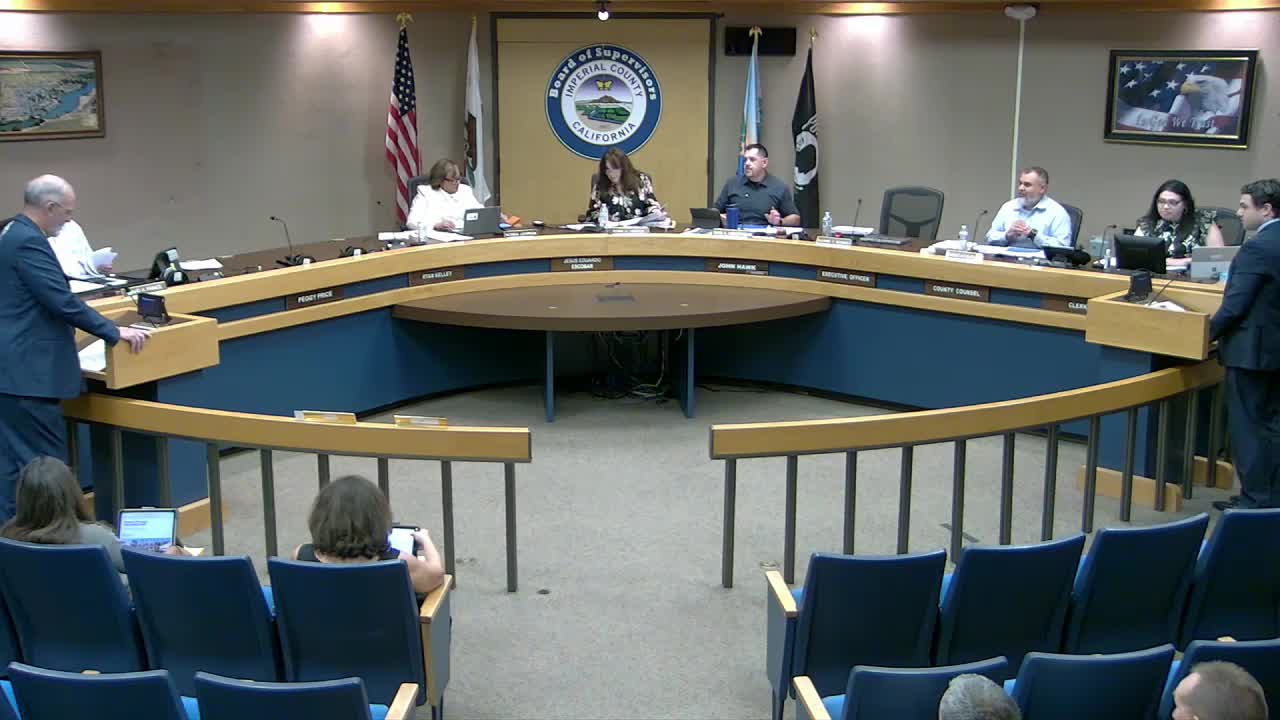
The presentations came during the regularly scheduled Imperial County Employees' Retirement System (ISERS) meeting on Sept. 17, 2025, at the Imperial County Administration Center. Managers reviewed performance, deployment strategy and risks as the board considers allocations and manager oversight.
Managers told the board that a combination of sector repositioning, active asset management and opportunistic capital should produce income growth and value creation as interest rates and demand dynamics stabilize.
American Realty Advisors characterized its portfolio as a value‑to‑core strategy that buys underperforming, non‑core assets, improves them and sells to core buyers once income and risk profiles are stabilized. Portfolio manager Josh Brodsky said the approach is to "derisk the investment" and "create a lot of value by derisking assets and increasing cash flow." The firm reported the fund has roughly $3 billion in assets, said its leverage on assets is about 40%, and described current leasing at about 85% occupancy. The firm told the board it is positioned to sell assets after stabilizing cash flows and to redeploy capital into new opportunities on a roughly three‑to‑five year hold cycle.
ASB Capital Management said it has been actively reducing office and retail exposure and increasing industrial and residential allocations. Frank Nigro and David Quigley told the board ASB had sold nearly $800 million of underperforming office and retail assets and now targets roughly 80% of the portfolio in what it calls "target sectors" (industrial, residential and self storage). Quigley said: "Office isn't going away, but near term ... it's going to continue to be a challenge." ASB highlighted a 1‑year uptick in income driven by leasing and rate resets and said it expects further NOI growth where markets absorb existing supply.
Clarion Partners emphasized industrial and multifamily as its high‑conviction sectors and said alternatives (life sciences, student and senior housing) are a growing allocation. Clarion noted it has pursued new‑build industrial projects, acquisition of younger industrial stock and older multifamily assets that can be upgraded. The firm said most retail in its portfolio is necessity‑based, such as grocery‑anchored centers, not regional malls.
The board's consultant, represented by Brian Kwan of Verus, gave a macroeconomic update that framed the investment discussion. Kwan said inflation remained "sticky" above the Fed's 2% target while the labor market has softened, and that investors are watching upcoming Fed decisions for signs of policy easing. Kwan noted international currency moves were a driver of recent quarter performance and that the fixed‑income market could contribute positively if rates continue to ease.
Board members asked managers about entitlements, lease‑up timelines and specific regional exposures. Managers acknowledged entitlement work can take six months to several years and said development and land assemblage carry greater timeline risk but also larger upside if entitlements are secured. ASB and Clarion both described a preference for smaller infill industrial buildings where owner‑users and leasing demand are strong.
On local and regional questions, managers gave examples of current assets: American Realty Advisors referenced a small industrial building sold to an owner‑user; ASB cited Tampa Commerce Center and projects in Phoenix and Murrieta; Clarion described life‑science and infill industrial holdings in innovation markets. In response to questions about multifamily supply in Phoenix, ASB said record absorption is taking place and some markets still warrant continued hold positions until supply/demand normalizes.
The presentations will be incorporated into the board's forthcoming reviews of strategic allocation and manager monitoring. Several board members asked staff to return with follow‑up materials on specific holdings and performance attribution for consideration at a future meeting.
Ending: The board took no allocation vote at the meeting; the session was informational and managers did not request specific changes to the portfolio allocation at this time.