Get Full Government Meeting Transcripts, Videos, & Alerts Forever!
Get email alerts on the Land Use Housing topic
No spam. Unsubscribe anytime.
Advisory board recommends approval for 138‑home Rodon Estates; members press for safeguards on natural forest area
Summary
The PAB recommended adoption of a small‑scale CDMP amendment to redesignate about 20.9 acres for a 138‑unit Lennar Homes project (Rodon Estates), accepting a declaration of restrictions. Board members questioned density, cluster‑home commitments and protections for a 2.8‑acre natural forest community (NFC).
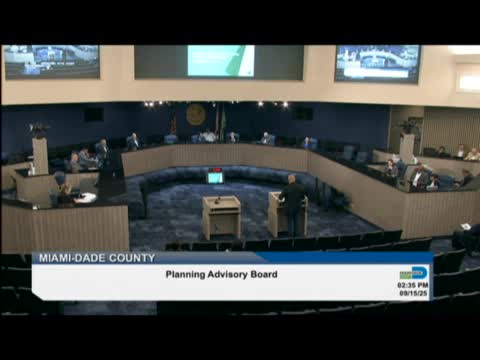
MIAMI-DADE COUNTY — The Planning Advisory Board voted Sept. 15 to recommend adoption, with acceptance of a proffered declaration of restrictions, for CDMP20250003 (Lennar Homes/Rodon Estates), a small‑scale land‑use amendment that would redesignate a roughly 20.9‑acre site to permit 138 detached single‑family cluster homes.
Mark Dorsey, principal planner with the Department of Regulatory and Economic Resources (RER), summarized staff analysis and the recommended action. The application would change the site from estate density (currently allowing up to 52 single‑family units) to low density with a DI‑1 urban design bonus. The applicant proffered a declaration of restrictions limiting development to 138 units, requiring connection to public water and sanitary sewer, an endangered species survey, preservation and long‑term maintenance of a 2.8‑acre natural forest community (NFC), and a notice to future owners about the adjacent NFC. "The staff recommendation was adopt with acceptance of the declaration of restrictions," Dorsey said.
The applicant's representative (identified in the hearing as Amanda, counsel for the applicant) said the project is intended to provide housing diversity within the urban development boundary and that the proposed 138 units equal a density of about 6.6 dwelling units per acre. She said the project is "about half" of what would be allowed under a full DI‑1 buildout and that the clustered single‑family product is a hybrid meant to increase housing variety.
County staff presented projected service impacts: an increase in water demand of about 18,060 gallons per day, an estimated addition of 43 school‑age students, a projected 135 vehicle trips per hour (an 81 vph increase over current conditions), and a fire‑service estimate of 138 annual alarms categorized as a medium impact on service capacity. The site lies about 333 feet east of the urban development boundary and is within the U.S. Fish and Wildlife Service consultation area; staff said an endangered species survey is required prior to development approvals.
Board members questioned the DI‑1 density increase and whether the change amounts to spot zoning. One member read county code 2‑116.19 aloud to remind the board that CDMP applicants may not rely on verbal representations of specific uses unless a restrictive covenant or concurrent development application commits to those uses. Staff and the applicant pointed out a concurrent zoning (planned area development) application and site plan are being processed with the CDMP amendment and are expected to be heard by the Board of County Commissioners on the same day, giving the county an opportunity to review the site plan and the proffered commitments together.
On the question of unit type, staff told the board the CDMP declaration limits the density and includes commitments, but the exact building product type is primarily enforced through concurrent zoning/site‑plan approvals. The applicant's materials include draft floor plans and elevations in the zoning application. The Redland Community Council recommended adoption with acceptance of the declaration, and no neighborhood opposition was recorded at that council meeting.
Daniel Rogers moved to adopt the amendment with acceptance of the declaration of restrictions; Vice Chair McRae seconded. The clerk conducted roll call and the motion passed unanimously on the PAB recommendation.
Why it matters: The change would allow infill residential development inside the urban development boundary and add housing capacity in a market the county projects will be short of single‑family units. The hearing included detailed service‑level projections and board discussion around how the county ensures developer commitments are enforceable through concurrent zoning and restrictive covenants.
Next steps: The PAB recommendation and the applicant's declaration and concurrent zoning application move forward to the Board of County Commissioners for final action. Staff noted follow‑up items including the endangered species survey and coordination with the department that will manage the NFC preservation and long‑term maintenance.