Get Full Government Meeting Transcripts, Videos, & Alerts Forever!
Get email alerts on the Police Oversight topic
No spam. Unsubscribe anytime.
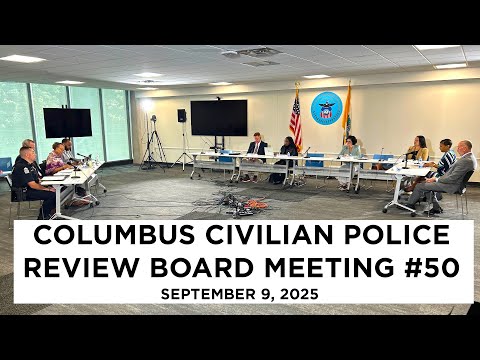
Assistant chief outlines how Columbus police handle board recommendations, discipline and policy reviews
Summary
Assistant Chief Conves of the Columbus Division of Police told the civilian review board that recommendations tied to specific cases go to the division’s internal affairs bureau while policy suggestions go through a separate research and development and accreditation review process.
Assistant Chief Conves of the Columbus Division of Police told the civilian review board that recommendations tied to specific cases go to the division’s internal affairs bureau while policy suggestions go through a separate research and development and accreditation review process.
Conves said case-related recommendations arrive at Internal Affairs, are packaged with evidence and routed up the chain of command. "The collective bargaining agreement kind of dictates how the chain-of-command review goes," Conves said, adding that supervisors must record concurrence or provide written justification when they disagree with a finding.
The board heard that discipline is governed by progressive-discipline rules in the collective bargaining agreement but can be escalated for critical misconduct. "Generally, we must follow progressive discipline," Conves said. He described the typical progression as documented constructive counseling (DCC), written reprimand, suspension, demotion and termination, and said arbitration is binding when grievances reach that stage: "We are under binding arbitration," Conves said. He added that the department must implement arbitrators' decisions.
Conves described the department’s internal timelines as variable. "The shortest was two days. The longest I think was 60 days," he said, noting that time to review depends on the rank of the focus officer, staffing, leave and whether multiple chain-of-command levels must respond. He said many reviews are short when reviewers concur; reviews that require written justification take longer.
On policy recommendations from the board, Conves said those are handled by the Professional Standards Bureau, which houses accreditation and research units that compare draft language to national best practices and require legal review. He noted the department follows CALEA standards and distributes policy updates quarterly, with a mechanism for temporary, exigent policy changes when courts or emergent issues require immediate action. He described a recent temporary retraining tied to court scrutiny of post-use-of-force handcuffing.
Conves described tools the department uses to identify patterns and target intervention, including a discipline-tracking system and an early-warning system called EARS. He said EARS aggregates uses of force, Taser deployments, injuries to arrestees and complaints to highlight officers with outlying patterns and that the division may recommend retraining or other supervisory actions when patterns emerge.
He provided annual discipline counts for context: "In 2024, we issued 257 documented constructive counselings, 33 written reprimands, five suspensions, one demotion and two terminations," Conves said, and he characterized DCCs as an indicator that supervisors are correcting behavior early.
The assistant chief also addressed pursuits and pursuit alternatives, saying Columbus maintains a restrictive pursuit policy and relies on tactics such as helicopter monitoring, PIT maneuvers and stop-sticks. He said a recent procurement review of GPS-based launchers returned mixed results and the department did not adopt the device after learning several agencies reported limited effectiveness at higher speeds.
On transparency and complainant notification, Conves said the department continues to notify complainants of outcomes and that an appeals process remains in place through the chain of command and upward review.
Board members asked whether the inspector general’s office and Internal Affairs coordinate on allegation wording and investigative completeness; Conves said the agencies meet regularly and that supervisors provide feedback on wording such as compound or descriptive allegations that can complicate findings.
The board thanked the assistant chief for a lengthy briefing on process and practice. "We appreciate you," one board member said.