Get Full Government Meeting Transcripts, Videos, & Alerts Forever!
Get email alerts on the Tree Fund Ordinance 10 39 topic
No spam. Unsubscribe anytime.
Shoreline staff propose broadening tree fund uses to plant, maintain trees on non‑city public land
Summary
City staff presented proposed ordinance 10‑39 to allow the Shoreline tree fund to support tree planting on public property managed but not owned by the city, to fund certain maintenance from fines and settlements, and to clarify eligible mitigation fees; PRCS Tree Board supports the changes.
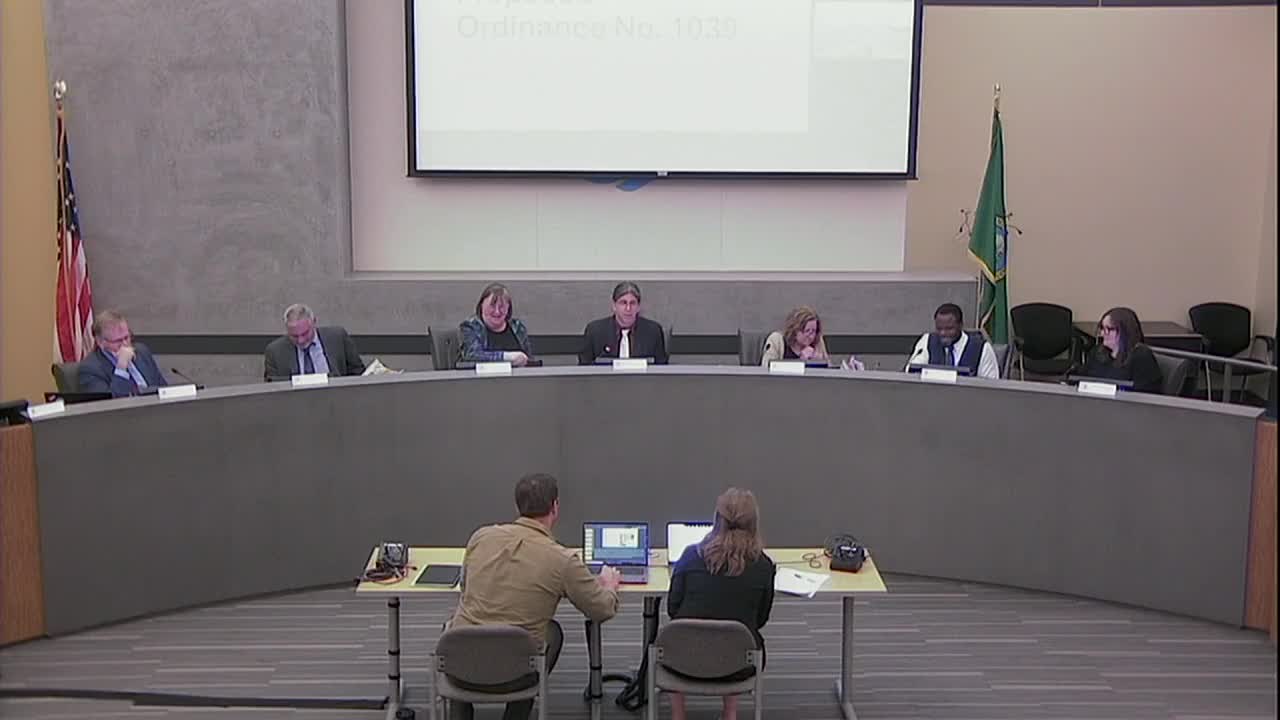
Shoreline staff on Monday presented ordinance 10‑39, a proposed amendment to city code that would broaden how the city’s restricted tree fund may be used. The changes are intended to allow tree planting and certain forestry activities on public land the city manages but does not own, and to clarify which fee revenues may be used for tree program work.
Katrina Steinle, senior management analyst with Parks, Recreation and Community Services (PRCS), said the tree fund currently consolidates in‑lieu replacement street tree fees, a recently adopted significant tree removal fee, and fines and settlements directed to public trees. Under existing code, many of those fees are restricted to planting and establishing trees on city‑owned property or rights‑of‑way and must be spent within five years when tied to state mitigation requirements.
Urban forestry supervisor Kevin Hickenbottom described the staff proposals in ordinance 10‑39: allow the city to use restricted tree fund monies to plant and establish trees on public property managed by the city but owned by other entities (for example, Shoreline School District parks), permit the tree fund to support urban forestry program activities such as maintenance beyond the plant‑establishment phase where the funding source is not state‑restricted, and clarify the code’s list of eligible funding sources by explicitly including mitigation fees.
Staff said the PRCS Tree Board reviewed the proposal in May and provided a letter of support included in the staff report. Staff also said the city has been in communication with Seattle City Light about potential plantings along the Interurban Trail and that volunteers are planning a fall planting at Paramount Park, which is school‑district property; under current code the city could not use in‑lieu fees to fund those trees without the proposed change.
Council questions focused on legal constraints tied to state law, the five‑year spending requirement on certain mitigation‑linked fees, and how agreements with other public agencies would define long‑term care of planted trees. Staff said fees that are restricted by state law (RCW provisions governing development mitigation) would remain limited to planting and establishment on city property and within the five‑year obligation window; fines and settlements and other non‑RCW‑restricted revenues in the tree fund would be eligible for broader uses, including maintenance and longer‑term care where agreements permit.
Council members also raised concerns about using the fund to address sidewalk‑and‑root conflicts or to substitute for infrastructure project budgets. Staff said the fund could support tree health measures tied to sidewalks (for example, soil improvements or design work to preserve tree roots), but could not be used to build sidewalks themselves. The mayor and other council members asked staff to return with details if tree fund dollars will be proposed to offset expensive sidewalk treatments.
Staff recommended a clarifying edit to the draft ordinance to explicitly list “mitigation fees” so future mitigation‑type fees for public trees are unambiguously included. The ordinance is scheduled to return to council for potential action on Sept. 22.