Get Full Government Meeting Transcripts, Videos, & Alerts Forever!
Get email alerts on the Healthcare topic
No spam. Unsubscribe anytime.
Salinas Valley Health warns of rising uninsured rates, outlines local clinic expansions
Summary
Salinas Valley Health officials told the Gonzales City Council that federal and state Medicaid changes and cuts to supplemental payments will raise the county's uninsured rate and put local hospitals under financial stress; the system described clinic growth and new access initiatives.
Dr. Renner, chief executive officer and infectious-disease physician at Salinas Valley Health, told the Gonzales City Council on Oct. 6 that the health system expects a significant rise in uninsured residents after recent federal changes to Medicaid (Medi-Cal) funding and eligibility.
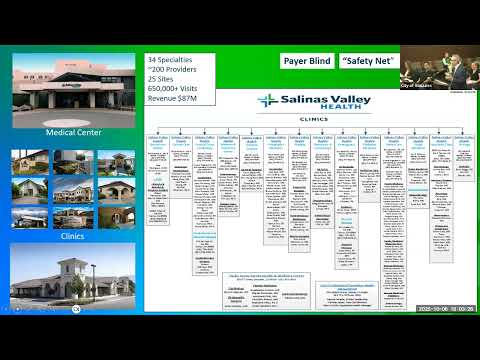
The health system's clinic network now includes more than 200 providers and is expected to deliver roughly 700,000 patient encounters in the current year, Dr. Renner said. He told the council that Monterey County has about 430,000 residents and that roughly 195,000 are enrolled in Medi-Cal; he estimated that 44'45% of county residents are on Medi-Cal and that in Salinas the share may be closer to 60%.
Why it matters: Salinas Valley Health said cuts to supplemental Medi-Cal funding and other federal changes will reduce reimbursements and increase the number of uninsured people seeking care. Dr. Renner said the hospital system currently loses about $90 million a year caring for Medi-Cal patients at the hospital and draws about $20 million in supplemental funds; changes to those funding streams and new redetermination rules could leave tens of thousands without coverage and threaten the viability of several local hospitals.
Dr. Renner described both the financial challenge and local steps the system is taking. "We lose about $90,000,000 a year," he said, adding that the supplemental funds that the system uses to partially offset the shortfall amount to roughly $20 million annually. He warned council members that, based on estimates from Central Coast Alliance for Health, 20 to 25 percent of people enrolled in Medi-Cal could lose coverage over the next three years because of reenrollment and policy changes.
What the system is doing: Salinas Valley Health emphasized expanding outpatient care and urgent-care access to reduce costly emergency-department visits. Dr. Renner described the Taylor Farms Family Health and Wellness Center in Gonzales as a model clinic: it has nine providers, extended hours and some visiting specialists. The system also runs an orthopedic urgent clinic Monday through Friday and after-hours telehealth services tied to patients' charts.
Dr. Renner said the health system will continue community programs such as a mobile clinic (more than 20,000 encounters to date), Blue Zones / Live Well activities, vaccine outreach campaigns and fitness classes. He urged vaccination uptake after describing last season's respiratory illness hospitalizations: "Last year, we had over 200 patients very sick and hospitalized at Salinas Valley Health with influenza and RSV. Almost none of these people were vaccinated. Everyone who died was unvaccinated."
Council questions and community comments: Council member Lorraine Worthy asked how the clinics bill uninsured patients; Dr. Renner said the system uses a sliding-fee scale and generally does not send uninsured patients to collections. Worthy also pressed about mental-health capacity; Dr. Renner said the system has added behavioral-health telehealth integrated into clinics and has treated "thousands" of patients through those services but that inpatient-level care remains outside clinic scope. Several residents and council members praised the Taylor Farms clinic's staff and services.
Ending: The presentation did not include formal council action. Council members thanked Salinas Valley Health for the update and asked staff to follow up on behavioral-health services and clinic access details.