Get Full Government Meeting Transcripts, Videos, & Alerts Forever!
Get email alerts on the Sheriff Budget Staffing Mstu Sros topic
No spam. Unsubscribe anytime.
Sheriff scales back deputy request; board debates school resource officer funding and sales-tax capital uses
Summary
Sheriff Billy Woods trimmed his original request after the commission pushed back, cutting some sworn positions and adding community service specialists; commissioners raised questions about who should pay for school resource officers and whether sales-tax capital rules can cover leased high-cost equipment such as body cameras and tasers.
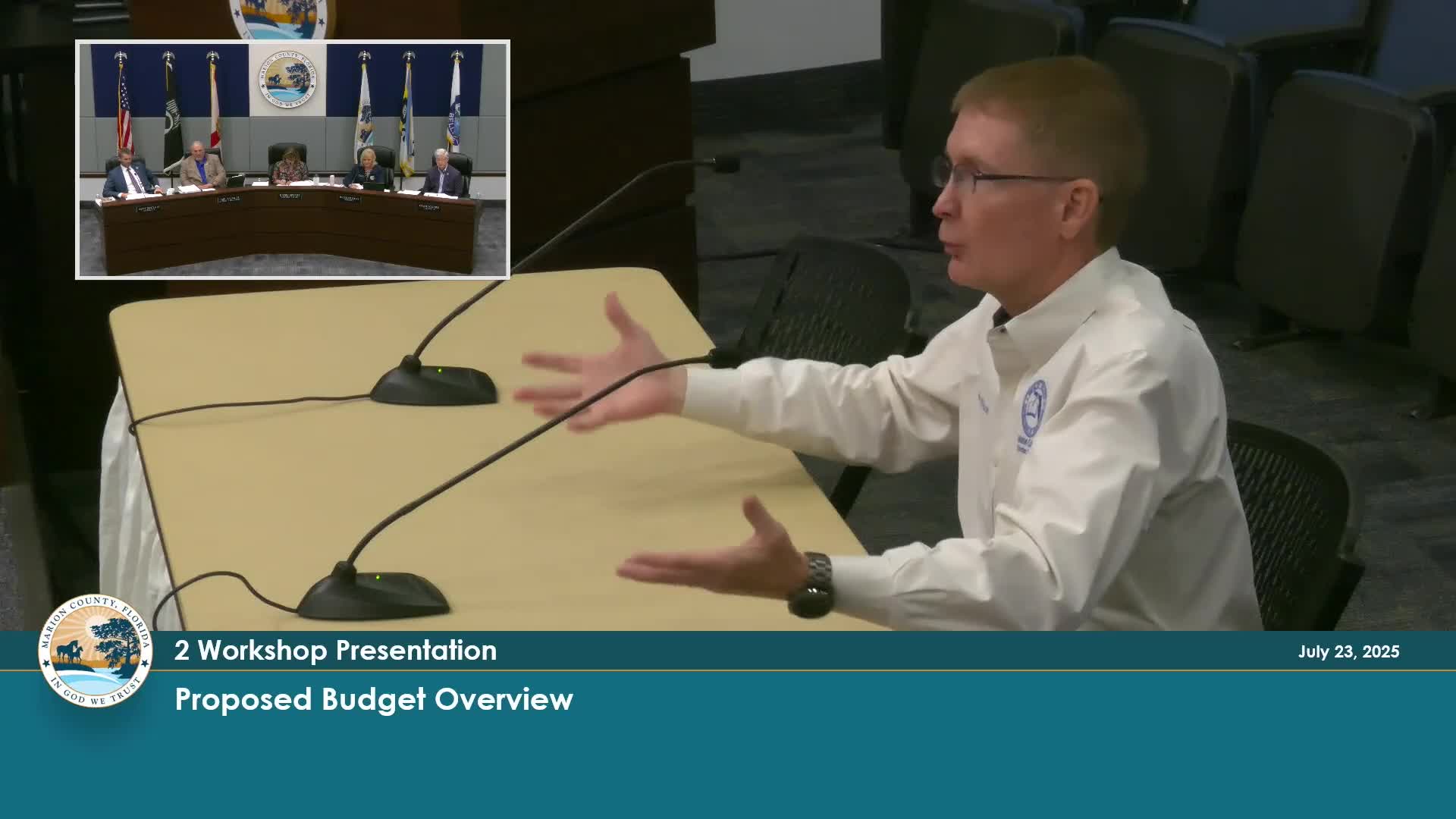
Sheriff Billy C. Woods told the Marion County Board of County Commissioners that his original FY2025-26 staffing request reflected a broader staffing study that found Marion County needed roughly 108 deputies now and projected several hundred more over five to ten years as population grows.
Woods said he reduced his original request from 25 new sworn deputies (and four community service officers) to a proposal that adds 12 sworn deputies and 10 community service specialists, and that he removed 15 proposed detention deputy positions from the jail budget in the current submission. He also cut one pilot position, reduced aviation repair spending, and removed other one-time capital items after discussions with commissioners and budget staff.
"The original budget is exactly what this office should be for this county," Woods said, describing the staffing study's recommendations and explaining that commissioners'priorities led him to scale back requests.
Commissioners pressed the sheriff on recurring costs and long-term planning. Commissioner Curry asked for a multi-year staffing plan and said she wanted the sheriff and budget staff to provide multi-year projections the commission could rely on during the next budget cycle. Woods agreed to produce a plan similar to the three-year buildup the board used previously, noting the county's rapid population growth made projections more challenging.
SRO funding: Commissioners debated school resource officer (SRO) payments. The sheriff explained that private schools are required to pay the full SRO package while public school SRO costs are currently shared; Woods said he charges the school district roughly half the full deputy cost for SROs, producing a partial offset to county expense. Commissioners expressed concern county taxpayers were effectively double-paying because the school district has separate funding sources, including a 1.5-mill levy and sales-tax revenue.
"The school should be paying for it," Commissioner Bryant said. "If we're going to be expected to pay for it, then we should be involved in the negotiations."
Capital and equipment: Commissioners and staff discussed whether leased items such as body-worn cameras, vehicle cameras and taser programs could qualify for the county's public-safety sales-tax capital program. Several commissioners suggested pursuing state or federal advocacy to address what they described as de facto monopolies and leasing arrangements that raise recurring costs; options include seeking legal analysis of whether leases can be treated as capital for sales-tax purposes and writing to state and federal attorneys general seeking review.
Budget offsets and one-time funds: Budget director Audrey Fowler said there is about $1.47 million in general-fund nonrecurring funds and noted a sheriff turnback of $1,405,232.31 from the prior year that had been earmarked for sheriff projects. Fowler said some nonrecurring county funds could be used to reduce near-term pressure on the MSTU law-enforcement millage but cautioned against reducing nonrecurring reserves below $1 million.
Why it matters: The sheriff's budget request touches long-term public safety capacity, recurring salary and retirement costs, and capital funding. Commissioners said they want multi-year staffing projections and clearer agreements on SRO funding before committing recurring county dollars.
What's next: The sheriff and finance staff will prepare a multi-year staffing and cost plan, staff will research whether leasing arrangements for cameras and tasers can be treated as capital for the sales-tax program, and county legal and intergovernmental staff will consider a letter to state and federal authorities about leasing practices affecting public-safety costs.