Get Full Government Meeting Transcripts, Videos, & Alerts Forever!
Get email alerts on the Community Paramedicine And Street Response topic
No spam. Unsubscribe anytime.
S.F. Fire Department restructures community paramedicine; EMS 6 to handle overdose follow-ups
Summary
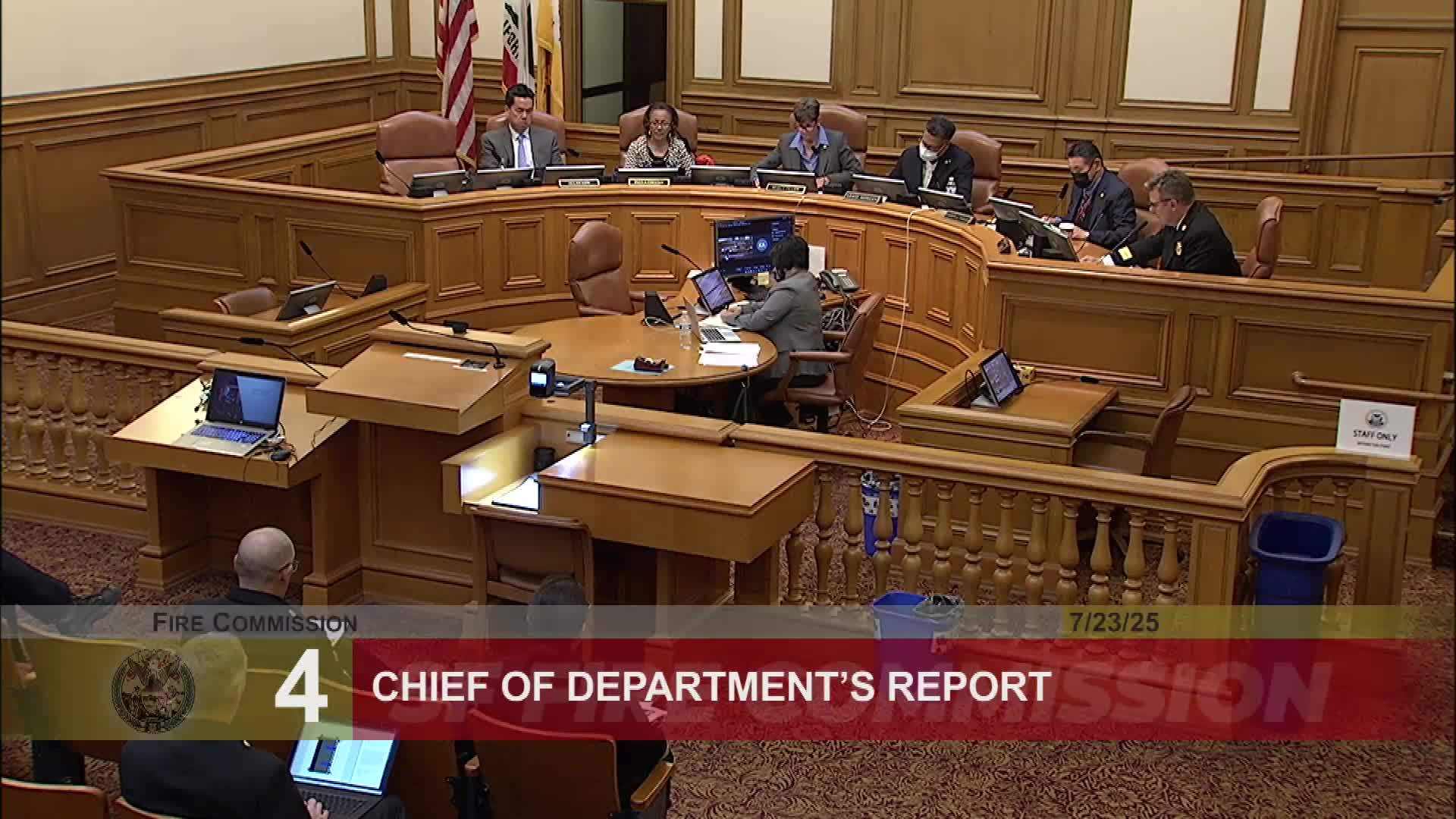
Chief Dean Crispin reported July 23 that the San Francisco Fire Department has reconfigured its community paramedicine programs, reassigned captains to neighborhood street teams and shifted overdose follow-up work to EMS 6 as part of broader budget and staffing changes.
San Francisco — The San Francisco Fire Department announced changes to its community paramedicine operations during the Fire Commission meeting on July 23, Chief of Department Dean Crispin said, including reassignment of community paramedic captains to neighborhood street teams and a transfer of overdose follow-up duties to EMS 6.
The changes come after the City and County of San Francisco’s recently approved $15.9 billion budget, which Chief Crispin said closed an $800 million gap and required the department to eliminate three civilian positions and deactivate Quick Response Vehicle 1 and EMS 6 Delta.
The restructuring is captured in General Order 25A069, Crispin told the commission. “We restructured our community paramedicine division to support the neighborhood street teams. Our community paramedicine division handles over 20,000 calls per year,” he said, adding that the order specified three substantial changes, including demobilizing the street overdose response team and reallocating three community paramedic captains per day to work with street conductors.
Why it matters: The shifts affect how the department responds to nonemergency and behavioral-health calls and aim to coordinate care so fewer people are taken to emergency departments. Crispin said the department will publish a utilization guide in August so suppression members understand how to work with community paramedicine staff.
Details and implementation steps
- Overdose follow-up: Crispin said the department demobilized its street overdose response team as of June 7 and that EMS 6 will “take over the overdose follow-up duties that previously were taken care of by” the SORT team.
- Neighborhood coordination: Community paramedic captains will be reassigned to neighborhood street teams; the department allocated three CP captains per day to work with street conductors to manage neighborhood street team operations.
- Operational guidance: A utilization guide to clarify interactions between suppression units and community paramedicine will be issued in August, Crispin said.
- Staffing and budget: The chief confirmed the department lost three civilian positions and deactivated specific emergency vehicles as part of the budget adjustments the Board of Supervisors approved.
Public-safety and other operational notes
- Skirt street crisis response teams: Crispin described ride-alongs with the Skirt units (street crisis response teams). “In 4 hours, we were able to put 51 50 holds on 2 individuals,” he said, noting the teams’ de-escalation and transport work and raising a question about what services come next for those individuals after initial stabilization.
- Interagency coordination: Crispin said the department has coordinated with Police, Sheriff, the Department of Emergency Management and the mayor’s office to plan responses to ICE-related incidents and to enter chaotic scenes safely; planned incidents will be executed under unified command.
- Concerns about out-of-service time: Commissioners pressed the chief about longer call durations for welfare/well-being checks that Skirt teams now handle; Crispin acknowledged those calls can take up to 45 minutes and create out-of-service time for units.
- Related departmental changes: The chief also reviewed other administrative changes in the same report, including recruitment and academy schedules, a new auto-extrication manual, an AI pilot for staff tools, and ongoing seismic/station planning with the Department of Public Works.
What’s next: The Fire Department will publish the utilization guide in August and continue coordination with other city agencies to refine neighborhoods teams and follow-up care pathways.