Get Full Government Meeting Transcripts, Videos, & Alerts Forever!
Get email alerts on the Budget And Finance topic
No spam. Unsubscribe anytime.
Pittsburg presents 5-year financial forecast; submits balanced 2026 budget with no mill-rate increase
Summary
City Manager Darren Hall presented a five-year forecast and submitted the 2026 budget July 22. Staff recommends 3% cost-of-living raises for employees, 3% utility fee increases, and no change to the city mill rate; a previously proposed one-time 15% sewer rate increase was set aside after review of debt schedules and reserves.
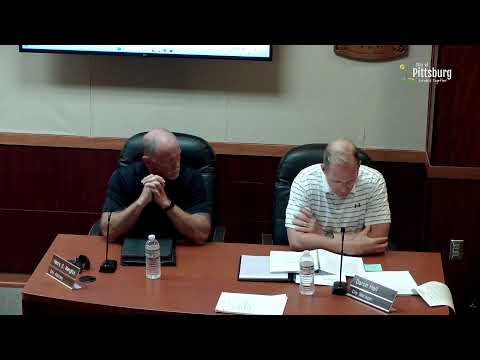
City Manager Darren Hall and finance staff presented the Pittsburg City Commission with a five-year financial forecast and the city manager’s submitted 2026 budget at the July 22 meeting.
The submitted budget was presented as structurally balanced and totals roughly $74 million, according to the staff presentation. Hall said the forecast incorporates the county’s June assessed valuation numbers and updates presented in May. Staff recommended a 3% cost-of-living increase for city employees in 2026 and a 3% utility rate increase across utilities; after reviewing debt schedules, staff withdrew an earlier recommendation for a one-time 15% sewer rate increase and decided to proceed with the smaller annual increases instead.
Key fiscal points described by staff: - Assessed valuation: county figures show an overall assessed-valuation increase of about 7% for 2026; roughly half of that growth staff attributed to higher valuations on existing property and the remainder to new construction and remodels. Staff noted a timing anomaly in the county roll related to a hospital sale that will be tax-exempt by year-end and therefore removed from revenue projections. - Wastewater financing: staff described a large loan from the Kansas Department of Health (KDH) for the wastewater treatment plant (discussed as roughly $43 million). A state law change now allows repayment over 30 years instead of 20, which reduces near-term debt service; staff said the first loan payment will not be due until 2028. - Rates and reserves: city staff said utility-rate increases will be 3% rather than a single large increase, and that reserves are being managed to maintain a two-month (~16%) minimum operating reserve target. Debt-service property-tax mills will remain steady, with staff noting an 8-mill debt component and an unchanged general fund mill rate in the forecast. - Major projects and economic activity: staff highlighted three adjacent projects—EaglePicher facility (city-supported project), the National Institute for Materials Advancement prove-out facility (federal funding), and a Kansas Bureau of Investigation (KBI) regional lab and training facility—collectively valued at more than $80 million. Staff said the city will participate in a retention/pond and drainage solution tied to those developments and is considering adding an approximately $4 million pump-station scope to the KDH loan so it can be financed rather than paid from cash.
Staff also reviewed revenue sources: sales tax remains the city’s largest general-fund revenue source (city portion 1.5%; Kansas state 6.5%; Crawford County 1%), with voter-approved earmarks for a public-safety sales tax (expires 2033) and a street-maintenance sales tax (expires 2031). Staff said sales-tax collections are up this year, and the city’s trade-pull factor shows the city draws retail sales from outside the city limits.
Next steps: staff will publish the submitted budget online; the city calendar calls for a public budget hearing on Aug. 12 and adoption on Sept. 9. Hall characterized the submitted 2026 budget as balancing current service levels, maintaining reserves and spreading the wastewater-related debt over a longer term to avoid an immediate large rate spike.