Get Full Government Meeting Transcripts, Videos, & Alerts Forever!
Get email alerts on the Land Use Zoning topic
No spam. Unsubscribe anytime.
Maury County commission reviews draft unified development plan; residents raise water, farmland and density concerns
Summary
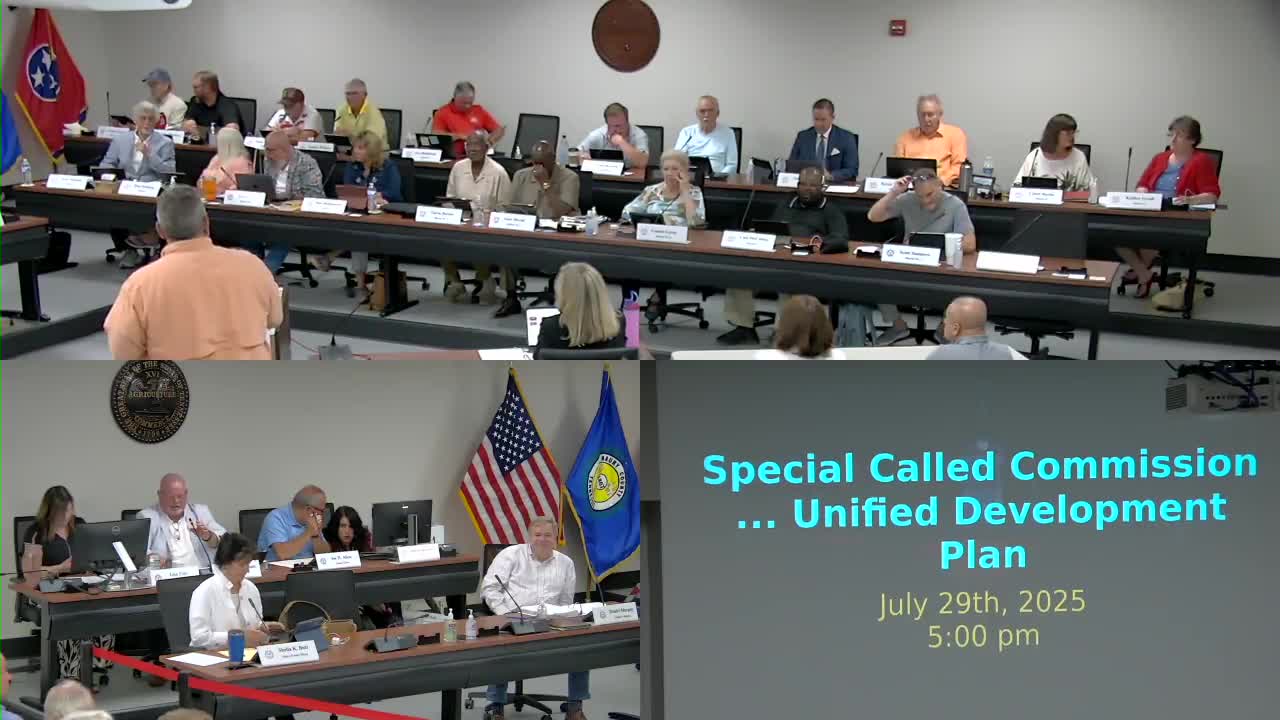
Maury County commissioners met in a special-called session to review a draft Unified Development Plan and zoning ordinance rewrite, hear public comment and collect recommendations for the planning commission ahead of further public hearings.
Maury County commissioners met in a special-called session to review a draft Unified Development Plan and zoning ordinance rewrite, hear public comment and collect recommendations for the planning commission ahead of further hearings. The meeting centered on proposed new zoning districts, changes to permitted uses and procedures, and safeguards for solid waste and decentralized wastewater systems.
The county's planning staff presented the draft ordinance and said the document is intended as a toolbox for the county and developers, not an immediate set of rezonings. "We are here to gather information, bring it back to the planning commission," Robert, planning staff, told commissioners, adding that the earliest formal adoption would be in September if the process moves forward.
Why it matters: The draft would replace zoning text that dates to 1986 and introduces new base districts and overlays designed to preserve agricultural land, provide options for planned developments, and create a formal review path for large solid-waste facilities. Commissioners and residents repeatedly returned to three recurring concerns: whether the county has adequate water to support future growth, how small-lot or mixed-use zoning might affect rural character, and how decentralized wastewater systems (so-called "drip" systems) would be treated.
What staff proposed and what commissioners questioned
- New and revised districts: Staff said the draft groups existing single-acre agricultural/residential categories into a Residential General (RG) district (1-acre minimums), creates a Rural Residential (RR) option with a 5-acre minimum, and adds an Agricultural Preservation (AP) voluntary district with a 15-acre minimum and incentives to keep farmland intact. Robert described the AP district as voluntary and said family subdivisions would be allowed under a restricted covenant in some circumstances.
- Commercial neighborhood and commercial center: The draft includes a new Commercial Neighborhood (CN) district and a Commercial Center (CC) district to permit mixed-use developments on urban edges. Staff said the CN tool is meant to be available only on land identified for that use in a future comprehensive plan and only on collector/arterial roads near municipalities. Several commissioners said they do not want large mixed-use or townhome-style development scattered through rural parts of the county; others said a limited tool might slow municipal annexation.
- Solid waste overlay: Attorney Christy Ransom, who works with the building and zoning department, described a Solid Waste Overlay District that would require any new private transfer station, large landfill or major waste-processing use to be rezoned with an overlay before a site plan could be approved. "Before that use can be placed anywhere ... the county commission would ultimately have to make the decision to rezone and add that solid waste overlay," Ransom said, describing the overlay as a county-level gatekeeper.
- Decentralized wastewater ("drip") systems: Staff proposed stricter standards for multi-lot decentralized wastewater systems, including a required backup disposal site and larger buffers than currently used. Commissioners expressed concern about reliability; several said they would prefer stricter limits or to deter land-application sewer systems by not counting them as required open/green space. Commissioner Evans noted statewide problems with failing systems and urged not to treat a failed system's land as permanent open space.
- Accessory dwelling units, family burial grounds and small-scale ag uses: The draft expands and clarifies accessory uses: accessory dwelling units are sized and limited; family burial grounds would become a permitted accessory use with perpetual-care trust requirements; and the use table adds a small-scale meat-processing category with acreage- and size-based limits intended for bona fide farm operations rather than large processors.
Public comment and next steps
The commission voted to allow an extended public comment period during the meeting and heard about two dozen speakers. The Maury County Farm Bureau's board (represented by Neil Delk) urged incentives for voluntary agricultural-preservation zoning and supported the draft AP district and the family-subdivision concept. Several residents urged that minimum lot sizes remain large (one repeated request was to preserve a 1-acre expectation or to prefer 3' to 5-acre minimums rather than small-lot subdivisions) and said they feared commercial neighborhoods and higher-density residential tools would bring urban-style development into rural areas.
Commissioners directed staff to collect written recommendations and return the draft to the planning commission for further study; staff said additional public presentations and formal public hearings are planned before adoption. Robert said staff will advertise additional public meetings and that, as drafted, some tools (for example, the commercial neighborhood) cannot be used until the county updates its comprehensive plan and identifies appropriate locations.
Formal actions recorded at the meeting
- Motion to approve the meeting agenda (mover: Commissioner Grodi; second: Commissioner Pravetti). The vote passed; chair recorded that one person stepped away and the agenda passed with 20 in favor and 1 absent.
- Motion to suspend rules and allow public comment during the session (mover: Commissioner Miller; second: Commissioner Pravetti). The motion passed by voice vote. (No roll-call tally supplied in the transcript.)
What staff and commissioners said (selected direct quotes)
- Robert, planning staff: "We are here to gather information, bring it back to the planning commission. We need recommendations from the county commission to formulate this and bring it into a final product and for the public we will be advertising at the earliest this could be adopted at the current time would be September."
- Christy Ransom, attorney, building and zoning department: "In the event that someone comes to the county and they want to do a private landfill or some other large, waste related uses ... they would have to come to the county commission and have that property rezoned with that solid waste overlay, in order to then submit a site plan for that use itself."
- Commissioner Howard (paraphrase of remarks): He emphasized thinking in decades, not months, saying "what brought me to Maury County was a 1 acre lot," and urging protection of the county's rural character as part of a long-range view.
- Neil Delk, president, Maury County Farm Bureau (paraphrase): The Farm Bureau supported the AP district, the family-subdivision tool and expedited work on a 5-acre RR district to help preserve working farms and the agricultural economy.
What remains unresolved
- Water availability: Commissioners and residents repeatedly asked whether the county can permit new large developments while regional water supplies and planned utility improvements remain uncertain. Staff said utilities are issuing conditional letters for water availability tied to future intake or treatment projects; several commissioners asked whether the county should require clearer commitments from water providers before accepting large subdivision approvals.
- Density and where tools may be used: Several commissioners asked that the draft explicitly limit commercial neighborhoods and residential-neighborhood (small-lot) tools to urban-fringe areas shown on a comprehensive plan map. Staff and commissioners agreed that the CN tool would not be available until similar areas are identified in the comprehensive plan.
- Decentralized wastewater policy: Commissioners asked staff to return with a recommendation on whether backup disposal areas for land-application systems should be counted toward open-space/green-space calculations, noting a policy choice would affect developers' density calculations and the long-term reliability of those systems.
What comes next
Staff will collect written comments and recommendations from commissioners, return the draft to the planning commission for revisions, and schedule further public presentations and formal public hearings before a final vote. Several commissioners said they wanted additional analysis of water capacity and agricultural impacts before adopting tools that enable higher densities.
Ending note: The meeting left the draft ordinance intact but not finalized. Staff and the planning commission will continue edits and outreach; commissioners repeatedly asked staff to bring back clearer maps and to tie some of the draft's new district tools to a completed comprehensive plan before those tools are available for rezoning requests.