Get Full Government Meeting Transcripts, Videos, & Alerts Forever!
Get email alerts on the Budget Process topic
No spam. Unsubscribe anytime.
Edmond council reviews budget creation, year-end closing and state deadlines
Summary
Council and staff outlined the city’s annual budget cycle, statutory deadlines, and year-end practices including the 90-day invoice acceptance period that affects finalizing fiscal-year accounts.
Mayor (name not specified) opened a special Edmond City Council budget workshop by saying the city is "not in trouble financially" and that the meeting was meant to tighten budget management and year-end processes. Kathy Panas, a finance staff member, led a presentation describing the city’s timeline for creating and adopting its annual budget and the steps taken during the year to manage appropriations.
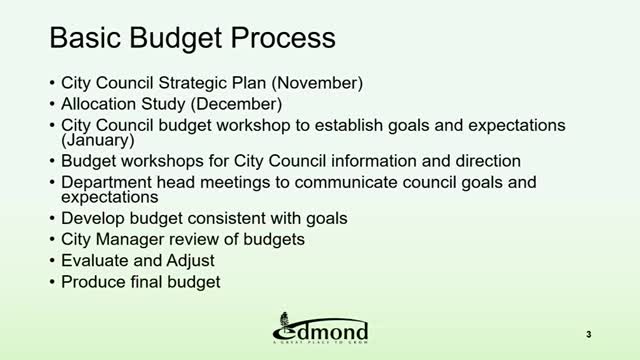
Panas summarized the calendar the council follows: a November strategic planning input, a December overhead allocation study, a January kickoff for council priorities and reserve targets, department budget entries in January–February, department review meetings in March, workshops through the spring and a final evaluation in May. "Budget workshops occur throughout the budget cycle," Panas said, and staff compile a preliminary budget from department entries before producing a final version for public hearing and adoption.
The workshop emphasized legal timing and publication requirements. Panas said the city must hold a public budget hearing no later than 15 days before July 1, publish the budget at least five days before that hearing (typically in The Oklahoman), adopt the budget at least seven days before July 1, and transmit the adopted budget to the Oklahoma State Auditor within 30 days after July 1 (effectively by July 30). She also explained that the fiscal year ends June 30 and that "invoices are currently accepted through September 30," a statutory practice that allows the city to honor claims for work performed before the fiscal-year end.
Council members and staff discussed how year-end timing and the statute about accepting post-June invoices affect closing the books. One council member noted a desire to close the year faster but staff said the September 30 window for prior-year claims limits how quickly the final numbers can be certified. Anne DeCarnas, assistant city manager of administration, and other staff said the city will continue monitoring budget-to-actual reports through the year and that departments can view their own financials in the city’s system.
Panas outlined the internal budget adjustment process: changes to appropriations are approved by city council and reported to the state, and the finance committee recently proposed clarified language to replace vague terms in a 1980 policy. She said the finance committee’s temporary recommendation will appear to council in about two weeks. Panas described budget amendments as transfers of appropriation or supplemental appropriations that increase revenues and expenditures; staff and the city attorney clarified that the legal term under state law is “budget amendment.”
The council directed staff to develop improved visibility and recurring checks on budget-versus-actuals; a council member said quarterly budget reports are being considered or reinstated so managers and council can see early whether a line or category is running over prior to year end.
Ending: The session closed with council and staff agreeing to form task- and finance-committee work on clearer budget amendment language, improved reporting cadence (quarterly reviews), and other process reforms aimed at ensuring compliance with state statutes and giving department managers better tools to monitor spending.
Votes at a glance: The only formal vote recorded in the workshop transcript was to adjourn; the motion carried.