Get Full Government Meeting Transcripts, Videos, & Alerts Forever!
Get email alerts on the Elections Voting Machines topic
No spam. Unsubscribe anytime.
Cochise County supervisors hear presentation raising legal and transparency questions about electronic voting systems
Summary
Paul Rice, a Phoenix-based presenter, told the Cochise County Board of Supervisors on Aug. 8 that state and federal procedures governing electronic voting machines raise legal and transparency concerns for Arizona counties.
Paul Rice, a Phoenix-based presenter, told the Cochise County Board of Supervisors on Aug. 8 that state and federal procedures governing electronic voting machines raise legal and transparency concerns for Arizona counties.
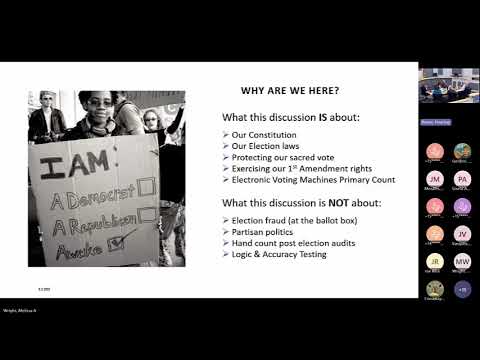
Rice said his review focused on three questions: whether electronic voting machines are legal under Arizona law, whether county boards are obligated to use them, and whether Arizona law requires county supervisors to certify county election results. "This is not about election fraud. This is about the law, and about the constitution," Rice said.
Rice briefed the board on the federal Help America Vote Act of 2002 (HAVA), the Election Assistance Commission (EAC) process for accrediting voting system test laboratories (VSTLs), and the distinction between VSTL accreditation and certification of specific voting-system software or hardware. He said early EAC guidance and a 2015 VSTL manual required VSTL accreditation periods not to exceed two years; later manual language removed that explicit two-year re-accreditation requirement, and Rice said certificates he has located show inconsistent accreditation periods.
Rice told the board he has made repeated public-records requests to the EAC seeking documents that trace where engineering change orders (ECOs) and software modifications have been deployed at the state and county levels and said the EAC responded that it does not track ECO deployment by state. "The EAC does not track where engineering change orders have been deployed on a state level, nor does the EAC track any information on what systems or modifications each state has adopted beyond the EAC’s system-level map," Rice read from an EAC reply he cited.
Rice described ECOs as five-digit-numbered change orders for previously EAC-certified voting systems and said he could not find a complete, public listing of ECOs deployed in Arizona on the Secretary of State’s Election Procedure Manual (EPM) website. He showed copies of older VSTL accreditation certificates (SLI Compliance and Pro V&V) and letters from EAC staff indicating that under earlier manual language a grant of accreditation was valid for a period not to exceed two years.
Board members and county staff questioned whether the 2019 EPM and later EPM versions were legally in force; a county staff member present said, "The EPM for 2023 is valid." Rice noted that parts of the equipment-certification chapter that previously cataloged ECOs and modification procedures were removed from the 2023 EPM and, he said, moved to EAC-handbook materials.
On state law, Rice summarized his review of Arizona statutes (Title 16, chapter 4) and the Arizona Constitution, and argued the statutes use the permissive term "may" when describing use of voting devices and do not explicitly say a county "shall" be required to use electronic voting machines. He also told the board that, in his view, Arizona statutes require canvassing (the examination and counting of returns) but do not impose a separate statutory duty for supervisors to "certify" elections in a way that would compel certification when a legitimate, material concern remains unresolved prior to a certificate deadline.
Rice urged the board and the legislature to create a statutory procedure to address credible, material election integrity concerns before a certification deadline so supervisors are not forced to choose between certifying and what they view as upholding their oath of office. He said this is a recurring theme from litigation and appeals following the 2022 elections in Arizona and related filings (he referenced cases and filings by Warren Peterson and others).
Supervisors discussed the practical limits posed by shortened statutory timeframes for canvass-related actions and the absence of a clear statutory "cure" procedure for resolving material concerns before certificates must be issued. No motion or vote was taken. County Administrator Sharon Gilman, Deputy County Administrator Joe Casey and Deputy County Attorney Niece Bridal participated in the discussion; staff said the work session is for information and public comment would not be taken.
Rice said he would share the records and documents he used in his presentation with the board. He also suggested that the county and other Arizona counties could explore or develop validated hand-count methods if the board elected to pursue alternatives to machine-based tabulation, but he and board members acknowledged practical and legal obstacles to replacing or supplementing machines without clear statutory processes and safeguards.
The meeting closed with supervisors thanking Rice for the briefing and noting the issue will require further legal and legislative review. The supervisors did not take formal action at the Aug. 8 work session.