Get Full Government Meeting Transcripts, Videos, & Alerts Forever!
Get email alerts on the Land Use Development topic
No spam. Unsubscribe anytime.
Summit County manager approves Park City Junction administrative development agreement, extends a phasing deadline
Summary
County Manager Shane Scott approved the Park City Junction Administrative Development Agreement after a public hearing July 28, 2025, and amended the agreement to extend the trigger for tranche 6 from five months to nine months; the decision activates a sequence of planning, design and joint-venture steps required by state law and the agreement.
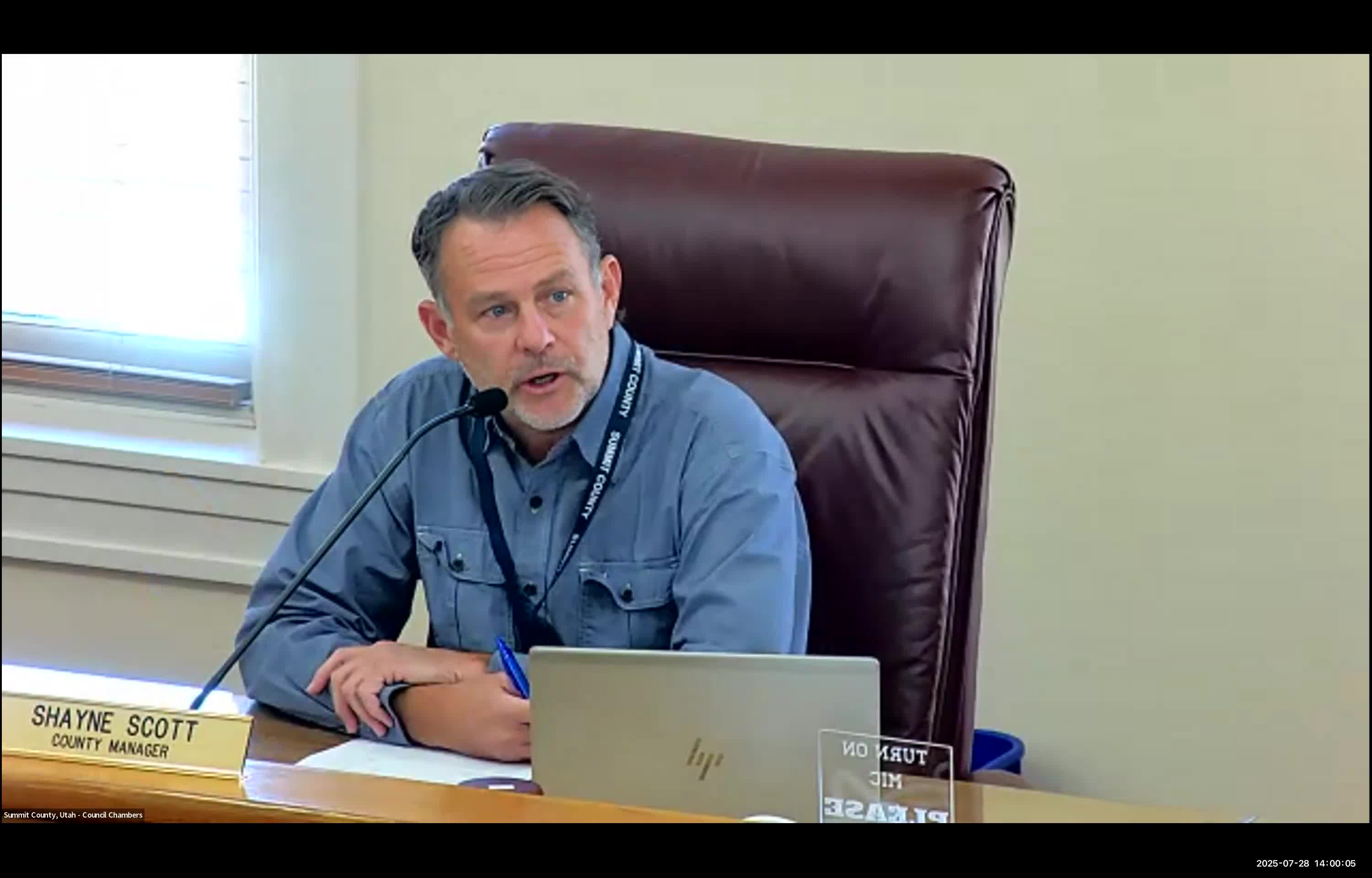
Summit County Manager Shane Scott approved the Park City Junction Administrative Development Agreement following a public hearing on July 28, 2025, and made a single modification: extending the time trigger for tranche 6 from five months to nine months.
The agreement implements state-driven entitlements tied to Senate Bill 26 and sets an administrative path for site plans, design standards and a public–private joint venture (P3) with Dakota Pacific and High Valley Transit. Approval begins deadlines in the agreement, including a 180-day period for negotiating the P3 joint-venture details and submitting a revised Housing and Transit Reinvestment Zone (HTRZ) proposal to the Governor’s Office of Economic Opportunity.
The manager’s action follows presentations by county staff and Dakota Pacific, a recommendation from the planning commission and a public comment period in which several residents urged denial. Peter Barnes, Summit County community development director, told the hearing that “This development agreement itself doesn't permit anything to be built,” and described the document as an implementation tool that sets standards and processes — not building permits.
Dakota Pacific representatives summarized the project as a mixed-use redevelopment of roughly 64.4 acres at Kimball Junction that would include commercial space, structured parking and multiple types of housing. Company presenters described a P3 area intended to host retail and a future transit center, two levels of structured parking (about 1,000–1,100 stalls), civic uses and county-owned affordable housing. In their presentation Dakota Pacific said the overall program would include a mix of housing products and that the developer expects a substantial share of units to be deed-restricted affordable (Dakota Pacific described the project as having roughly 56% of units deed-restricted with an average AMI of about 69% in their summary).
Barnes and Dakota Pacific also described schedule and approval steps the agreement triggers: design standards subject to a 45-day approval window once filed with the planning commission; final site plans, subdivision plats and subsequent permitting processes that will be reviewed publicly; and phasing milestones intended to align development with UDOT traffic improvements for State Route 224. Barnes noted that the county manager is the final land-use authority under the administrative process established to comply with SB 26 and the county’s temporary zoning ordinance implementing 10-3-19(a).
Several members of the public spoke in opposition during the hearing. Ed Rutan, a Pine Brook resident, said the public “almost unanimously expressed its strongest opposition” at prior hearings and asked that any approval explain why the county was moving forward despite that opposition. Robert Phillips, identified as a resident, criticized prior council actions and the referendum process, calling the project “unwanted” and saying the councilors who supported it should be “ashamed.” Kathy Mears, who said she had attended multiple public hearings, said Dakota Pacific had been “dishonest” in the public process. Colleen Conley, a resident living off SR-224, said petition and petition-signature efforts showed broad public objection.
Manager Scott said those comments were on the record and that public input had helped shape the agreement. He described the decision as administrative and said his action was based on findings and conclusions in the staff report. Scott moved to approve the development agreement with one change, stating that, for tranche 6, he would “like the time... be extended from 5 months to 9 months.” The meeting record shows no roll-call vote; the manager exercised his authority to approve the administrative development agreement as the final land-use decision under the temporary ordinance.
Key elements described in the staff presentation and Dakota Pacific materials include: - Project footprint: roughly 64.4 acres (some portions already developed and some undeveloped). (Peter Barnes) - P3 joint venture: county, High Valley Transit and Dakota Pacific; the DA triggers a 180-day window to negotiate the P3 details after the agreement is recorded. (Peter Barnes) - County-owned housing: Dakota Pacific and staff described the county owning about 160 units within the P3 portion of the project. (presentation) - Residential program: the developer described multiple totals across the record (transcript references to 725, 819 and 885 appear in presentation remarks); staff said the DA reduces the previously approved unit count by five units. The transcript shows inconsistent unit totals; the development agreement text should be consulted for the final, authoritative unit counts. (transcript/presentation) - Affordable housing: developer-presented targets include a high proportion of deed-restricted units and an average AMI described in the presentation; the agreement creates mechanisms intended to secure deed restrictions. (presentation) - Public benefits and design: $4,000,000 cash contribution for public open-space improvements and pedestrian connections, including a planned plaza and a pedestrian-bridge betterment to link east and west Kimball Junction (noting the bridge is also tied to separate UDOT work). (presentation) - Parking and transit: two levels of structured parking estimated at about 1,000–1,100 stalls intended to serve commercial uses and a future transit center and to provide park-and-ride capacity for bus rapid transit (BRT). (presentation) - Timing and approvals: design standards subject to a 45-day approval after filing; subsequent site-plan and subdivision reviews will go through public hearing and planning commission stages before building permits. The DA does not itself authorize building permits. (Peter Barnes)
After the hearing Scott announced his decision to approve the administrative development agreement and the single change to tranche timing. He closed the hearing and adjourned the meeting.
Next steps described during the hearing are that, if the administrative development agreement is recorded, the county and Dakota Pacific have 180 days to negotiate the P3 joint-venture terms and the county must submit a revised HTRZ application to the governor’s office. Dakota Pacific said that, assuming approvals and market conditions, occupancy could begin as early as 2027 with phasing through the end of the decade; the parties repeatedly cautioned that construction timing depends on UDOT coordination and market factors.
The planning commission had recommended approval to the county manager. The transcript also records that the December 2024 council-approved development agreement (Ordinance 987) and subsequent state action under SB 26 changed the review path and required the administrative format now before the manager. Several speakers also noted there is an outstanding citizen-led referendum and ongoing legal review about whether referendum language will appear on the November ballot; the transcript records that a court decision is expected in August 2025 and that the referendum effort was a salient public concern raised during the hearing.
The manager’s approval begins the administrative and contractual tasks set out in the development agreement; it does not itself authorize construction or building permits. Staff and Dakota Pacific said the project will return in future public reviews for design standards, site plans and subdivision plats under the Snyderville Basin Development Code and the DA’s provisions.
Ending: The administrative approval starts deadlines and negotiations that the county and Dakota Pacific described as necessary to move toward the P3 joint venture, design standards and subsequent site-level approvals; opponents said they will continue efforts including a pending referendum and legal challenges. The county manager recorded the administrative approval with the one timing modification and adjourned the hearing.