Get Full Government Meeting Transcripts, Videos, & Alerts Forever!
Get email alerts on the Operations Budget Public Safety topic
No spam. Unsubscribe anytime.
SFFD details budget cuts, reassigns overdose follow‑up to EMS 6 and urges action on lithium‑ion storage
Summary
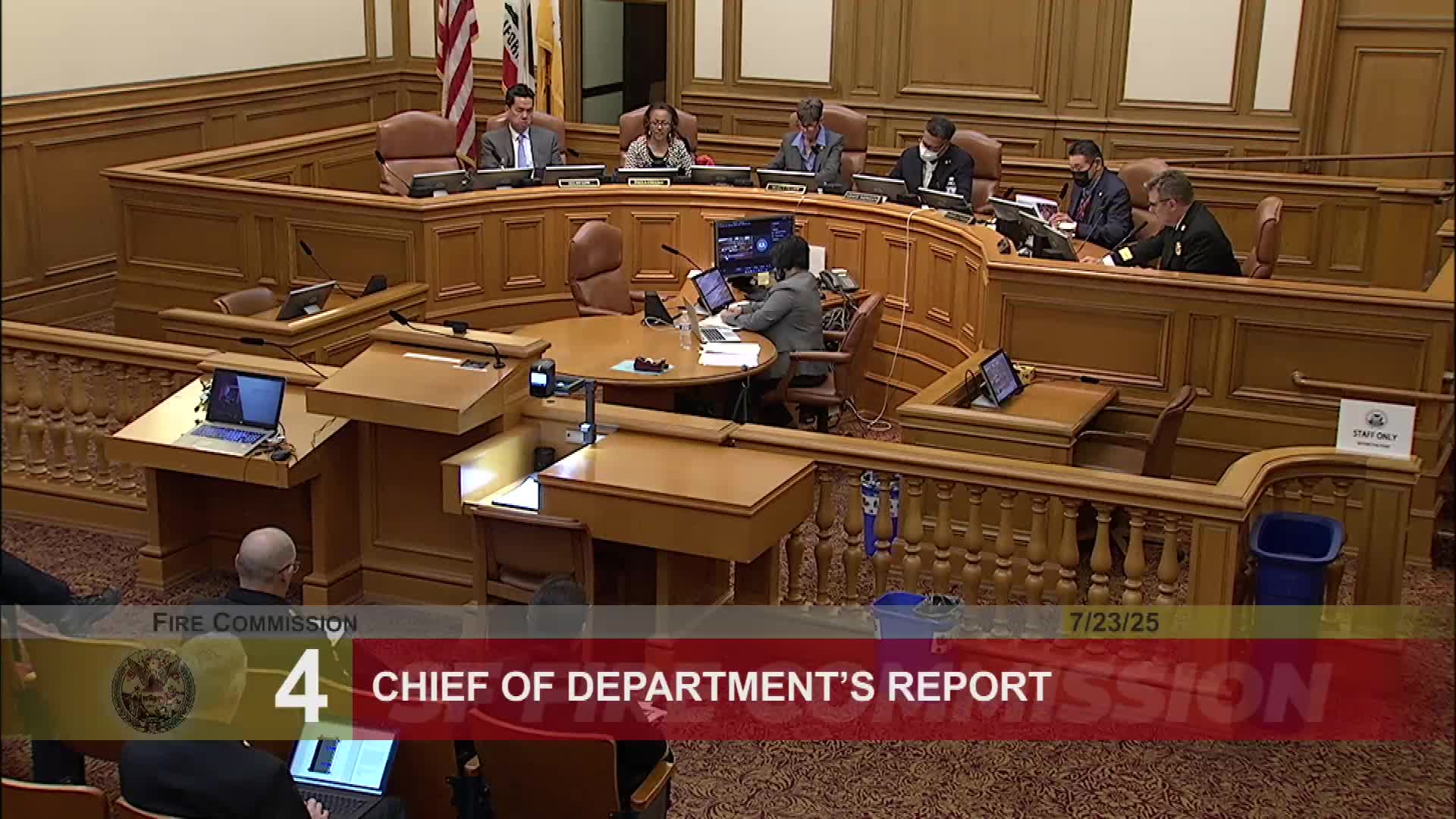
Chief of Department Dean Crispin told the Fire Commission the department absorbed cuts after the supervisors approved a $15.9 billion city budget, and described operational changes including reassignment of SORT overdose follow‑up to EMS 6 and a community paramedicine restructure to bolster neighborhood street teams.
Chief of Department Dean Crispin told the San Francisco Fire Commission on July 23 that the City and County of San Francisco’s FY2025 budget was adopted after the Board of Supervisors closed an $800 million gap and that the Fire Department had absorbed cuts while remaining operational.
"The City and County of San Francisco budget of $15,900,000,000 has been approved by the supervisors. We closed an $800,000,000 gap. Everyone shared the pain, including the San Francisco fire department," Chief Crispin said.
The chief described concrete staffing and unit changes: the department lost three civilian positions and deactivated Quick Response Vehicle 1 and EMS 6 Delta. He also detailed a reorganization of community paramedicine to integrate with the neighborhood street teams and to free suppression units to work more closely with paramedics.
"Our community paramedicine division handles over 20,000 calls per year," Crispin said. He said the department will reassign community paramedic captains to neighborhood street teams, allocate three community paramedic captains per day to work with street conductors, and publish a utilization guide in August so suppression crews understand how to interact with community paramedicine.
Crispin said the city’s SORT (street overdose response team) has been demobilized as of June 7 and that EMS 6 will now handle overdose follow‑up duties. "The SORT team members have been reassigned, most of them to SCRT, so that we can support the neighborhood street teams. Then EMS 6 is handling the follow‑up for overdoses," he told commissioners.
Lithium‑ion battery fires — frequently linked to scooters and e‑bikes — were a major safety item in the chief’s report. Crispin said the department has seen a rise in residential fires caused by thermal runaway in improperly stored batteries and that existing ordinances make improper storage illegal, but enforcement and targeted outreach remain challenges.
"When you have thermal runaway with those micro mobility devices, it's very difficult to extinguish. It puts out incredibly toxic smoke, and it typically sets off a sprinkler," Crispin said. He said the department will work with the Department of Homelessness and Supportive Housing (HSH) and building managers to communicate storage limits and building requirements, including a practical limit of four devices per room unless the room has specific fire resistive construction and sprinklers.
Commissioners asked for clarification on how the reconfigured teams interact. Crispin explained that the neighborhood street teams operate by police district with a community paramedic captain, a conductor for DEM, and partner organizations; the mobile SKIRT (street crisis) units remain separate but will be called in as needed for transports and medical response. In two ride‑along shifts Chief Crispin observed SKIRT staff place two people on 5150 holds and praised their de‑escalation skills.
The chief also highlighted non‑operational items including plans to revisit a 2017 Public Works seismic report ahead of a potential 2028 bond measure to repair or rebuild some stations, an updated auto extrication manual to respond to modern vehicle construction, and training pilots for Microsoft Copilot to identify administrative uses for AI.
Commissioners thanked department leaders for the report and pressed for continued public education on battery storage and for close coordination with other agencies on care transitions and field safety.
Votes at a glance
- Approve minutes from the July 9, 2025 meeting — motion passed. Mover: Vice President Paula Collins; seconder: Commissioner Nakasho. Recorded votes in the transcript: President Marcy Frazier — yes; Commissioner Alan Lowe — yes; Commissioner Armee Morgan — abstain. (The transcript records the motion passed; several other commissioners’ recorded responses were not specified in the public audio.)
- Move to closed session on existing litigation (Kareem McKnight v. City and County of San Francisco, USDC No. 22‑cv‑04600) — motion to go into closed session passed. Recorded votes: President Marcy Frazier — yes; Commissioner Nakasho — yes; Commissioner Lowe — yes; Vice President Paula Collins — yes.
- Motion not to disclose closed‑session discussion/outcome — motion passed. Recorded votes in the transcript: President Marcy Frazier — not to disclose; Commissioner Armee Morgan — not to disclose; Commissioner Nakasho — not to disclose; Commissioner Alan Lowe — aye (recorded as "Aye"); Vice President Paula Collins — not to disclose.
What this means
The department’s reorganization shifts some duties from specialized overdose follow‑up teams to EMS 6 and redirects experienced SORT members into mobile crisis response and neighborhood street teams. The reported removal of two response units and three civilian positions are immediate budget impacts, while proposed station work tied to a future bond remains in planning. Lithium‑ion battery incidents remain a continuing operational and public‑education focus for both SFFD and partner agencies.
Commissioners did not take additional binding policy votes on the operational restructures at the meeting; the chief said utility guidance, training and cross‑agency coordination will continue as the changes roll out.