Get Full Government Meeting Transcripts, Videos, & Alerts Forever!
Get email alerts on the Land Development Code Conservation Community topic
No spam. Unsubscribe anytime.
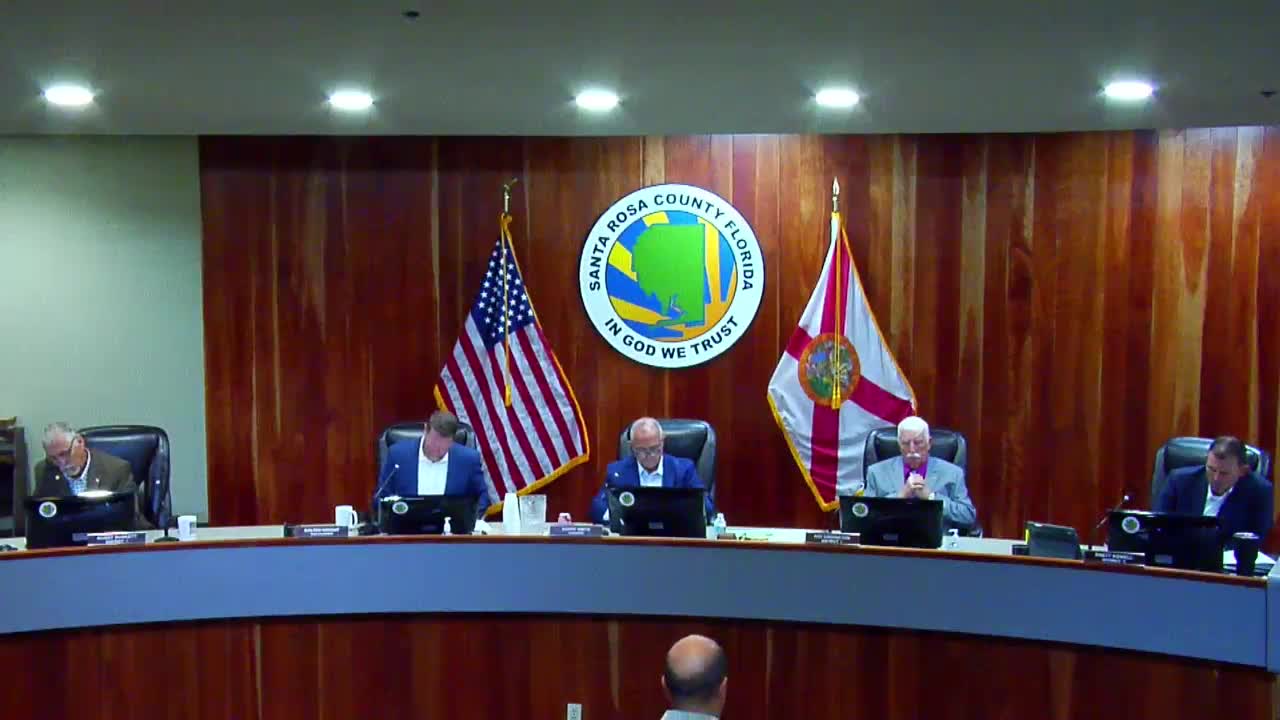
Residents and commissioners debate ‘conservation community’ provision in Santa Rosa County land-development update
Summary
Public commenters urged the county not to adopt a proposed “conservation community” provision to the land-development code, citing concerns about density, loss of private property, wetlands counting as green space and fiscal impacts; commissioners expressed differing views but made no formal change.
Public commenters on Aug. 14 urged the Santa Rosa County Board of County Commissioners not to add a proposed “conservation community” provision to the county’s land-development code, saying it would increase density, transfer significant amounts of land to public ownership and could shrink the property tax base.
The proponents of that view included Ryan Fowler of PACE Florida and Anna Fowler, who said the provision would convert large agricultural lots into smaller clustered lots, enable developers to count wetlands as conserved green space and could result in the county owning and managing portions of developments.
"The county will own and manage and centrally control 25% of the conservation communities," Ryan Fowler said during public forum, arguing that removing that acreage from tax rolls could force higher taxes or reduced services for the school board, fire districts and sheriff's office. He also referenced federal conservation goals that he said had prompted state and local initiatives to set aside land.
Anna Fowler said the provision would alter the county’s rural character in northern Santa Rosa by trading large lots for smaller clustered lots and could create conflicts when agricultural uses—horses, cattle, poultry—exist next to small-lot residential clusters. She said wetlands could be used as “green space” to permit higher-density development adjacent to those wetlands without a rezoning.
Several commissioners and county staff responded in general terms. Commissioner Wright said he supported the conservation-community approach in some locations, arguing it preserves open areas and walking trails while still allowing clustered housing in appropriate places. Commissioner Rowell said he would only support conservation communities if the county also required clear, enforceable metrics—such as definitions and requirements for “quality affordable attainable housing”—to ensure that any density trade-offs produced a public benefit.
Jerry Cooley and other residents urged procedural transparency and asked whether the code language specifies permitted uses inside conservation areas; they said the draft language did not clearly state what facilities would be allowed in conserved parcels. Commissioners and staff acknowledged those concerns but did not adopt changes or schedule a vote at the Aug. 14 meeting.
Why it matters: The proposed land-development change would affect how new subdivisions are laid out, how wetlands are counted, and whether parts of clustered developments are held in public ownership. Commissioners said they would continue deliberations in future code updates and workshops rather than take an immediate vote.
The board took no formal action to adopt or reject the conservation-community provision at the Aug. 14 meeting; the item remained in discussion and public input phases.