Get Full Government Meeting Transcripts, Videos, & Alerts Forever!
Get email alerts on the Innovation Partnership Fund topic
No spam. Unsubscribe anytime.
California behavioral health commission seeks input on $100 million Innovation Partnership Fund
Summary
The Mental Health Services Oversight and Accountability Commission hosted a virtual listening session on the Innovation Partnership Fund (IPF) to gather input from behavioral health clients and people with lived experience on the grant design for a five‑year, $100,000,000 allocation created by Proposition 1.
The Mental Health Services Oversight and Accountability Commission hosted a virtual listening session on the Innovation Partnership Fund (IPF) to gather input from behavioral health clients and people with lived experience on the grant design for a five‑year, $100,000,000 allocation created by Proposition 1.
Commission staff outlined a timeline and grant design concepts and asked for public feedback on four proposed ways to define "innovation," three broad funding pillars and six program priorities that would guide awards. Commissioners Gary Tsai and Rachel Chambers attended in their official capacities to listen and take questions.
Commission staff described the IPF as a statewide, one‑time allocation to be received on July 1, 2026, and said they intend to present a draft grant concept to the commission in October, release an RFP outline in January and publish a request for proposals in late January or early February, with contracts to begin July 1, 2026. "We have this 100,000,000 5 year allocation for innovation partnership funds that, we will receive on 07/01/2026," said Brenda, the commission's executive director, while describing the planning timeline and next steps.
Staff from Sellers Dorsey presented draft language that would let the IPF support: (1) advanced new models, tools, partnerships or technologies not yet widely implemented in California; (2) practical community‑centered solutions that increase access to prevention, treatment and recovery supports; (3) projects that demonstrate a clear break from the status quo rather than incremental changes; and (4) work that is actionable and ready for real‑world implementation. Staff noted the language is intended to be read as a set of alternatives ("ors") rather than requirements that projects meet every bullet.
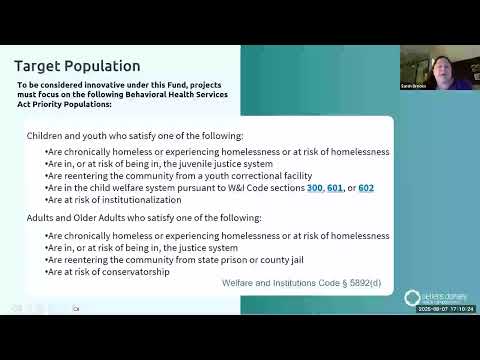
Participants asked clarifying questions about eligibility, scope and intent. Brenda said both nonprofit and for‑profit organizations may apply. In response to questions about whether the IPF targets particular diagnoses, staff repeatedly pointed to the statute and the Behavioral Health Services Act's priority populations: the funds must focus on "populations with the highest behavioral health needs," including children and youth at risk of homelessness or institutionalization, and adults at risk of involvement with the justice system or conservatorship, among other statutory categories. "It's not diagnosis driven," Brenda said, adding that the emphasis is on high‑needs status as defined in statute.
Public commenters urged clearer definitions and metrics. Kevin Dredge asked for ways to "track this and and measure" outcomes. Several participants, including Kim Stafford and Rhea (Ria) Garrett, pressed whether the program would fund new, untested models or favor scaling existing programs; others warned that with a limited statewide pot, awards should prioritize truly novel projects rather than simply scaling already funded services. Jerry Hall and other commenters called for requirements on data, transparency and timely reporting so stakeholders can evaluate projects. Multiple commenters recommended explicitly supporting peer‑led or consumer‑run organizations and expanding peer specialist roles across traditional and nontraditional provider settings.
Staff described three proposed pillars for the IPF — youth (prevention and early intervention at a population level), workforce (expanding peers and other providers), and connection (quality and system integration) — and six proposed priorities that would shape solicitations, including equity, financing and sustainability, public‑private partnerships, lived experience and community leadership, alignment with state behavioral health transformation efforts, and demonstrable agility and lean process integration.
Public commenters recommended adding "access" to the connection pillar and requested clearer definitions of terms such as "equity, financing and sustainability." Several speakers offered local examples of peer‑run innovation centers and described programs that serve individuals who are high‑need but not necessarily diagnosis‑specific — for example, people who have achieved housing but still require ongoing supports.
Staff closed by inviting written input to program@bhsoac.california.gov and noting two additional listening sessions will be held with the same materials. The commission said it will incorporate feedback into a version 3 of the grant concept for discussion at the September program advisory committee meeting and eventual presentation to the full commission in October.
Why this matters: The IPF is a one‑time, statewide Proposition 1 allocation intended to pilot and scale approaches intended to improve behavioral health outcomes and reduce disparities for statutorily defined high‑need populations. The commission's choices on definition, eligibility and reporting will shape which organizations can apply and how the state evaluates and sustains promising approaches.