Get Full Government Meeting Transcripts, Videos, & Alerts Forever!
Get email alerts on the Education topic
No spam. Unsubscribe anytime.
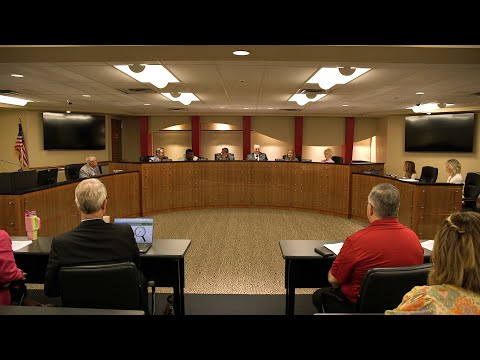
Union board adopts Strong Readers policy, approves career‑tech and dual‑credit agreements and several operational measures
Summary
At a regular meeting, the Union school board adopted a state‑required reading policy, heard an annual college remediation report and approved contracts and appointments including an ODCTE grant, a dual‑credit memorandum with Tulsa Community College, a boiler replacement contract and authorization to raise adult meal prices pending USDA guidance.
The Union school board on an evening meeting adopted a board policy implementing the state'required Strong Readers (Reading Sufficiency) Act, heard an annual report on college remediation rates and approved multiple operational contracts and appointments, including funding agreements with the Oklahoma Department of Career and Technology Education and Tulsa Community College.
The adopted policy, numbered 5034 and described at the meeting as the Strong Readers Act, directs the district to use an approved dyslexia screener and other state‑approved screening instruments, provide reading intervention and professional development, notify parents of student progress, and post a statutorily required annual report on the district website by Sept. 1 with specified counts and percentages by grade. "This is the Strong Readers Act that is required by law," said Miss Kiger while presenting the new policy and its reporting requirements.
The policy passage followed a presentation explaining that the posted report must include, by grade, counts and percentages of: students who did not meet grade‑level targets on the approved screener; students enrolled less than two years in the district; students who demonstrated grade‑level proficiency on the screener; and students on individualized education plans (IEPs) who demonstrated grade‑level proficiency. The board moved and approved the policy by voice vote; several members recorded "yes" during the roll call.
In a separate informational presentation, Doctor Moore reviewed the district's annual college remediation metrics, noting the report stems from section 13 of Senate Bill 183 (1989) and is intended to evaluate school and district performance on college readiness. Moore said the district had 1,030 graduates in the reported year and that about 48.7% — 491 students in the fall and 580 during the academic year — attended college for the first time. He reported remediation rates for first‑time college students as follows: English about 5.5%, math about 20.7% and reading about 20%. Moore said the overall remediation rate in the report was 28.6% and that the district's trend since 2020 has fluctuated with a dip and partial rebound following COVID‑era changes.
"It's a metric to evaluate college readiness for our students," Doctor Moore said while noting the state report is publicly available through the Oklahoma State Regents for Higher Education website, okayhighered.org.
On funding and program agreements, the board approved a contract with the Oklahoma Department of Career and Technology Education (ODCTE) to support eight approved business and STEM teachers with program allocations totaling $101,750 for the 2025–26 school year. "They are able to utilize this funding for their individual programs for expenses such as equipment, technology, and professional development," Doctor Robinson said during the request for approval.
The board also approved a memorandum of understanding with Tulsa Community College (TCC) for concurrent and dual‑credit programs totaling $194,250 from general funds. Doctor Robinson described the partnership as enabling Union High School students to take transitional math and composition courses, and said about 150 tenth‑, eleventh‑ and twelfth‑graders will begin college classes on Aug. 18. She noted 31 EDGE students in the class of 2025 earned associate degrees along with their high school diplomas; since the EDGE program began, 136 associate degrees have been earned by EDGE participants.
Board members asked about tracking and return on investment for the EDGE program. Doctor Robinson said TCC is conducting a research project and that the district is attempting to collect longitudinal data but that tracking is challenging once students leave the district. Robinson described current cost sharing: TCC covers the first 30 credit hours (12 hours when students are juniors and 18 hours when seniors) and Union covers the remaining roughly 30 hours; the district uses a $125 per credit hour rate in budgeting and estimated the program'level investment at about $7,000 per participating student under current pricing.
Personnel and capital actions approved during the meeting included naming Morgan Crane as a certified adjunct instructor for 2025–26, contingent on state certification status. "He is a certified instructor, has a principal certificate and a math certificate, and we are waiting on his physics results," Mister Loecker said. The board approved the appointment by roll call.
The board awarded a bond‑funded contract for replacement of the high school boilers to Advance Boiler Repair and Service Inc. for $683,192.53. District staff described the existing boilers as 1999 technology that experienced a critical malfunction; the replacement will install three smaller condensing boilers with a 10–12 week lead time and was estimated to be ready by late October or early November to provide heat for the high school (everything except the ECA facility).
Food services staff requested authorization to raise adult meal prices to match forthcoming U.S. Department of Agriculture guidance. "As of today, we have not received guidance from USDA on what the pricing is," Mister Bushyhead said, asking the board to authorize adjustments when the USDA posts the required rate. The board approved the authorization; staff said they will round to whole dollars for administrative ease where appropriate.
All motions requiring votes were approved by roll call with affirmative votes recorded for board members present. Several routine consent‑agenda items were approved by a single motion and roll call earlier in the meeting. No item in the transcript was tabled or failed.
The board closed with remarks about staffing levels and preparation for the school year and adjourned after recording a final unanimous vote to end the meeting.