Get Full Government Meeting Transcripts, Videos, & Alerts Forever!
Get email alerts on the Deib Grant topic
No spam. Unsubscribe anytime.
San Luis Obispo opens DEI High Impact Grant cycle with $150,000 pool, applications due Sept. 2
Summary
City of San Luis Obispo DEI staff outlined eligibility, funding priorities, partnership rules and a timeline for the DI (DEI) High Impact Grant; applications close Sept. 2 and awards will be recommended by the Human Relations Commission and decided by City Council.
Matt Pennon, DI manager for the City of San Luis Obispo, and Samantha Bates Bonham, DEI admin specialist, told local nonprofit representatives on July 31 that the city is accepting applications for the DI (DEI) High Impact Grant, a competitive program intended to support creative projects that advance diversity, equity and inclusion within the city.
The grant program is funded from the city’s general fund and has a total pool of $150,000 for this cycle, Pennon said. "We have a $150,000 for this, grant fund," he told attendees. Applications will close Sept. 2 at 5 p.m., Pennon added: "That's when applications will close." Technical-assistance hours are scheduled for Aug. 7 from 1 to 4 p.m.; a Human Relations Commission public hearing is set for about 5 p.m. on Oct. 1, and City Council is expected to make final funding decisions in November 2025.
Why it matters: city staff said the grant is distinct from the city’s human services funding and is aimed at creative, implementation-focused projects that build belonging and reduce structural inequities for San Luis Obispo residents. Pennon and Bates Bonham emphasized measurable outcomes and ongoing reporting so the city can track impacts and inform future work by the office of DEI.
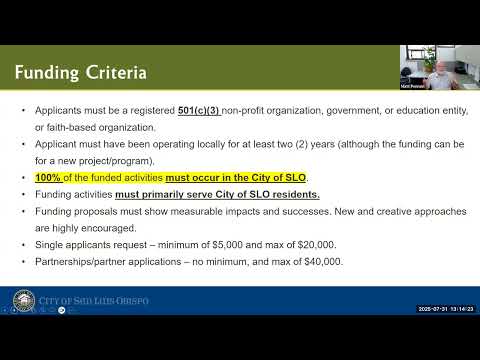
Key eligibility and application rules: applicants must be a registered 501(c)(3) or apply through a 501(c)(3) fiscal sponsor. Organizations must have operated locally for at least two years (though individual projects may be new). All funded activities must occur 100% within the City of San Luis Obispo and primarily serve city residents, the presenters said. The minimum single-organization request is $5,000 and the maximum is $20,000; partnership applications (two or more organizations) have no minimum and a $40,000 maximum. Pennon told attendees that the city will not allow an organization to receive more than one award (no "double dipping").
Program and reporting timeline: awarded projects are expected to begin Jan. 1, 2026. Contracts must be executed with the city prior to disbursement of funds. Grantees must submit a midyear report (first round due July) and a final end-of-year report (due January 2027), and the city will review measurable outcomes submitted in those reports.
Selection and decision process: the Human Relations Commission develops funding recommendations; those recommendations go to the City Council, which has final discretion over awards. Pennon said staff will assign each applicant a Human Relations Commissioner liaison.
Restrictions and guidance: funds may not be used for political campaigning, promotion of ballot measures or candidates, religious proselytizing, or for profit/personal gain. Projects may focus on underserved or underrepresented communities but must be accessible to the entire community.
Application tips and staff support: staff warned that the online application must be completed in a single sitting and does not save progress; they recommended drafting answers in a separate document first. Pennon and Bates Bonham encouraged creative proposals, partnerships, clear budgets (separate line items for subprojects if applicable), and measurable outcomes. They also invited applicants to use technical assistance hours and to contact the DEI office directly with questions.
Attendees and next steps: staff said they had 18 registrants and roughly 12 participants on the call; they recorded the session and will post materials on the city website. The city plans to route contracts to recipients in November–December and distribute funds in January 2026 once contracts are returned and processed by the city’s fiscal team.