Get Full Government Meeting Transcripts, Videos, & Alerts Forever!
Get email alerts on the County Budget topic
No spam. Unsubscribe anytime.
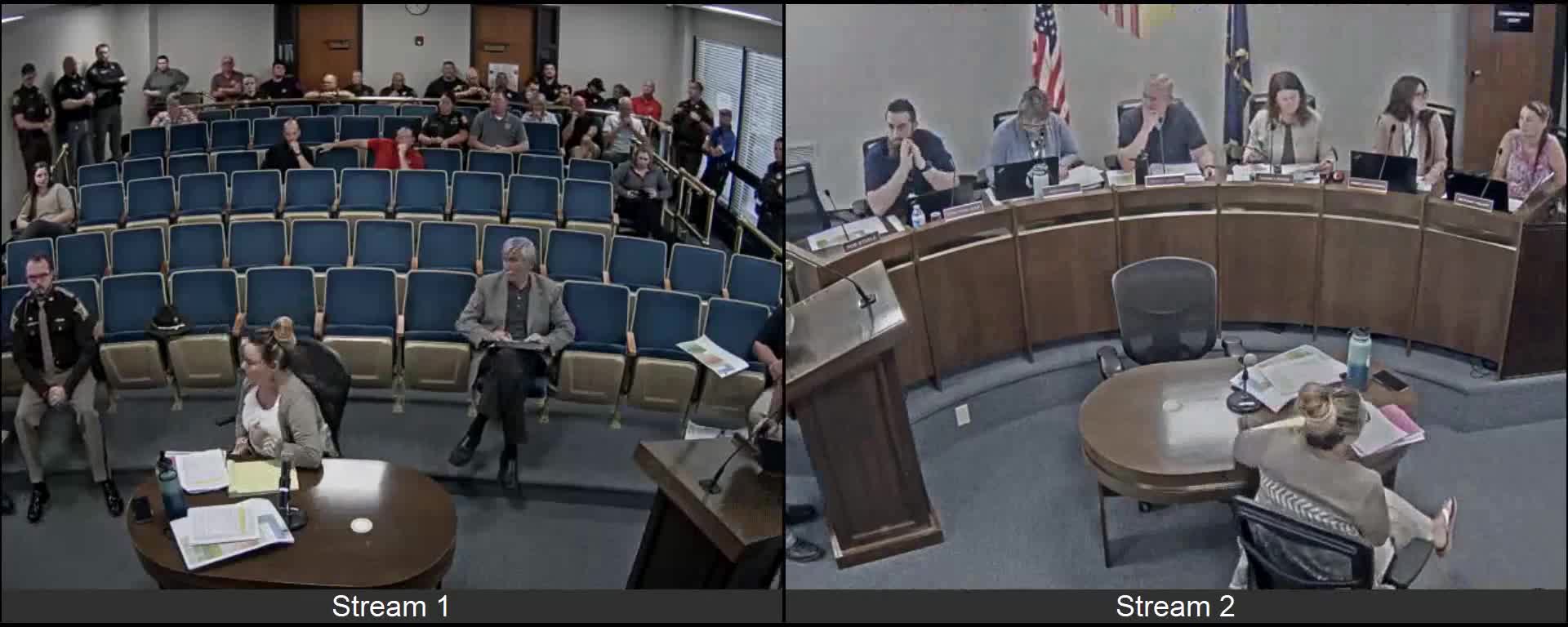
Madison County council debates how to close $1.3M shortfall, schedule vote on sheriff merit contract
Summary
Council members and finance staff reviewed a roughly $44 million general-fund estimate for 2026, discussed using reserves and the Capital Asset Improvement Fund to cover a proposed three‑year sheriff merit employees contract, and agreed to advertise the 2026 budget at a higher figure while scheduling a September vote on the contract.
Madison County officials spent more than two hours on budget projections Tuesday, weighing options to cover a projected shortfall for the 2026 general fund and debating whether to use reserve accounts or a proposed public-safety levy to pay for a three‑year compensation agreement for sheriff merit employees.
Todd, a county finance staff member handling revenue estimates, told the council the preliminary 2026 general‑fund estimate is roughly $44.04 million, “lower than our budget for this year of about $44.08 million.” He flagged three trends reducing revenue: slowing growth in local income tax receipts, reduced jail bed contract revenue and lower interest income on investments. He said some major state property‑tax and deduction changes make the usual 80% collection assumption for net assessed value “more risky this year.”
The shortfall and the pending merit employees contract were the focal points. A proposal circulated among council members would buy out or otherwise fund the three‑year agreement the commissioners and the sheriff’s merit employees negotiated. Council member Jody said she would “buy the contract out,” proposing the council honor the three‑year agreement by drawing on the Capital Asset Improvement Fund and, if needed, the rainy day fund. Finance staff reported the rainy day balance at about $17.9 million and the capital asset fund at about $2.27 million.
Todd summarized the county’s choices succinctly: “we either need to decrease spending and cut more, we need to raise revenue or transfer revenue.” Council discussion focused on the tradeoffs among (a) cutting departmental budgets and asking department heads for additional operating savings, (b) transferring existing levies or one‑time reserves into the general fund, and (c) raising revenue via a proposed public safety (PSAP) levy that county staff said could raise roughly $1.1 million if maximized.
Multiple council members urged department heads to identify modest savings. Several departments reported small line‑item reductions; for example, a juvenile services line saved about $26,398. Council members noted hiring freezes and reductions in part‑time budgets as potential near‑term measures, but several said those steps alone would not close the gap. One council member asked staff to re‑examine fixed contracts (medical services for the jail, software licenses and other recurring costs) and longevity/payroll matrix items for accuracy.
On how to proceed with the merit employees contract, council members discussed two paths: advertise the 2026 budget including the contract as negotiated by the commissioners and merit employees, or advertise without the increased compensation and return to the issue after final assessed‑value and certified net assessed value (CNAV) figures arrive. Finance staff said CNAVs and the final property levy distribution are usually not complete until late summer, complicating precise budgeting now.
Rather than postpone action, members agreed to advertise a higher 2026 budget that includes the merit contract figures and to place a formal vote on the sheriff merit employees agreement on the September meeting agenda. At the meeting the finance staff provided an advertising figure (including the contract) and said the budget could be adjusted before the council’s final vote in October. Council members emphasized that any use of the Capital Asset Improvement Fund to cover compensation costs would require concurrence by the commissioners, and several said they would request that the commissioners release specified amounts from that fund to help meet the contract obligation.
Council members also debated timing and equity of revenue measures. Some said they would not support raising county taxes (a PSAP levy) unless employees received pay increases that offset the new tax burden on county households; others argued existing reserve balances and tighter spending controls could bridge the shortfall without a new tax. Several members expressed concern that assessed‑value increases could paradoxically reduce available levy capacity because state law caps levy growth.
The council set the next public hearing for the budget on Sept. 9 at 6 p.m. and directed staff to advertise the 2026 budget at the higher figure that includes the merit contract. They also scheduled a vote in September to consider the merit employees agreement for 2026–2028. Staff committed to return updated CNAV numbers and any additional departmental savings prior to the council’s final October vote.
The discussion included repeated requests for clearer, itemized savings from departments, and several council members said they were reluctant to tap the rainy day fund for ongoing salary increases except as a short‑term accommodation. The council asked legal staff and county attorneys to clarify which capital asset fund expenditures could be reallocated to help meet compensation obligations before final appropriations are adopted.