Get Full Government Meeting Transcripts, Videos, & Alerts Forever!
Get email alerts on the Municipal Finance Audit topic
No spam. Unsubscribe anytime.
DeKalb Township receives clean audit; auditor flags segregation-of-duties, accounting restatement
Summary
Newkirk Associates presented an unmodified (clean) audit for the fiscal year ending March 31, 2025, while noting material weaknesses including segregation of duties and the need for accrual-basis statement preparation. The board approved the audit and routine bills by roll call.
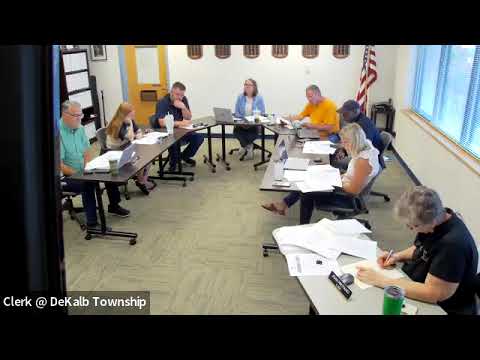
DeKalb Township trustees on Aug. 19 received an annual audit from Andrea Meyer of Newkirk Associates that resulted in an unmodified opinion, while the auditor identified internal-control issues the firm said are common in small local governments.
The presentation, given at the start of the meeting during the "presentations" portion, said the audit produced a clean opinion on the financial statements but included required communications about internal-control matters and accounting adjustments, including a restatement tied to a new accounting standard for compensated absences (referred to in the audit as GASB 101). The board voted to approve the audit documents and to pay the board's listed bills for July and August.
Andrea Meyer, Newkirk Associates' auditor for the engagement, told trustees the auditors found no disagreements with management and no significant difficulties completing the work. "Everything — both the town and the road — had all the documents that we asked for," Meyer said. She added that while the audit contained numerous journal entries, most were reclassifications or routine accrual reversals associated with accrual accounting.
Meyer said the audit letter included two items the firm must disclose as material weaknesses: a lack of segregation of duties and the township's lack of in-house staff capable of preparing accrual-basis financial statements. "With segregation of duties, ideally you want somebody different in the recordings, the transactions different from having custody of the assets," Meyer said, adding that the limitation is "primarily for a lack of resources" in smaller governments.
She told trustees that board oversight — reviewing the packets provided before meetings and asking questions about payments — helps mitigate the risks that arise when a small staff performs multiple financial functions. The audit also noted that the township's responses to the auditors' fraud-inquiry letters were slow to return, which Meyer flagged as an area for improved engagement by trustees.
The audit documents also describe a prior-period difference in the General Assistance beginning cash and fund balance related to voiding checks in QuickBooks. The auditors described that voiding older checks alters historical data and recommended using corrective journal entries so changes remain recorded in the year to which they belong.
Meyer discussed a change in how compensated absences are accounted for this year, which the audit report attributed to the pronouncement the firm referenced as "GASB 101." That change required governments using accrual accounting to restate beginning net position to reflect accrued compensated-absence obligations; Meyer said the restatement is not the result of township error but a widespread effect of the new guidance.
The audit's subsequent-events note, the auditor said, disclosed transactions after the township's March 31 fiscal year end but before the meeting: the township is under contract to sell a parcel of land (sale not closed), construction of a storage building currently underway, and the purchase of an additional cemetery parcel funded by a donation. Those items are described in the audit's notes and supplementary information.
After the presentation, trustees moved and seconded approval of the audit and to pay the bills listed on the agenda. The roll-call vote for the motion to approve the July audit report in the amount of $194,583.08 and to pay the August bills totaling $89,417.05 recorded five affirmative votes: Trustee Thurman (aye), Trustee Acres (aye), Trustee McLaughlin (yes), Trustee Bridal (yes) and Supervisor Hess (yes). The motion passed.
The board also voted to receive, file and approve the treasurer's July budget reports (roll call recorded as Trustee Bridal: yes; Trustee McDonough: yes; Trustee Akers: aye; Trustee Thurman: aye; Supervisor House: yes) and approved the July meeting minutes by voice vote.
Trustees and staff discussed next steps for filing the annual report with the Illinois Comptroller; the auditor said she planned to prepare the reports for submission and noted the board would review and approve the submission before it goes out. The meeting record shows trustees were unsure of the exact statutory filing date mentioned in the discussion; the clerk and auditor discussed completing the filings in the coming weeks.
The auditors offered to answer follow-up questions after trustees have had time to review the mailed and emailed audit documents. Meyer said, "If after you go home and you think about it... don't hesitate to reach out to Mary or Craig. They both have my contact information, and I'd be happy to answer any questions that may pop into your head even at a later time."