Get Full Government Meeting Transcripts, Videos, & Alerts Forever!
Get email alerts on the Sports Tourism topic
No spam. Unsubscribe anytime.
Sport Oregon highlights event wins and warns venue shortcomings cost NASCAR and Formula E
Summary
Jim Metzl, executive director of Sport Oregon, told the Arts and Economy Committee on Sept. 9 that while Portland has won major sports events and produced tens of thousands of hotel room nights, shortcomings in road, facility and public‑safety infrastructure contributed to the loss of NASCAR and Formula E dates.
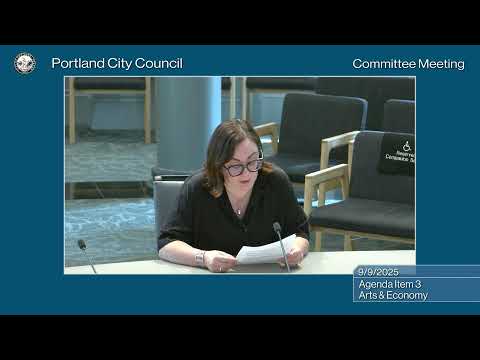
Jim Metzl, executive director of Sport Oregon, briefed the City Council’s Arts and Economy Committee on Sept. 9 about the nonprofit’s fiscal‑year work to attract and host sports tourism and to expand community programs. Metzl and Sport Oregon staff credited a recent increase in major events and hotel room nights but warned that venue and corridor conditions have cost the city marquee dates.
Metzl said Sport Oregon’s partners secured high‑profile events including the NCAA Division I women’s basketball regionals, a large professional skateboarding festival on the waterfront, and the 2026 USA Fencing Summer Nationals, which the presentation estimated would bring roughly $10 million in economic impact and about 6,000 athletes and 11,000 hotel room nights.
The organization reported that its 2024–25 efforts, working with Travel Portland and others, generated roughly 62,000 booked hotel room nights. Sport Oregon also described foundation grant work — including a program called She Flies and a new Play Oregon initiative — and said it made 12 grants totaling about $125,000 to nonprofits in the most recent year.
Metzl warned that Portland recently lost future NASCAR dates even after the event delivered strong crowds. He attributed the promoter’s decision to two factors: the condition of the highway interchange at I‑5 and Victory Boulevard that serves Portland International Raceway (PIR), and shortcomings inside the facility, where he said promoters and series expect hardened medical and media facilities rather than temporary tents and stacked containers.
"They aren't gonna bring their fans in their front door when their front door looks like that," Metzl said of the interchange conditions, and he added that promoters now expect permanent medical and media centers rather than temporary structures. Sport Oregon staff also said Formula E left in part because a competing market "wrote a check," and because Portland did not meet certain facility and streetscape expectations for an international series.
The presentation outlined a multi‑year vision for the Expo Center and Delta Park area that would convert underutilized halls into large indoor courts, fields and ice sheets to host mass tournament play and attract year‑round bookings. Metzl said Metro and Sport Oregon have won votes to pursue development concepts for Halls D and E, with early budget money in place and a goal to begin bookings in late spring 2026 after short‑term flooring and standards investments.
Sport Oregon urged closer coordination across city bureaus, promoters and private investors to sustain events and to develop venues including Moda Center, Providence Park and Portland International Raceway. Metzl cautioned that the city’s ability to host future marquee events — and the NCAA women’s Final Four in 2030 — depends on upgrades to key facilities: "If we deliver on that event, there is no WNBA All‑Star Game. There is no NBA All‑Star Games in our future" if the venues are not competitive, he said.
Council members across the dais acknowledged the presentation and offered to work with Sport Oregon on a strategic roadmap and on neighborhood and corridor improvements that would support major events. No formal votes were taken during the briefing.