Get Full Government Meeting Transcripts, Videos, & Alerts Forever!
Get email alerts on the Economic Development topic
No spam. Unsubscribe anytime.
Prosper Portland director vows community-centered TIF work, cites small-business supports for struggling storefronts
Summary
At a Sept. 9 Arts and Economy Committee meeting, new Prosper Portland Executive Director Cornell Wesley outlined priorities including Tax Increment Financing that centers community input, a small-business 'critical repair' program for storefront damage, and attention to Gateway and working-waterfront neighborhoods.
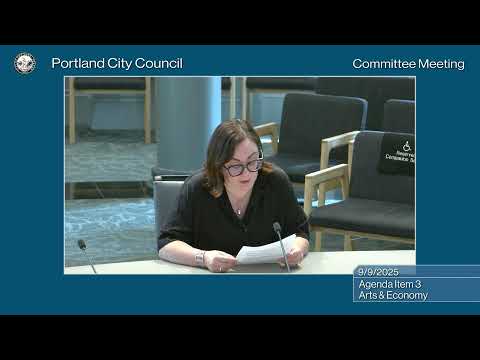
Cornell Wesley, the new executive director of Prosper Portland, told the City Council’s Arts and Economy Committee on Sept. 9 that his agency will center community input in redevelopment projects and accelerate small-business support programs aimed at keeping storefronts and legacy businesses open.
Wesley, introduced to the committee at its morning meeting, said Prosper Portland will operate from “customer service, efficiency, effectiveness, [and] accountability,” and described Tax Increment Financing — a tool Prosper uses for redevelopment — as “just a tool” that must be applied so “the impact will be, to their benefit and not to their detriment.”
The comments came during a 40‑minute dialog with council members about neighborhood impacts, commercial vacancies and the city’s waterfront and Gateway area. Councilor Smith, who represents District 1, pushed Wesley to ensure Prosper’s work includes eastern neighborhoods and cited a need to respond to a high-profile recent vacancy at a Fred Meyer site in Gateway. Wesley pointed to an existing community-led Gateway plan — which he described as Prosper’s guiding framework — and said Prosper will “work hand in glove” with property owners and neighborhood leaders to reimagine uses of city‑owned real estate.
Councilor Clark pressed Wesley on support for independent storefronts across the city. Wesley highlighted Prosper’s “critical repair” program to help businesses respond to vandalism, broken windows and other immediate storefront damage, and said Prosper plans to expand resources that enable small firms to remain open and “expand and hire an additional one person.” He also said the agency will target “legacy businesses” — those he defined as 25 years and older — to encourage mentoring and knowledge transfer to newer entrepreneurs.
On the working waterfront, Councilors noted tension between industrial employers and riverfront public uses. Wesley pointed to examples from other river cities where waterfront redevelopment has combined commerce and recreation, and committed to meeting with stakeholders on both sides as Prosper pursues projects.
Wesley framed Prosper as one piece of a larger city toolbox: “I am one of the tools in the toolbox,” he said, adding that success will require partnering with bureau leaders and community organizations.
Committee members responded positively and asked Prosper Portland to return with more detailed plans and continued neighborhood outreach. No formal actions or votes were taken during the discussion.
Wesley said he looks forward to bringing projects back to the committee for more detailed briefings and promised follow‑up with council offices and community groups on Gateway and storefront initiatives.