Get Full Government Meeting Transcripts, Videos, & Alerts Forever!
Get email alerts on the Downtown Arena Spurs topic
No spam. Unsubscribe anytime.
San Antonio council approves nonbinding term sheet for downtown arena after heated public comment; pause resolution fails
Summary
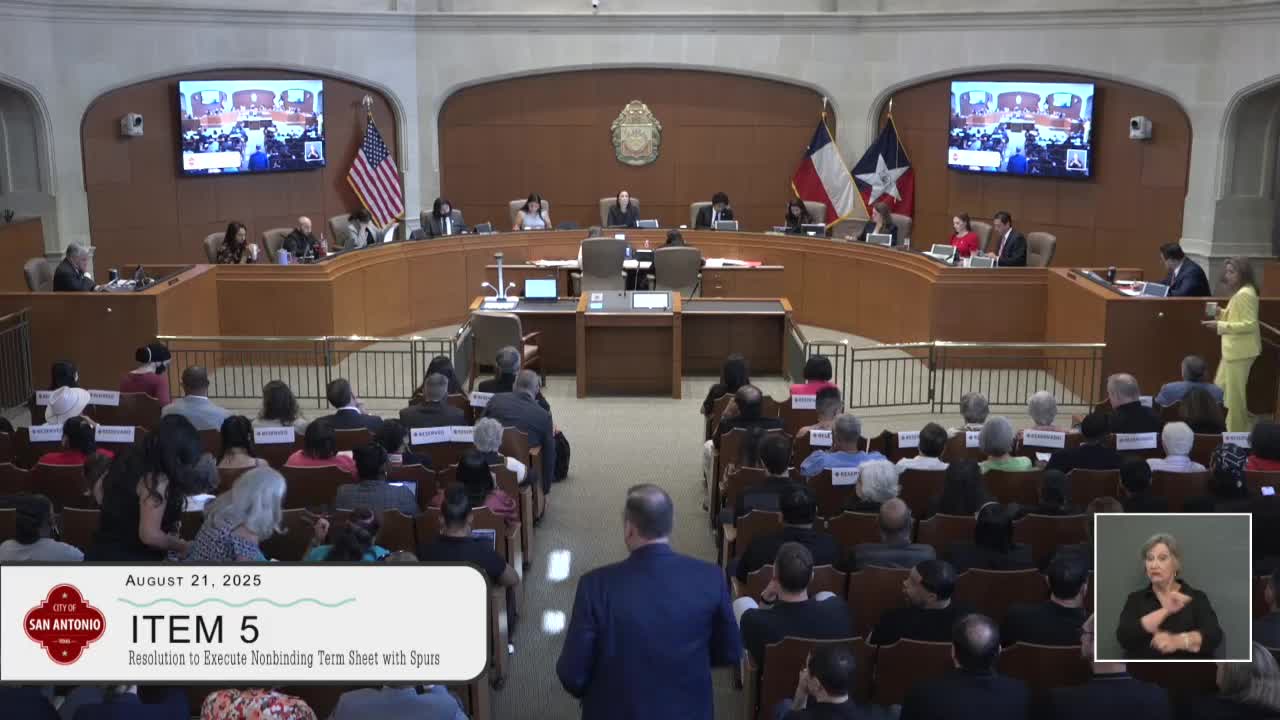
San Antonio — The San Antonio City Council on Aug. 21 authorized the city manager to conclude negotiations and sign a nonbinding term sheet with the San Antonio Spurs’ development group for a proposed downtown arena after lengthy public comment and debate.
San Antonio — The San Antonio City Council on Aug. 21 authorized the city manager to conclude negotiations and sign a nonbinding term sheet with the San Antonio Spurs’ development group for a proposed downtown arena, after more than three hours of public comment and a contentious debate among council members.
Mayor Gina Ortiz Jones read the staff presentation of the proposed term sheet and the project’s financing framework, saying the proposal does not commit the city to immediate binding obligations but is intended to lay out the terms for later steps, including voter approval. “This is a reminder: this is a term sheet, not a binding agreement,” Mayor Gina Ortiz Jones said during the presentation.
Why it matters: The term sheet frames a project that staff and presenters said would combine roughly $500 million in Spurs contribution for the arena, up to $311 million in potential county hotel-tax financing and a maximum city contribution of about $489 million tied to future financing structures and tax increments; staff described a total arena-and-adjacent-development cost in the neighborhood of $1.3 billion. Council approval to advance the term sheet triggers a public vote on the county financing measure and begins negotiations that would produce the binding agreements and additional approvals the council would later consider.
What the council did: Council members considered two competing resolutions. - Resolution 4 sought to pause council consideration of any term sheet until the council received an independent economic-impact study (to be carried out by a firm without ties to the Spurs) and until each council member had held at least two in-person public engagements about the study and the term sheet. That motion failed, recorded in the meeting as "4 a favor, 7 en contra." - Resolution 5 authorized the city manager to finish negotiations and sign a nonbinding term sheet with San Antonio Spurs-related entities with terms substantially similar to the published draft. Council voted to approve that resolution; the meeting minutes reflect the motion passed and the council directed staff to continue community outreach and further negotiations.
Project basics and funding numbers presented to council City and presentation materials presented these headline figures during staff remarks: - Spurs contribution for arena construction: $500,000,000 (stated as the Spurs’ contribution for the arena plus any costs above that they would assume). - County contribution (hotel/visitor-tax funded): up to $311,000,000 (to be decided by county ballot measure). - City contribution: up to $489,000,000 maximum in debt supported by project-related revenues described in the term sheet (not the city general fund, per staff presentation). - Approximate total arena and related development cost: $1.3 billion (presenters said the final total could vary and that amounts above $1.3 billion would be the Spurs’ responsibility). - Development guarantees and scale: presenters said the private development partners and Spurs-linked investors were guaranteeing roughly $1.4 billion in private development over 12 years on roughly 25 acres (about 18 acres described for mixed-use development adjacent to the arena). - School-district funding and lease terms described in the draft: an annual payment pattern for the operator (referred to in the presentation as the schools’ contribution) of about $2.5 million per year over a 30-year lease term (a $75 million total figure was cited), and an initial-year arena rent payment of $4 million that would escalate by 2% annually.
Public comment: Hours of testimony showed deep division The council heard from roughly 108 people who had signed up to speak on the two items, according to staff. Speakers represented neighborhood groups, labor unions, business groups, clergy, community organizers, and Spurs officials; testimony ranged from full-throated support to forceful opposition.
Community critics urged delay and an independent analysis. "There has been negotiation in closed sessions that was not transparent," said Graciela Sánchez, a speaker who identified herself as representing community groups and who urged the council to seek an independent economic-impact study before advancing the term sheet. "You are committing public money without a full, independent analysis," she said.
Business and development leaders urged council to move forward so voters would have the information needed for the November ballot. "This project will create construction jobs and long-term economic activity," said Jeff Western, president and CEO of the San Antonio Chamber of Commerce, who urged approval so the public could decide at the ballot box.
Spurs representatives also addressed the council. Peter Holt, identified in testimony as with the Spurs organization, described the team’s long ties to San Antonio and the organization’s community involvement and urged passage of the term sheet to preserve the chance that the team would remain based in the city as negotiations and the public process continued.
Council debate and staff responses Council members pressed staff and Spurs representatives during a multi-hour discussion on several points: the potential impact on the city’s general fund and bond capacity; displacement and anti-displacement protections for nearby neighborhoods; whether hotel-occupancy and incremental tax revenues cited in the term sheet would legally be available for the proposed debt structure; the adequacy of the economic assumptions in the studies provided by project consultants; and labor standards and community-benefit commitments.
Mayor Gina Ortiz Jones and several council members emphasized that the term sheet is nonbinding and that multiple steps remain, including final contract negotiations and voter approval of county financing. Ortiz Jones said an independent study could be useful but argued the council also needed to preserve the opportunity to complete negotiations and place the financing measure before voters.
Outcome and next steps - The council voted down the resolution that would have delayed action until an independent study and additional public hearings were completed (the motion on Resolution 4 failed, "4 a favor, 7 en contra"). - The council approved the resolution authorizing the city manager to conclude negotiations and sign the nonbinding term sheet (Resolution 5), and staff were directed to continue community outreach, work with unions and neighborhood groups on community-benefit features, and return with negotiated contract documents and financing specifics for later council consideration. The approved term sheet moves the process toward the county ballot measure and subsequent contract negotiations.
What remains unresolved The term sheet does not create binding city debt or alter the general fund directly; it sets a framework for later steps that would include specific financing instruments, potential bond issuances, and final legal agreements. Many commenters and several council members urged an independent economic-impact study, stronger anti-displacement measures, explicit labor protections, and more community meetings before final contracts are executed. Staff said they will continue public outreach and that final agreements and specific financing measures will return to council for approval.
Local reaction and context Supporters said the project could catalyze downtown development, create construction and hospitality jobs, and increase the city’s appeal for conventions and visitors. Opponents said previous large projects had failed to deliver promised neighborhood benefits, warned of displacement and insufficient detail about how the city would be protected if revenue projections fell short, and urged more independent review. Several speakers pointed to past San Antonio projects including the Alamodome and to other cities’ experiences where teams relocated after failed financing votes.
Councilmembers and staff noted the proposal has been discussed with county officials and representatives of the Spurs, and that the county’s financing measure will be a separate ballot question for county voters. The council’s vote to approve the term sheet does not by itself obligate the city to spend general-fund dollars; it advances negotiations and commits staff time to finalize binding documents should the public financing measure succeed.
The council moved on to other business after approving the resolution to authorize the city manager to finish the negotiations; public outreach and more technical analysis are expected to continue as the process advances.