Get Full Government Meeting Transcripts, Videos, & Alerts Forever!
Get email alerts on the Underwriting Renewal topic
No spam. Unsubscribe anytime.
SJVIA adopts staggered 2026 renewal approach, uses reserves to smooth increases
Summary
The SJVIA approved a renewal strategy for plan year 2026 that applies different rate changes by plan and uses a portion of accumulated reserves and interest income to reduce the immediate impact on members, while recommending plan-design adjustments in Tulare County.
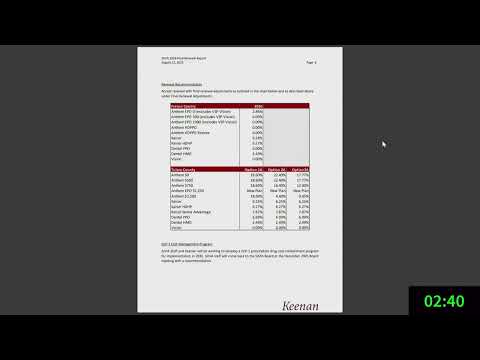
The San Joaquin Valley Insurance Authority on Aug. 27 approved the consultant-recommended underwriting renewal for plan year 2026, a staggered approach that targets lower increases for some plans, higher increases for the richest plans, and temporary use of reserve balances to smooth member costs.
Why it matters: The pooled SJVIA renewal varied sharply by county and plan: the consultant presented overall renewal estimates of about 3.29% for Fresno County, 17.29% for Tulare County, and a pooled SJVIA renewal of 7.14% before plan-design adjustments. Directors and staff emphasized the goal of keeping benefit choices affordable while aligning each plan’s premiums with its actual claims experience.
Key features: Consultants recommended using roughly half of the most recent interest income generated by trust reserves (about $0.5 million of roughly $1 million reported interest) to offset rates and smoothing a portion of required retro funding from reserves rather than passing the full increase immediately. For Tulare County, staff proposed plan-design changes (including increasing ER copay from $100 to $250 plus coinsurance) and adding an intermediate plan with a $1,250 deductible to encourage migration from the heavily used $750 plan to a higher-deductible option.
Staff showed that the SJVIA’s current IBNR and stabilization reserves are substantial — consultants certified reserves and recommended the smoothing approach so that members are not hit with a single-year spike. Directors said they favored a phased approach that targets higher increases to the richest plans (which have loss ratios well over 150%) and minimal or no increases to plans that are self-sustaining.
Motion and vote: Staff recommended option 3A (plan-design changes plus partial use of reserve smoothing); Supervisor Magsig made the motion and a second was recorded. The board approved the motion.
Next steps: Staff will implement the new plan designs, publish plan-specific rates for open enrollment materials, and report back on enrollment migration and financial impacts. Staff also committed to monitoring whether migration into higher-deductible plans meets projections and to return to the board if midyear adjustments are required.