Get Full Government Meeting Transcripts, Videos, & Alerts Forever!
Get email alerts on the Coastal Resilience topic
No spam. Unsubscribe anytime.
HARB approves National Park Service seawall work, new fee booth and accessibility improvements at Castillo de San Marcos
Summary
The board approved a certificate of appropriateness for National Park Service plans to repair and raise sections of the Castillo de San Marcos seawall, add accessibility improvements and relocate the fee booth; staff and board urged use of historically appropriate materials and finishes.
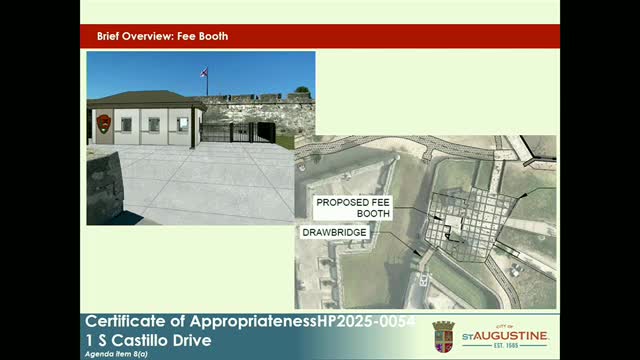
The Historic Architecture Review Board approved a certificate of appropriateness on Aug. 21 for National Park Service plans to repair and raise sections of the Castillo de San Marcos seawall, construct ADA-accessible paths in the park, and replace the park entrance/fee booth. The work would raise the north and south transition seawalls to match the central center seawall elevation and introduce repaired or matching granite/block work where the wall is failing.
Why it matters: The Castillo and its waterfront wall are defining historic elements in St. Augustine. The proposed work has both historic-preservation and resilience rationales: the National Park Service said portions of the wall have reached their structural life and that raising sections to the level of the central granite seawall would reduce storm-overtopping at a location known to be vulnerable during high tides and storms.
What the board discussed: Staff described the project and noted coordination with FDOT and city seawall work. The applicant presented cross sections, mock-up plans and a plan to construct an onsite trial mock-up of the new wall for review. Board members and staff recommended materials compatible with the fort, asked the applicant to use historic-appropriate roofing and trim on the new fee booth and recommended the board prefer wood-shingle appearance where feasible. The board also suggested considering bronze/earth-tone finishes for new security fencing so the fence is less visually dominant near the fort’s light stucco and coquina surfaces. The fire marshal and staff flagged a possible gate-width adjustment for emergency access; applicants acknowledged that gate design might change to accommodate emergency vehicles.
Outcome: The HARB approved the Certificate of Appropriateness, finding the design met the Secretary of the Interior’s Standards for Rehabilitation as compatible contemporary work when executed with the recommended material choices. The board asked the Park Service to present material samples and final fence/roofing details for administrative review.
Next steps: The National Park Service will construct a local mock-up of proposed wall material on park property, provide samples for staff review and continue coordination with State Historic Preservation (Florida SHPO) and staff on roofing and fence finishes. NPS said the scope is being coordinated with concurrent FDOT and city seawall projects.