Get Full Government Meeting Transcripts, Videos, & Alerts Forever!
Get email alerts on the Council Attorney Engagement topic
No spam. Unsubscribe anytime.
Cranston council approves amendment to engagement with city council attorney after debate over billing and disclosure
Summary
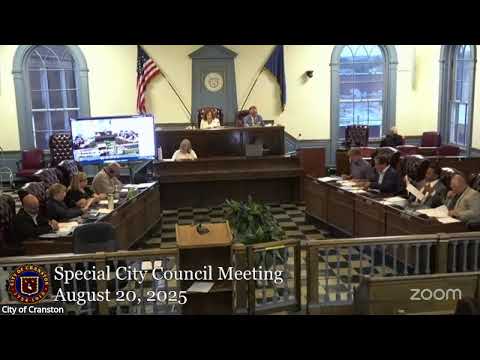
On Aug. 20, 2025, the Cranston City Council approved an amendment to the Feb. 7, 2025 letter of engagement with council attorney Stephen J. Angel that changes how hourly billing statements are handled, after objections from the city solicitor and public comments about notice and transparency.
The Cranston City Council on Aug. 20 approved an amendment to the Feb. 7, 2025 letter of engagement with Stephen J. Angel of Angel Law LLC that sets a process for submitting hourly billing statements, including redaction rules and restricted access to unredacted time records.
The amendment addresses how invoices and time specifications for hourly work will be handled: billing statements are to be submitted by the Angel Law firm to the finance director, with redacted time specifications provided to council members; unredacted time specifications would remain with the firm and be available to council members by appointment in the presence of the council attorney. The amendment also clarifies that hourly billing under the engagement springs into effect only when litigation or a conflict with the administration requires Angel to act as litigation counsel rather than under the flat monthly fee.
The change was introduced for committee referral at a special council meeting and then considered and approved at a special meeting of the finance committee before the full council approved it later the same evening. Council discussion focused on three areas raised in the amendment and in subsequent debate: (1) the mechanics of who receives invoices and how they are redacted, (2) whether the change improves or reduces transparency, and (3) whether the city solicitor must or would approve the amendment as to form.
Stephen J. Angel, the attorney under the engagement, told the finance committee that the amendment was circulated to council members in late July and that the proposed language substitutes the payments and responsibilities section on pages 5–6 of the existing letter of engagement. Angel said the flat-fee portion of the engagement remains unchanged at $3,500 per month (budgeted as $42,000 annually) and that hourly billing only applies for work outside that flat-fee scope, typically when a conflict with the administration arises. He argued that redaction for time specifications is necessary to protect attorney-client privileged or sensitive material and cited Rule 1.6 of the Rhode Island Rules of Professional Conduct as the legal basis for preserving confidentiality in those details.
Solicitor Malay objected to portions of the amendment and told the committee he would not approve the document "as to form." Malay said the charter gives the city solicitor authority to prepare or approve the form of contracts in which the city has an interest and raised concerns that language directing the finance director to pay invoices could conflict with charter procedures. Malay also said he had not received the amendment in advance and warned about potential Open Meetings Act issues related to document posting.
Council members split on how to weigh transparency against confidentiality. Council Vice President Wahl, chairing the finance committee, said members received a redacted version and that the amendment was intended to allow council members to inspect unredacted invoices by appointment while protecting privileged material from public disclosure. Councilwoman Graziano and Councilman Bonanno described the change as making the engagement "better" and "more transparent;" Councilman Ritz said he would vote no because he felt the process lacked adequate notice. Public commenters at the finance committee meeting also criticized the timing and posting of the amendment, saying it was not available online before the meeting.
Votes at a glance - Special council meeting (motion to refer amendment to finance committee): motion passed 5–4. Recorded votes — Yes: Graziano, Haroyan, Andujar, Wall, Marino. No: Campobiano, Bonanno, Ritz, Traficante. - Finance committee (motion to approve amendment, recommended to full council): passed (recorded roll call during the finance meeting: Yes: Graziano, Andujar, Traficante, Haroyan, Wall; No: Ritz; Abstain: Marino). - Full council (final vote to adopt amendment): passed 6–2–1. Recorded votes — Yes: Bonanno, Graziano, Horayan, Andujar, Traficante, Wall. No: Campo Piano, Ritz. Abstain: Marino.
Council and city staff noted budget constraints if hourly work beyond the $42,000 line item were to be incurred: Finance Director (identified in the meeting as Director Moran) said no additional funds were in the city council budget and that expenditures must follow budgetary processes, including possible fourth-quarter transfers if necessary. Multiple speakers referenced a prior period of conflict (June 11, 2024) when hourly work had been authorized and billed.
The meeting record shows the executive-session item that had been listed on the council agenda was withdrawn after the amendment vote. The council adjourned after taking the amendment up and approving the measure.
The text of the amendment and the council's vote records were discussed in the meeting; several members asked that any future invoicing practice include the finance director and preserve the council's right to inspect unredacted records under controlled circumstances, while the city solicitor emphasized his charter authority to approve contract form and raised procedural and Open Meetings Act concerns.