Get Full Government Meeting Transcripts, Videos, & Alerts Forever!
Get email alerts on the Federal Policy Hr1 topic
No spam. Unsubscribe anytime.
Assembly subcommittee warned HR 1 will cut Medi‑Cal, food aid, clean‑energy incentives and tighten student‑loan rules
Summary
California lawmakers and state officials told an Assembly Budget subcommittee that HR 1, now federal law, could reduce Medicaid funding, restrict CalFresh eligibility, rescind Inflation Reduction Act programs and change student loan repayment — and that many implementation details still depend on federal guidance.
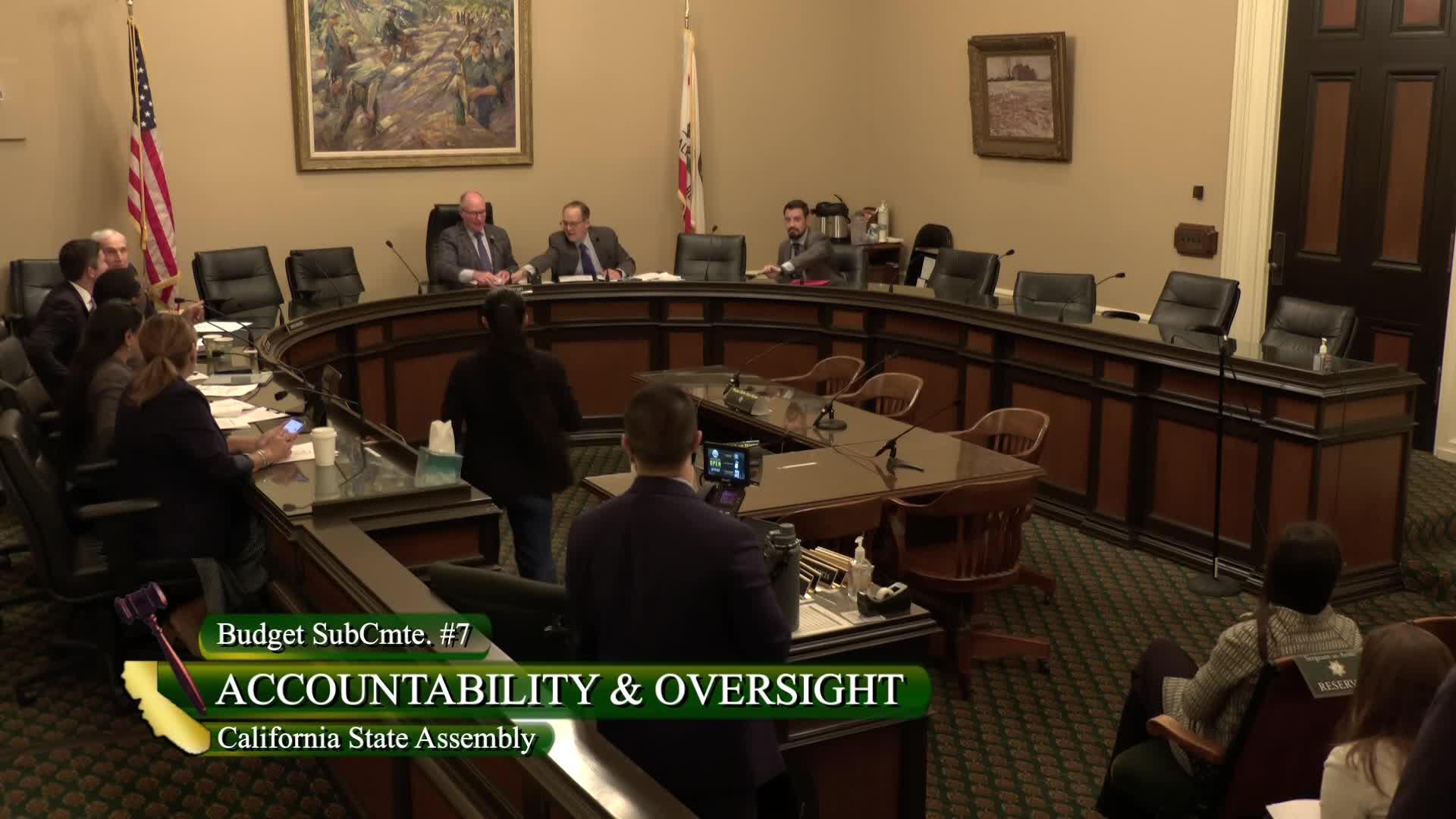
Chair Hart convened the Assembly Budget Subcommittee on Accountability and Oversight for an informational hearing on HR 1, the federal law enacted in mid‑2025, saying, "Now that HR 1 has passed congress and been signed by the president, we can now begin to assess its full and significant impact." The chair told members the hearing would map programs most vulnerable to the law and start planning California's response.
The Legislative Analyst's Office and the Department of Finance delivered the hearing's technical outline: the law immediately restricts states' ability to levy many provider taxes that underpin Medi‑Cal funding; tightens eligibility and verification requirements for Medi‑Cal and CalFresh (SNAP); sunsets or rescinds several clean‑energy and electric vehicle tax credits; and changes federal student loan and Pell eligibility rules. Carolyn Chu of the Legislative Analyst's Office told the committee her review focuses on "first‑order effects" — actions the state must take to implement the law — and stressed that significant federal guidance is still pending.
Mary Halterman of the Department of Finance summarized the statute's timing and scale, saying HR 1 "was signed by the president on 07/04/2025" and listing immediate, near‑term and later implementation deadlines. Halterman flagged a possible immediate restriction on provider taxes and noted the administration was awaiting federal rules that will determine how work requirements, redeterminations and other changes are implemented at the state and county level.
Both fiscal advisers flagged a central near‑term budget risk: the state's managed care organization (MCO) tax and related provider levies that currently finance parts of Medi‑Cal could be curtailed. Chu said the managed care tax is one of the major state taxes that "could be affected by the bill in the near term." The LAO noted the current funding pipeline includes about $4.2 billion in the current year that helps pay for Medi‑Cal services; if provider taxes are restricted the state would need alternative funding or program adjustments.
The committee heard specific program effects the presenters said could follow if federal regulators adopt a strict interpretation. Highlights provided to the subcommittee included:
- Medi‑Cal: limits on provider taxes, tighter redetermination cadence (eligibility reviews potentially every six months for some expansion populations), new work/community engagement requirements for certain adults, and caps on some state‑directed payments. The law also establishes a rural hospital transformation fund with $50 billion appropriated nationally over several years, subject to federal rules about distribution.
- CalFresh/SNAP: new work requirements for able‑bodied adults without dependents, restrictions on eligibility for some lawfully present immigrants, and increased state administrative cost shares phased in over coming years.
- Clean energy/Inflation Reduction Act rescissions: HR 1 repeals or rescinds multiple IRA programs and tax credits; Halterman said California had been estimated to receive roughly $1.7 billion in unobligated balances from several IRA programs for fiscal years 2022–2026 and singled out the Greenhouse Gas Reduction Fund (GGRF) solar program ("Solar for All") — an estimated $250 million award to California, of which the state had received only limited reimbursements to date.
- Higher education/student loans: the law limits federally subsidized graduate loans and restructures repayment plans, with several changes taking effect in 2026–2028; UC and campus financial aid officers warned the elimination of the Grad PLUS program for new borrowers could disproportionately affect professional students (doctors, dentists, lawyers) and strain health workforce pipelines.
Assemblymembers framed the hearing as urgent. Assemblymember Jackson said the law threatens "food, housing, education and health care," and warned of a coming wave of instability. Several members emphasized the state's limited ability to "backfill" large federal cuts and called for aggressive analysis, new revenue options and mitigation planning.
Stakeholders and public commenters said the law's effects would be immediate for some populations and administrative and fiscal headaches for counties and providers. Justin Garrett of the California State Association of Counties told the committee "counties will not be able to manage the increased cost that result from HR 1 without additional supports and resources and partnership." Laura Lane of the California Association of Public Hospitals said HR 1 "cuts nearly $1,000,000,000,000 from Medicaid over 10 years," and warned that public hospitals face sharp revenue losses and increased uncompensated care that could lead to closures, layoffs and reduced services.
Speakers from health advocacy groups, disability and aging organizations, child‑care and nutrition advocates, food banks, county public health officials and tribal health representatives stressed similar themes: immediate harm to low‑income Californians and immigrant families, amplified administrative burdens on county staff, and the risk that more patients will become uninsured or underinsured. Several nonprofit and county speakers urged the state to invest now in administrative automation and outreach to avoid triggering higher state cost shares tied to SNAP error rates and redeterminations.
Committee members pressed for concrete numbers and timelines. Department of Finance and the LAO said some items (tax changes, certain deductions and some clean‑energy phase‑outs) are already clear; others — especially how work requirements, provider‑tax waivers and waiver approvals will be implemented — depend on forthcoming federal regulation. Halterman warned that "the actual impact to the state may still be unknown at this time, even for the ones that were effective immediately." The LAO said it would produce follow‑up analyses on potential enrollment losses and fiscal exposure.
The hearing concluded with the subcommittee asking the administration and its fiscal offices for regular updates and more granular, program‑level estimates (for example, direct IRA grants and tax credit losses by sector, and estimated counts of Californians who may lose Medi‑Cal or CalFresh). Chair Hart closed the meeting saying the panel would "have to roll up our sleeves" and continue work across budget and policy committees.
Ending: The hearing produced no formal votes or binding actions; it served as an informational session to collect technical briefings, stakeholder testimony and to direct staff and the administration to produce further analyses and implementation plans for the legislature's consideration.