Get Full Government Meeting Transcripts, Videos, & Alerts Forever!
Get email alerts on the Pedestrian Safety topic
No spam. Unsubscribe anytime.
Tulsa committee debates ordinance to keep people off narrow medians, limit standing on sidewalks
Summary
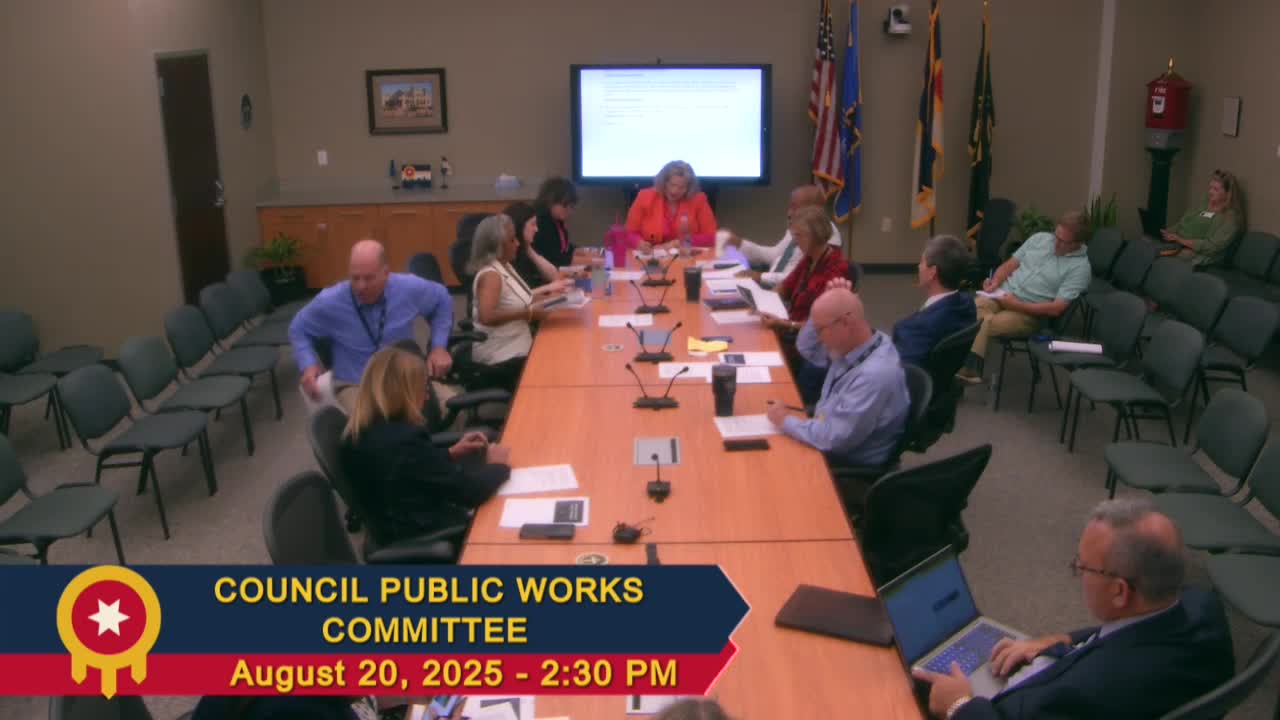
Tulsa’s Public Works Committee spent the bulk of its Aug. 20 meeting debating a proposed ordinance to require an 18-inch horizontal clearance between people and adjacent travel lanes on medians and some sidewalks and to restrict standing on narrow medians.
Tulsa’s Public Works Committee spent the bulk of its Aug. 20 meeting debating a proposed amendment to the city’s traffic code that would set a minimum 18-inch horizontal clearance between pedestrians and adjacent travel lanes and tighten rules about people standing on medians and certain sidewalks.
The ordinance, introduced as an amendment to Tulsa Revised Ordinances Title 37, would treat medians and sidewalks differently based on width. Under the draft language discussed at the committee meeting, medians under 10 feet wide would effectively be treated as unsafe for stationary activity; medians 10 feet and wider would allow activity without a reflective safety vest so long as people remain outside the 18-inch “horizontal clearance” from the roadway. The draft also repeats a $150 civil penalty the council previously set and would prohibit animals from being placed on medians or sidewalks in the regulated zone. The measure was on for first reading; committee members held a lengthy public discussion and no final vote was recorded.
Supporters told the committee the change is intended to reduce serious traffic-related injuries and deaths that can occur when people are positioned close to moving traffic. The ordinance text draws on engineering standards for a “clear zone” and applies the 18-inch horizontal clearance to both medians and sidewalks where adjacent travel speeds exceed 25 mph. Advocates said the change seeks to preserve pedestrians’ free-speech rights while removing the most hazardous positions adjacent to traffic.
But several council members, staff and outside experts at the table raised objections and questions about scope and consequences. Concerns included: - Enforcement and municipal-court impacts: council members warned that repeated citations and court appearances could disproportionately affect people experiencing homelessness or poverty and could add to already full municipal dockets. Committee staff noted existing court diversion tools and a Rule 8 process for people who cannot pay fines, but members said diversion depends on access and capacity. - Displacement and concentration: some members said restricting medians and sidewalks on higher-speed thoroughfares could displace panhandling and other street activity into business districts and narrower neighborhoods, potentially concentrating visibility rather than reducing it. - Applicability to urban sidewalks: multimodal and urban-design concerns were raised about applying an 18-inch engineering clear-zone concept, originally developed for highway design, to urban sidewalks where right-of-way and pedestrian amenities are intentionally close to travel lanes. Members requested data on crash locations and sidewalk geometry before applying the regulation broadly. - Constitutional and protest concerns: several members asked how the ordinance would affect protests, leafleting and other expressive conduct on sidewalks and medians. City legal staff said the draft is structured as a time, place and manner restriction and would apply regardless of speech content, but the committee discussed potential First Amendment implications and requested clarity. - Legal risk and precedent: legal staff discussed federal court decisions that shaped the draft. The committee referenced a Tenth Circuit decision striking down a broad citywide prohibition in Oklahoma City and the court’s reasoning that overly broad bans could violate free-speech protections. Staff said the draft attempts to be narrowly tailored (for example, by distinguishing medians by width) to reduce legal risk.
Committee members and staff asked for additional data and outreach before advancing the ordinance: crash data from Tulsa Police Department and BPAC, an inventory of median widths, input from social services and the Away Home/Better Way outreach partners, and clearer guidance about where enforcement would be applied. Several members suggested focusing enforcement and policy resources on speed reduction, targeted traffic enforcement, red‑turn regulations or other measures that directly address vehicle behavior as complementary safety approaches.
The committee did not take a final vote. City staff and legal counsel said they would return with additional information and possible drafting refinements based on feedback and potential legal concerns.
Ending: The ordinance remains at first reading. Committee members requested mapped data on median widths and crash locations, input from outreach partners and BPAC, and further legal review before the council considers second reading or final action.