Get Full Government Meeting Transcripts, Videos, & Alerts Forever!
Get email alerts on the Property Tax Budget topic
No spam. Unsubscribe anytime.
Springville Council adopts certified tax rate, finalizes $116.4 million budget
Summary
Springville City Council voted to adopt a certified tax rate that raises about $67,000 in general-fund revenue and approved a $116,371,444 final budget for fiscal year 2026; the average homeowner impact is about $4.18 per year, council and staff said.
Springville City Council on Wednesday adopted a certified tax rate tied to a 1.5% increase in the city operations portion of property tax and approved the final fiscal year 2026 budget totaling $116,371,444.
The council approved Resolution 2025-27 adopting a certified tax rate described in the motion as 0.001079 (with an operations rate of 0.000759) to generate roughly $67,000 in additional general-fund revenue. Council members then approved Resolution 2025-28 adopting the final budget for the year ending June 30, 2026.
Bruce, a city staff member who led the truth-in-taxation presentation, said state law requires a public hearing when a taxing entity proposes revenue above the county-certified tax-rate calculation. He told the council the proposal would preserve buying power against inflation and pay for a small service-level change in the police department (a master officer classification). "The total amount that we're talking about raising in the general fund with this property tax increase is actually $67,000," Bruce said.
Bruce walked the council through how Utah's property-tax calculations work, noting the county discounts residential values by 45% for taxation and that the city receives about 11% of the typical property tax bill. Using the county's average residential value of $475,000 as an example, Bruce said the taxable value after the residential discount would be $261,250. Under the city's calculations, the proposed increase would raise the operations portion of the tax bill from about $194.11 to $198.29, raising the total annual bill for that example homeowner (including debt service) from $277.71 to $281.89 — an increase of about $4.18 per year. Bruce gave a comparable estimate for a commercial property as about $7.60 per year.
Council members and staff discussed why the city has raised property taxes in recent years. Director Riddle, referenced during the meeting, and other council members said inflation and the historical decision not to annually adjust rates had eroded municipal buying power. "For the last — this will be the third year of proactively raising property tax by an inflationary amount in an effort to keep the buying power of the city whole," Bruce said. Council members described the choice as a gradual approach to avoid sudden, large increases later.
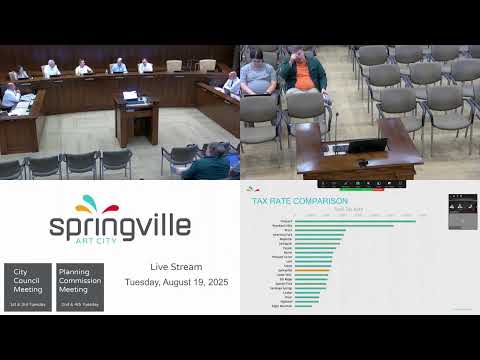
Council members also discussed the city's existing debt. Bruce said the city issued general obligation bonds for the library (paid off in 2031, he said) and for the CRC (paid off around 2036). He noted those debt-service levies are separate from the operations portion and are not changing as part of the night's action. The council compared Springville's operations-only tax rate with neighboring cities and reiterated that Springville remains toward the lower end of local rates.
During the public-comment portion, a participant raised a question linking business growth and sales-tax revenue to property-tax decisions; council members and staff responded that the city's revenue strategy includes sales tax, growth, and grants but that property-tax adjustments are one tool to maintain service levels. Several council members and the mayor urged clearer outreach: post the presentation on the city website and publicize budget meetings earlier in the year so residents can weigh in during the January–April budget process.
Votes at a glance: Resolution 2025-27 (adopt certified tax rate) was introduced and passed by roll call (recorded yes votes in the transcript: Greg, Mike, Mindy, Logan). Resolution 2025-28 (adopt final FY2026 budget in the amount of $116,371,444) passed by roll call (recorded yes votes in the transcript: Logan, Craig, Mindy, Mike).
The council completed the meeting by noting the budget-adoption requirement under state law and scheduling follow-up meetings; staff said the tentative budget adopted in June remained unchanged while the final adoption was required by statute.