
Rogers School District outlines shift to integrated instruction for English learners
Get AI-powered insights, summaries, and transcripts
Sign Up Free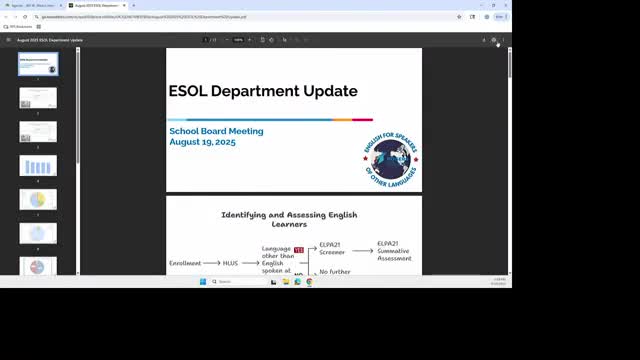
Summary
At the August board meeting, district staff presented data on the ESOL program—4,279 students served, roughly 8% of the district—and described a strategy to move from pull-out English-language instruction toward integrated classroom supports and targeted teacher professional development.
Christy Brown, identified at the meeting as the presenter of the ESOL report, told the Rogers School District Board of Education on Aug. 1 that the district is maintaining about 4,279 students in its ESOL program and plans to shift instruction so English-language development happens more inside grade-level classrooms.
The change, Brown said, follows an internal review and staffing adjustments made this year. "We are on the right path as far as supporting our teachers. We recognize where we're at is not where we wanna be with our English language learners," she said. Brown asked the board to note three executive directors now supporting the department: Melody Sebastian for federal programs and compliance, and Sarah Henry and Karen Heffel for curriculum, teaching and learning. Brown also named three ESOL curriculum specialists still in place: Susan Marino, Shauna Shields and Carla Buckholtz.
The nut graf: district staff said the principal goal is to move students from 'progressing' to 'proficient' on language assessments and to produce additional classroom-based evidence so more students can be formally dismissed from ESOL services. Brown described a dual strategy: continue targeted English-language-development (ELD) instruction while giving general-education teachers a "language lens" and tools to scaffold language in grade‑level lessons.
Brown provided the data the staff reviewed. For the 2024–25 school year the district reported about 4,279 students receiving ESOL services, roughly 8% of district enrollment (about 1,222 students reported a birth country other than the United States). Families listed approximately 51 birth countries and about 50 home languages are represented; Spanish and English are the most common home languages. The district uses a home-language-use survey at enrollment and the ELPA21 screener and assessment to determine initial placement and progress. Brown said the ELPA21 assesses reading, writing, speaking and listening on a 1–5 scale and categorizes results as emerging, progressing or proficient.
Brown explained that ELPA21 proficiency alone is not always sufficient to exit a student from ESOL services. The district requires two additional content-area artifacts (examples cited by Brown included district ATLAS benchmarks, secondary-level use of the civics exam, ACT, PSAT or WorkKeys) to show students can access grade-level content before they are dismissed from the program. Brown said the district wants to increase the number of students producing those content-area evidences and to move more students from progressing to proficient.
She described curriculum and instructional supports in place: the L Achieve curriculum at elementary and the HMH curriculum at secondary, a newly expanded newcomer program at Kirksey, Elmwood and Oakdale middle schools, and a plan for nine hours of professional development this year to build elementary classroom teachers' ability to teach ELD within math and other content lessons. Brown and other staff emphasized sheltered instruction that preserves grade-level standards while adding language supports.
Board members asked about delivery models. One board member asked, "In the elementary, is that pull-out, and what does it look like at middle school and high school?" Brown said the district is shifting elementary teachers to deliver ELD within the classroom—nine hours of professional development this year for that purpose—while middle schools continue to operate expanded newcomer pull‑out periods where LPAC teams determine whether a student needs dedicated ELD time or in-class supports.
Brown closed the report by framing the plan as incremental: continue dedicated ELD where needed, scale teacher supports to integrate language instruction into grade-level content, and collect classroom artifacts so more students can be dismissed from ESOL services in future years.
The board did not take formal action on the ESOL report at the meeting; staff said they will bring updated October enrollment figures and progress reports later in the school year.