Get Full Government Meeting Transcripts, Videos, & Alerts Forever!
Get email alerts on the Grid Reliability topic
No spam. Unsubscribe anytime.
Agencies say California is 'cautiously optimistic' on summer reliability but warn wildfire and heat risks remain
Summary
At an oversight hearing, CPUC, CEC, CAISO and DWR told the State Senate they are better prepared than in 2020 but flagged remaining risks from extreme heat, wildfire and transmission constraints; storage and new procurement have improved supply, while demand flexibility remains a key near‑term tool.
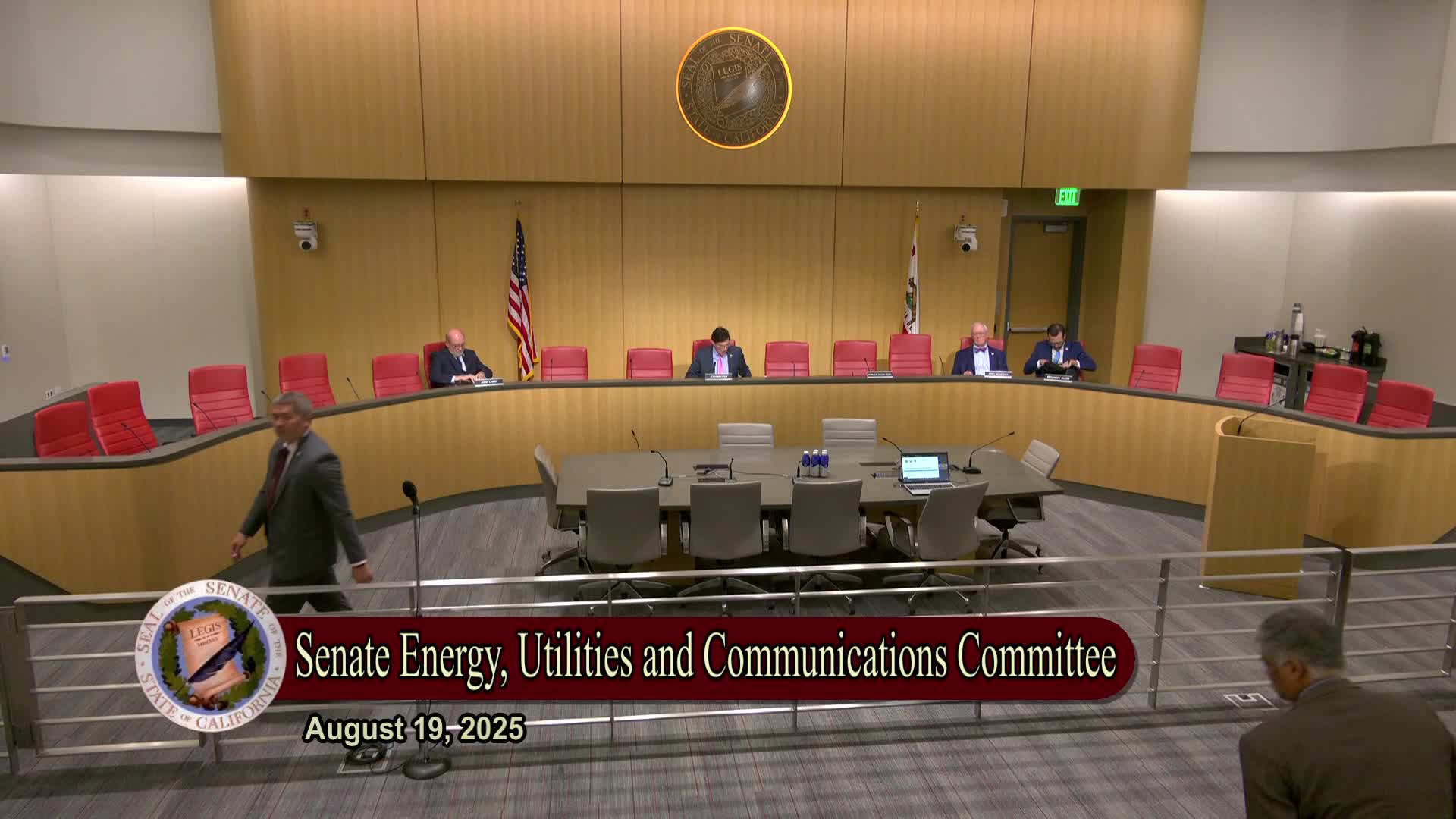
State energy regulators and the state’s grid operator told a California State Senate committee that the state enters the high‑demand months from a stronger position than after the rotating outages of 2020, but that risks from extended heat waves and wildfires could still stress the system.
“Agencies have adopted the word ‘cautiously optimistic,’” CEC Vice Chair Sibagunda told the committee during an Aug. oversight hearing called to review work on electricity reliability and provisions of SB 846 concerning Diablo Canyon. The California Independent System Operator’s president, Elliot Mainzer, said “so far this year, no flex alerts and no energy emergency alerts.”
The update matters because California’s net‑peak demand — the hours after solar generation falls but air‑conditioning load remains high — remains the primary reliability challenge, and agencies say a mix of new resources plus demand‑side programs are the tools most likely to avoid outages.
CAISO, the California Public Utilities Commission, the California Energy Commission and the Department of Water Resources reported several concrete changes since 2020: state utilities and other load serving entities have contracted nearly 18.8 gigawatts of new clean capacity under CPUC procurement orders; California has added thousands of megawatts of battery storage (CEC and agency presentations cited roughly 12,000 MW added since 2018 and CAISO gave a figure of about 13,500 MW of storage in its footprint); and last year procurement and interconnection activity produced a record build (nearly 7,000 MW of clean resources cited for one recent year). Agencies said the increase in storage has helped cover evening net‑peak hours when solar output declines.
Officials also identified remaining contingencies. The state retains a portfolio of near‑term emergency resources — roughly 4,000 MW in agency presentations — that can be dispatched in strain conditions, the largest component of which are once‑through‑cooling units managed by DWR (about 3,000 MW). DWR Deputy Director Delphine Ho told senators the DWR strategic reserve is primarily the once‑through‑cooling resources and short‑start assets under contract through 2026.
Agencies described three complementary paths for addressing reliability and affordability going forward: grow (more clean resources), share (regional market participation such as EDAM) and shift (demand flexibility and time‑of‑use pricing). Vice Chair Sibagunda described demand flexibility as one of three “buckets” of opportunity and said a 7,000 MW statewide goal for load‑shifting includes roughly 3,000 MW obtainable through rate design and other behind‑the‑meter measures.
The committee also heard updates on operational changes to speed interconnection and transmission permitting. CAISO described major reforms to the interconnection queue that removed speculative projects and prioritized study‑ready projects; CAISO said about 73% of a large cluster of requests were removed from study after implementing new readiness criteria. CPUC said it has adopted a new process to accelerate permitting for transmission upgrade projects (general order referenced as GO 131e) and to better coordinate environmental reviews.
Committee members pressed agencies on remaining weak points: exposure to a prolonged, West‑wide heat wave coincident with a catastrophic transmission event or large fire, localized transmission constraints that can force exports or curtailment, and uncertainty driven by federal trade and tax policy affecting supply chains for long‑lead resources.
Agencies urged continued emphasis on planning and project execution, noting the need to track contracted projects through interconnection and energization. “We have to continue doing the coordinated planning, and continue onboarding and energizing not only the transmission facilities, but also the other innovative grid‑enhancing technologies,” CAISO’s Mainzer told the committee.
Looking ahead, regulators said they expect to continue monitoring summer conditions, tracking progress on procurement and interconnection, and pressing for budgeted or statutory support for demand‑side programs. Several senators asked for clearer probability modeling of blackout risk in the near and midterm; agencies said work on refined probabilistic planning is under way and that the results will be useful for forthcoming policy choices.
The committee held the hearing to receive the reliability status update and to review SB 846 implementation. Senators said they will continue oversight as projects move from contract to construction and operation.