Get Full Government Meeting Transcripts, Videos, & Alerts Forever!
Get email alerts on the Education Performance topic
No spam. Unsubscribe anytime.
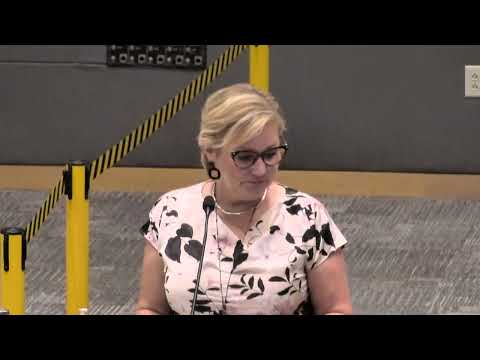
Superintendent Collins reports strong test results, outlines staffing and curriculum plans
Summary
Superintendent Jackie Collins gave the Charter School Authority Governing Board a detailed "state of the schools" report showing multiple schools outperforming district and state benchmarks, outlined a revised teacher-evaluation model and compensation investments, and summarized grants, partnerships and parent-engagement metrics for FY25.
Superintendent Jackie Collins told the Charter School Authority Governing Board on Aug. 19 that Oasis schools posted broadly strong standardized-test results last year, backed by targeted curriculum programs and investments in staff development.
Collins said Oasis Elementary South, Oasis Elementary North, Oasis Middle School and Oasis High School produced proficiency and learning-gain results that exceeded both Florida state and Lee County School District averages in many tested areas. "When you hit a tested level of 80 percentile or higher, you are automatically categorized as a school of excellence," Collins said, noting Oasis Elementary South met that threshold in several grades. She added that Oasis Middle School showed large year-over-year gains after focusing interventions on its lowest-performing students.
The report tied those results to systemwide strategies the district is pursuing: Cambridge coursework at the high school level, AVID instructional strategies, Kagan collaborative learning structures and WICR (writing, inquiry, collaboration, organization, reading) routines. Collins described site-level interventions such as a phonics program at Oasis South and a smaller-group math plan at Oasis North she called the "4-40 plan." She also summarized Cambridge exam results: of 1,207 Cambridge test attempts, 836 passed (about 69 percent overall), with particularly high pass rates in some ACE (Advanced Coursework and Education) classes.
Collins reviewed personnel metrics and pay investments. Teacher turnover fell from 17.4% in FY24 to 14% in FY25 (29 teachers left systemwide); support-staff turnover rose slightly to 19%. The district contracted Evergreen to perform a compensation and classification study and used budget reserves to implement pay-related changes: $1,458,000 for salary range adjustments, $725,000 for holiday and longevity bonuses, and about $462,000 in school recognition bonuses. Collins said those steps, plus a 1% increase for FY26, aim to help retention.
On evaluations, Collins said the district is phasing out its Marzano-based tool in favor of a modified Danielson framework implemented inside PowerSchoolevaluation hub. Under the revised model, she described a three-part weighting: 50% rubric-based domains (planning/prep, classroom environment, delivery of instruction, professional responsibilities), 33% overall student-growth measure (derived for now from school-level performance and point totals), and 17% teacher-set measurable professional goals. "The student growth component is 33% of the overall evaluative score," Collins said, adding that the board and staff are still refining how to measure growth without overtesting students.
Collins described professional development investments: AVID and Kagan training for teachers (train-the-trainer model), summer AVID attendance, AI and STEM training, and other targeted workshops. She said 55% of instructional staff attended optional professional-development sessions beyond required certifications.
Collins also listed FY25 funding and partnership highlights: a $20,000 Google grant, $70,000 from the Gutenberg Family Foundation, $30,000 from RIST, and the Oasis High School Booster Club raising about $45,000. She said the district prepared CAP (culinary program) and FTA (food quality) grant applications in FY25; dollar amounts for those grants were "not specified" and will be brought forward for board approval once known. Collins said parent engagement was high: Oasis South logged 7,446 parent-volunteer hours and Oasis North logged over 8,000.
Board members asked clarifying questions about math scores, Cambridge pass rates and the evaluation weightings. Board member Ms. Petit asked whether lower math gains in the lowest 25% were tied to algebra readiness; Collins said the school hired two new math teachers, added coaching and mentoring, used ESE push-in supports and introduced interactive notebooks as an AVID strategy. Collins and principals described grade-by-grade pathways (e.g., algebra placement) as drivers of variation in math results.
Collins closed by thanking the board and administrators and offering to answer follow-up questions.
The board did not take separate formal votes on the report; Collins requested questions and discussion during the meeting.
Ending: The governing board scheduled follow-up items on related budget and resolution items for later meetings, and members praised staff for the reported gains.