
Hopkinsville council repeals curbside recycling ordinance after heated debate
Get AI-powered insights, summaries, and transcripts
Sign Up Free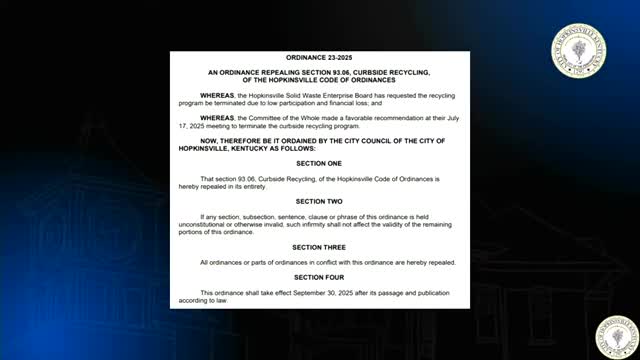
Summary
Hopkinsville City Council voted Aug. 19 to repeal the city's curbside recycling ordinance effective Sept. 30, 2025, after debates over persistent program losses, low participation and proposals to outsource or make participation mandatory.
Hopkinsville City Council on Aug. 19 voted to repeal section 93.06 of the Hopkinsville Code of Ordinances — the city's curbside recycling ordinance — with the ordinance set to take effect Sept. 30, 2025.
The vote followed more than an hour of public comment and council discussion about years of operating losses, low resident participation and possible alternatives including outsourcing the service or making participation mandatory. A motion to postpone final action and require a 60-day study failed, and the repeal passed on second reading.
Council members and staff said the solid waste enterprise has operated the curbside program at a substantial deficit and that participation never reached break-even levels. A council speaker summarized the financial shortfall this way: "We are losing $238,000 a year." Resident Betty Howard, who spoke during public comment, told the council, "I strongly oppose the repealing of the curbside program," and urged the body to delay action so residents could provide input.
Council member Travis moved to defer the second reading for 60 days to gather public input and explore options such as price increases or mandatory participation. That motion carried a brief discussion but failed on roll call (Yes: Council member Martin; Council member Sumner. No: Council members Bogard, Velez, Bridal, Drowd, Smith, Stallings, Marsh, Crabtree and Craig). Council then proceeded to a second-reading vote on the repeal ordinance; the ordinance passed (the recorded roll call showed one dissenting vote by Council member Martin and a majority in favor).
City staff and the Hopkinsville Solid Waste Enterprise Board told the council that recycling operations have historically run at a loss and that the enterprise lacks funds to underwrite continued service beyond the budgeted wind-down period. Staff said a previously planned wind-down period (described during the meeting as funded through the first fiscal quarter) covers only a limited time, and that, if the city pauses or continues the program, general fund subsidies would be required. Staff estimated the program needed far more participating households than the current 1,082 to achieve break-even relative to roughly 10,772 households not participating in the city’s service area. One staff presentation cited a sample monthly fee of about $32.50 for existing customers as the level required to cover costs if participation remained at current numbers; the current subscription rate for many residents was described in the meeting as about $5.50 per month.
Several council members and staff proposed a path for residents who still want curbside recycling: change the ordinance to allow a private contractor to provide curbside service under a permit or franchise arrangement. Staff identified Bowling Green as a comparable model that outsources the service to a private vendor, who contracts directly with residents. Council members asked staff to draft ordinance amendments and to solicit proposals from outside vendors to assess potential cost models and permit/franchise terms.
The council voted to add study of outsourcing and related ordinance changes to the business list with the expectation staff and solid waste representatives would bring proposals in September. A council member described the outsourcing option as a way to "allow our citizens who really want this an opportunity to have it" without the city subsidizing the program.
Votes and formal actions taken on the curbside item include: a failed motion to defer consideration and a successful second-reading adoption of Ordinance 23-2025 repealing section 93.06; the repeal ordinance specifies an effective date of Sept. 30, 2025. The council also approved adding study of outsourcing/ordinance amendment to the business list for consideration in September.
The council held a separate closed-session portion of the meeting later; no action was taken in closed session related to curbside recycling.
The hourly debate and the roll-call votes reflected wide disagreement among council members about whether to continue subsidizing curbside recycling, whether to raise user rates, and whether to pursue outsourcing. Council members asked staff to prepare clearer, comparative cost data and to invite potential private providers to present proposals at the September meetings.