Get email alerts on the Budget Development topic
No spam. Unsubscribe anytime.
Department of Metropolitan Development outlines 2026 budget with housing, engagement and legacy-property investments
Summary
DMD presented a largely balanced 2026 proposal with a 6.3% decrease driven by the phase-out of one-time federal ARPA grant funding, while keeping local service levels and highlighting housing pipeline investments, a new engagement division, and plans for City Market and Whistler Plaza.
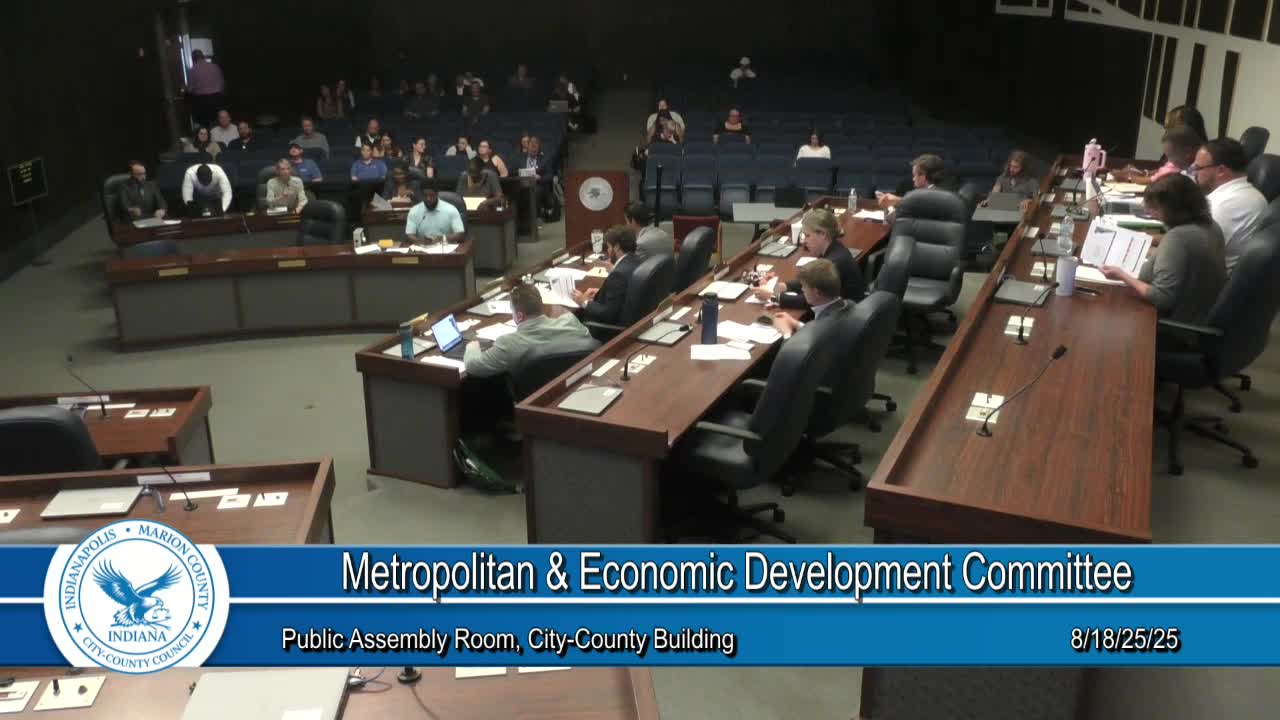
The Department of Metropolitan Development presented its 2026 proposed budget to the Metropolitan and Economic Development Committee on Aug. 18, 2025, reporting an overall decrease of roughly 6.3% compared with 2025, primarily because one-time ARPA-related federal grant funds are phasing out. DMD said the reduction would not materially affect core service delivery and that most local programs and staffing plans remain intact.
Director Megan Buksic and CFO Lucas Anderson outlined program priorities including affordable-housing investments, a new engagement division, additional oversight on city-owned redevelopment parcels, and continued work on legacy public spaces such as the downtown canal and Monument Circle. "We are proud of what we've been able to collectively put together," Buksic said, noting reorganizations and new staff hires to better serve the community.
DMD reported program accomplishments and pipeline figures: acquisition and relocation work for the Town and Terrace redevelopment (152 parcels acquired and 120 households relocated), a homeowner repair program that has received 555 applications with 192 active projects, and housing investments in the pipeline totaling 683 affordable rental units and 186 affordable homeownership units as of 2025. DMD's homelessness-policy team reported that 97% of people who enter DMD permanent housing programs remain permanently housed.
Lucas Anderson described the proposed budget breakdown and explained the federal grant decrease was tied to the phaseout of ARPA funding previously applied to HUD entitlement grants and other pandemic-response efforts. He said DMD sought to align 2026 spending with anticipated federal and local revenues, noted a $325,000 opioid-funding request to expand the master leasing program (potentially raising leased units from about 30 to 50), and described a $75,000 shift to the vacant-to-vibrant land-bank program to enable further property acquisition and to address property-tax timing issues.
Buksic highlighted DMD operational priorities: expanding engagement and customer-service capacity (a new engagement division), growing an economic incentives compliance team, and modernizing the development portal to streamline applications and data tracking. On the City Market and surrounding public space, DMD issued an RFQ for developers to deliver Whistler Plaza improvements and said it would continue pursuing private development for the Gold Building while seeking an operator and sustainable business model for the Market House.
DMD also reported new grant awards: a 2025 EPA Brownfields Communitywide Assessment Grant of $450,000 for environmental assessments and corridor development work and a Public Art for All grant of up to $30,000 to rehabilitate downtown canal murals commissioned for Super Bowl XLVI. DMD said it expects no programmatic impacts from the federal grant phaseout and that the department would continue to pursue grant funding and to leverage local dollars for housing and public-space investments.
Committee members asked for detail on enforcement and oversight tied to city-owned parcels such as Canal Village phase 3; Buksic and staff explained conditions in project agreements (architectural approvals, DMD inspections and reversion rights) and said the department would provide regular community updates. Members also asked whether the department's hiring needs could be eased by changing residency requirements; Buksic said DMD had strong applicant pools for open positions and was actively recruiting to fill vacancies.
The presentation closed with an emphasis on cross-department coordination, continued hiring and refinement of the development portal to measure housing outcomes and streamline approvals.
AI generated
The text on this page is AI generated. Summaries, highlights, and analysis are all produced from the original source material.
AI can make mistakes, so if you spot one, and we will fix it for everyone.
Note: the source content is unaltered by us. Any content source we link to, be it a video, an audio recording, a transcript, or a document, is presented exactly as its publisher released it. That publisher is usually a government body, sometimes an individual official or another organisation.