Get Full Government Meeting Transcripts, Videos, & Alerts Forever!
Get email alerts on the Housing Affordable topic
No spam. Unsubscribe anytime.
Committee approves PILOT for Canal Village 3 after developer outlines repair, tree and fence commitments
Summary
The Metropolitan and Economic Development Committee approved a payment-in-lieu-of-taxes (PILOT) pilot under Indiana Code for Canal Village 3 LP after the developer, BWI, described repairs and community commitments; neighborhood residents and tree advocates urged stronger enforcement and raised concerns about past work on Canal Village 1.
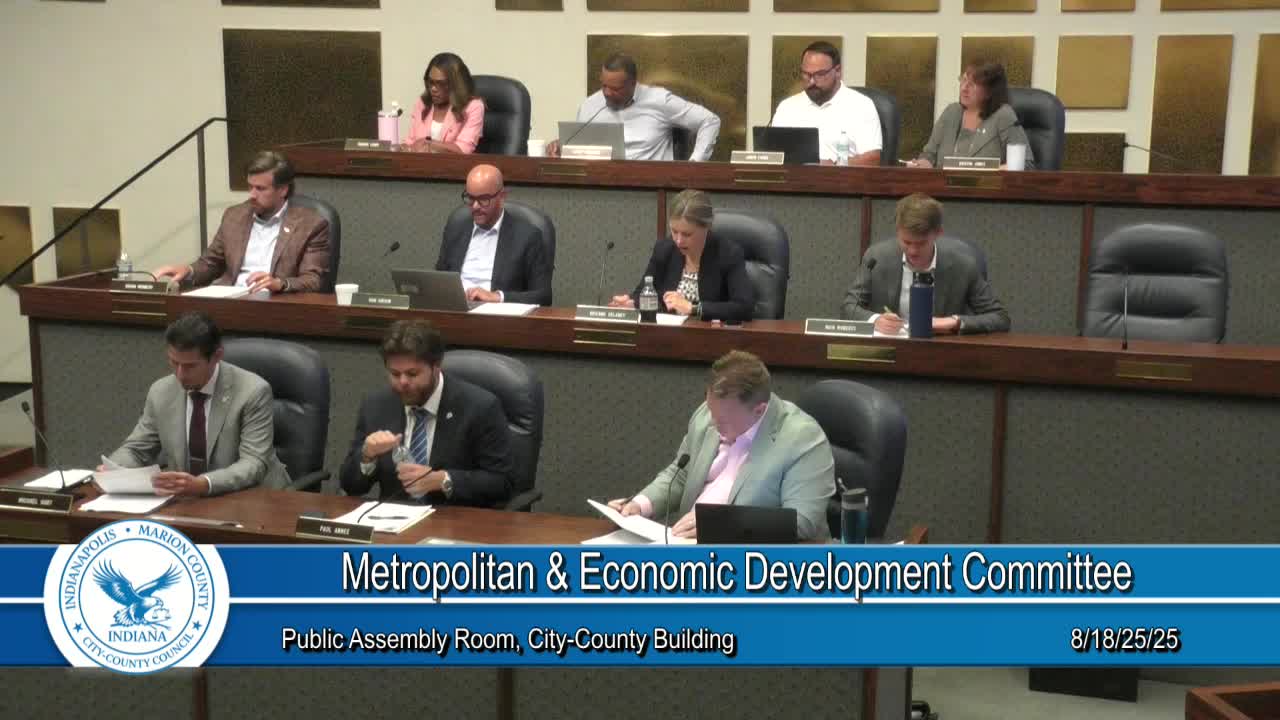
The Metropolitan and Economic Development Committee approved a payment-in-lieu-of-taxes pilot for Canal Village 3 LP on Aug. 18, 2025, a step the developer said is needed to close financing and begin construction next month. The pilot was approved under Indiana Code IC 36-3-2-12 and the project is expected to be financed in part with low-income housing tax credits under Section 42 of the Internal Revenue Code.
The pilot matters because it ties a city financial incentive to a privately financed affordable-housing project, and residents and neighborhood advocates made repeated requests that the city use the project agreement to secure repairs and environmental protections for existing tenants in Canal Village 1. Gary Hobbs, president and CEO of BWI, told the committee that BWI had completed or is expediting promised repairs, will prioritize tree preservation and will finish remaining privacy fences for Canal Village 1 residents ahead of the original schedule.
Hobbs said the developer had three commitments to the community: a resident survey about improvements (residents later chose privacy fences), completion of five community sponsorships, and fences along Clifton Street. He told the committee the remaining 35 fences for current Canal Village 1 residences would be completed by September, ahead of the contract deadline. "We are a business of our word," Hobbs said, adding that BWI will not remove trees except when "absolutely necessary" and has discussed tree replacement with Flanner House.
Neighborhood speakers urged the committee to tie the pilot to enforceable conditions and expressed continuing distrust about whether BWI will maintain commitments once the pilot is granted. "What it does not show is the true condition of this area after Canal Village 1 — the clear cutting of mature trees and loss of a tree canopy that once defined and served this neighborhood," said Laurie Perdue, co-director of the Community Canopy Alliance, while submitting photographic documentation to the committee. Ray Schnapp of the Community Canopy Alliance said the group's survey identified 13 heritage trees on parcels in the proposal area, ranging from a 50-year-old elm to a 175-year-old chestnut oak and a 189-year-old walnut tree, and described quantifiable stormwater and air-quality benefits those trees provided.
Other residents recounted continuing maintenance problems at Canal Village 1. "The repairs are not being done in a timely manner," said a neighborhood representative, who described a tenant who lived with a leaking roof for two years before a recent repair. Alita Kemp, a Northwest Landing resident, said many tenants do not trust the developer to follow through: "They don't trust the fact that he's going to complete the repairs and keep on top of this once everything is approved."
Committee members pressed staff for details about how the city would enforce developer commitments. DMD staff said the city owns 26 of the 33 lots in the phase 3 project, that the city's architect had signed off on BWI's architectural plans, and that the land transfer and project agreements would include: architectural review; a 15-year affordability requirement during which BWI would restrict rents to households at or below 60% of area median income; maintenance obligations that follow IHCDA livability standards; the city's right to conduct inspections during the 15-year affordability period; a right of reversion to take back title if the developer fails to complete redevelopment within a specified timeframe; regular monthly project updates to the community; and authority to revoke the pilot or assess penalties for noncompliance.
Committee members said those provisions, and the city’s ability to inspect and enforce them, were central to their decision. Councilors asked how residents could follow up if conditions were not met; DMD staff pointed to the mayor's action center and DMD project contacts as enforcement pathways and noted the city could take back ownership if the developer failed to meet commitments.
Votes at a glance — proposal outcomes recorded at the Aug. 18 hearing included appointments and the Canal Village action: Proposal 237 (appointment to Lawrence Township comprehensive plan citizen advisory committee) — motion carried by voice vote; Proposal 238 (appointment to City Market Corporation board) — motion carried by voice vote; Proposal 239 — tabled at committee; Proposal 184 (Canal Village 3 PILOT under IC 36-3-2-12) — motion carried by voice vote, pilot approved. (Vote tallies were recorded as voice votes in the transcript and numeric counts were not specified.)
The committee approved the pilot after the public comment period and a brief council discussion. Committee members and DMD staff emphasized that the project's commitments and the project agreement terms would be embedded in the land-transfer and pilot documents and that DMD and other city departments would retain enforcement tools, including inspections and the right to reclaim property for material noncompliance.
The developer asked council members for support to allow closing and construction to begin next month; the motion to approve the pilot carried by voice vote.
The committee hearing record shows the discussion included formal statements from the developer, multiple neighborhood speakers and DMD staff clarifying enforcement mechanisms. Committee members asked for ongoing community updates and clearer channels for residents to report compliance concerns.
Looking ahead, DMD staff said they would include the commitments in project agreements upon land transfer and provide monthly updates to the community until obligations are fulfilled. Residents and neighborhood groups asked the committee to monitor compliance closely and to use the pilot agreement's enforcement remedies if repairs or preservation commitments lapse.