Get Full Government Meeting Transcripts, Videos, & Alerts Forever!
Get email alerts on the Parking And Vehicle Storage topic
No spam. Unsubscribe anytime.
Cedar Falls council reviews ordinance change to clarify parking of trailers in rear yards; directs more staff work
Summary
City staff presented proposed amendments to Chapter 26 to clarify whether and how residents may store nonmotorized trailers, boats and similar items in side and rear yards. Council debated limits, surfacing requirements and enforcement and ultimately directed staff to gather more input.
City of Cedar Falls staff proposed an amendment to municipal code language on Monday to clarify whether trailers, boats and other nonmotorized recreational items may be stored in rear and side yards and, if so, under what conditions.
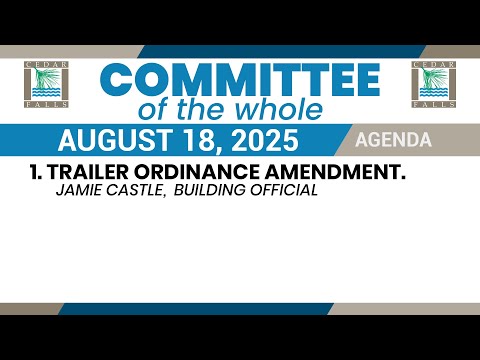
The issue was introduced during the Committee of the Whole meeting after staff said a council referral from roughly a year earlier asked them to consider removing prohibitions on parking and storing such items in rear and side yards. Jamie Castle, a city staff member, presented a draft amendment that would add language to Chapter 26 (off-street parking) clarifying that motorized vehicles must be parked on an approved hard surface while nonmotorized vehicles could be parked in side and rear yards subject to maintenance and size limits. Castle read the proposed language into the record, saying, “Parking of motorized vehicles is required to be on hard surface, meeting the requirements of chapter 26 of this code. Non-motorized vehicles may be parked in the side and rear yards. The area around and under the parked vehicle must be maintained in accordance with all applicable code requirements.”
Why it matters: residents and council members said the current code is confusing when read piecemeal, and enforcement varies. Staff said they receive frequent complaints — about vehicles parked on lawns, quantity of trailers, and proximity to neighboring property — and drafted the amendment to balance property use with nuisance protections.
Council members debated several specifics that staff had proposed: limiting the number of nonmotorized trailers allowed, minimum and maximum sizes, whether stored trailers must be empty, a short-term exception for motorized vehicles (staff proposed 48 hours in any 30-day period), whether boat storage should be treated as motorized or nonmotorized, and whether rear-yard allowances should vary by lot size. Several councilors said they wanted to preserve property rights and avoid imposing excessive new restrictions; others emphasized the need for clear, enforceable rules that prevent salvage-yard conditions and visual or safety impacts.
Council discussion focused on three recurring topics: the meaning of “parking area” and whether that term in Chapter 26 currently requires a hard surface; the practical effect of requiring a paved surface (driveway or slab) for backyard storage; and enforceability (how to measure number/size limits and how existing nuisance rules interact). Attorney Rogers and staff noted that existing code sections (Chapter 26, including section 26-2-20 and section 26-2-22) are written in ways that make interpretation uncertain and that some current enforcement treats backyard parking as requiring a paved surface.
Public comment: Craig Fairbanks of 405 Spruce Hills Drive urged minimal regulation, arguing property owners should be able to use their land. ‘‘It’s one of the basic American principles that we're allowed to have our land and do with it as we choose,’’ Fairbanks said.
Votes at a glance: Councilors first considered a motion to proceed with the original referral language (to allow parking in rear yards while leaving side-yard treatment unchanged). That motion failed in a 3-4 vote. Councilors then approved a separate motion directing staff to do additional outreach and research and to return with clearer options for ordinance language; that motion carried.
What was decided and what comes next: The council did not adopt a final ordinance change on Monday. Instead the council voted to direct staff to gather more feedback and prepare revised language that addresses the specific issues discussed — surfacing, trailer size and number limits, temporary exceptions, screening and lot-size distinctions — for future consideration by the council. Staff and several councilors said any new draft will also note how existing nuisance, fuel-storage and driveway provisions intersect with changes to Chapter 26.
Councilors and staff said clarifying definitions (for example, carving out a definition of “parking area” that distinguishes residential driveways/parking pads from commercial parking lots) could help future drafting. Staff also flagged enforcement practice: the department typically issues two notices before a citation and told councilors that many past complaints were resolved after notices rather than by issuing citations.
The committee paused the discussion after voting and scheduled the item to return to staff for further work. City staff will bring back proposed ordinance language and explanatory material to show how the draft interacts with the nuisance code, driveway rules and fuel-storage limits, and to propose specific limits (if any) on counts, size, lot-size tiers, screening or temporary-use allowances.