Get Full Government Meeting Transcripts, Videos, & Alerts Forever!
Get email alerts on the Economic Development Incentives topic
No spam. Unsubscribe anytime.
Wake County staff review business-development grant policy, highlight living-wage floor and targeted-growth incentives
Summary
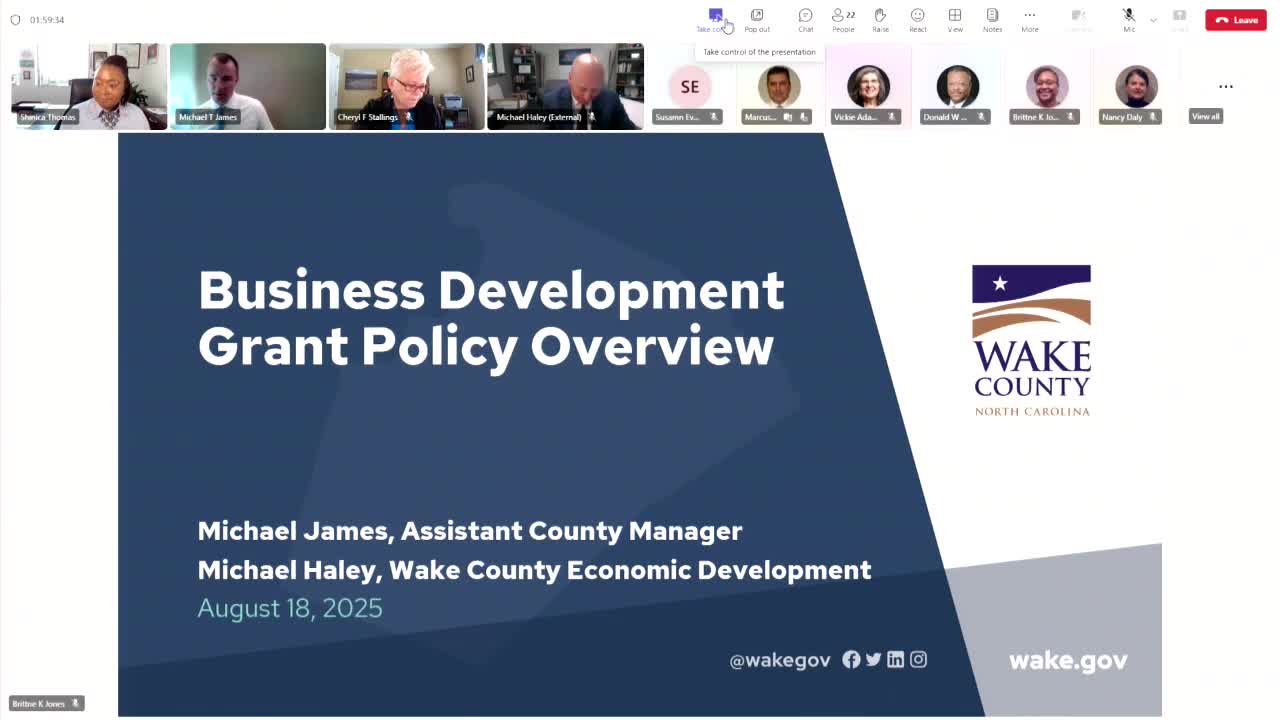
Wake County economic development staff and the county attorney’s office gave a detailed overview Aug. 18 of the county’s business-development grant policy, explaining statutory and case-law constraints, recent policy changes, and potential areas for future consideration.
Wake County economic development staff and the county attorney’s office gave a detailed overview Aug. 18 of the county’s business-development grant policy, explaining statutory and case-law constraints, recent policy changes, and potential areas for future consideration, including whether the county’s thresholds for large “transformative” projects remain adequate.
Michael James, an economic development presenter for the county, reviewed the policy’s structure and said the county’s grant program is performance-based, publicly documented and designed to support job creation, new assessed valuation, and economic mobility. "These are grants that are paid by the county ... to a private company in exchange for jobs creating capital investments that increase the local government's tax base," he said.
Legal and policy foundations: County attorneys and staff reviewed North Carolina precedent relating to public-purpose analysis for incentives. The presentation mentioned court precedent cited by staff (a late-1990s case described in the briefing) that established procedural safeguards — a "but-for" showing, written policy, written agreements, public hearings and performance-based terms — that have guided the county’s rules.
Key policy features described
- Eligibility tiers and thresholds: The policy defines multiple project tiers (standard tiers, state-match projects, a headquarters tier added in 2023 and a targeted growth category created in 2018). Minimum thresholds range from $2 million in new assessed valuation and 20 new jobs for the targeted growth category to $100 million and higher for larger transformative projects; incentive percentages and maximum term lengths vary by tier.
- Living-wage floor and average-wage requirement: The county adopted a living-wage floor in 2023 that sets a minimum wage for any job covered by an incentive at $24.37 an hour (about $50,690 annually, updated annually in the county’s personnel ordinance). Tied to that, the standard policy requires average wages for a project to be a specified percentage of Wake County’s average annual wage to qualify.
- Upward mobility bonus: An additional 5% grant is available if companies meet an "upward mobility" package: offer affordable health insurance, nondiscriminatory policies and robust leave, plus at least two employer practices that help mobility (childcare/transportation/education supports, plus programs like second-chance hiring). The bonus is paid only after the company meets its performance obligations.
Points for future discussion: Staff suggested the board consider whether the current investment thresholds and the tax-based payout methodology remain competitive for certain project types — especially headquarters or office projects, which can create a high number of jobs without large increases in assessed construction value. Staff noted that when the state participates (for example, through Job Development Investment Grants), modest local participation can unlock substantially larger state incentives.
Affordable housing note: County attorneys advised against using the business-development grant statute directly to require or fund affordable housing components within incentives, saying the legal authority and statutory requirements for affordable-housing funding are distinct. Attorneys noted counties may work on affordable housing through other authorities and programs but cautioned against mixing legal authorities in a single incentive agreement.
Ending: Commissioners thanked staff for the overview and discussed next steps for balancing the policy’s goals — economic mobility, attracting headquarters and supporting targeted-growth areas — while weighing administrative burden and competitiveness.