Get Full Government Meeting Transcripts, Videos, & Alerts Forever!
Get email alerts on the Cpace Financing topic
No spam. Unsubscribe anytime.
Wake County committee backs letting municipalities opt into new CPACE commercial financing program
Summary
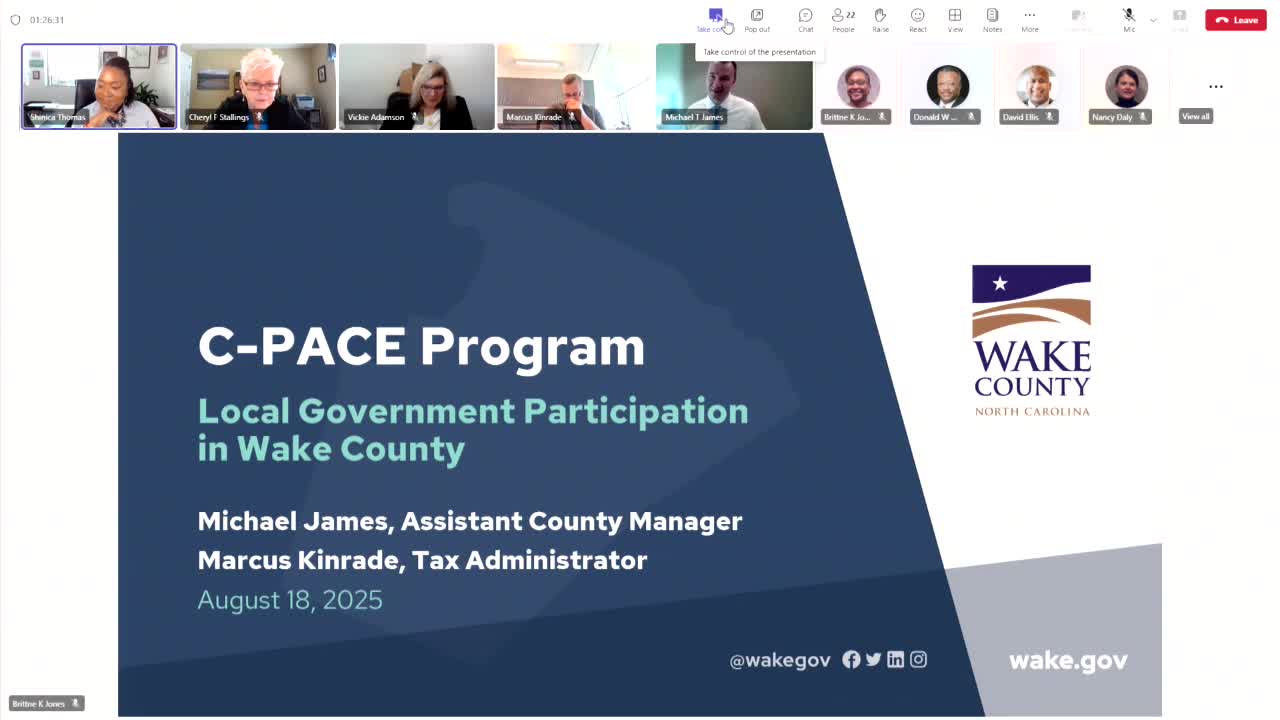
The Wake County Growth and Economic Strength Committee voted Aug. 18 to advance a staff recommendation that municipalities be authorized to participate in North Carolina's new CPACE program by requesting county concurrence, rather than having Wake County administer CPACE countywide.
The Wake County Growth and Economic Strength Committee voted Aug. 18 to advance a staff recommendation that municipalities be authorized to participate in North Carolina's new CPACE program by requesting county concurrence, rather than having Wake County administer CPACE countywide.
Michael James, who briefed the committee, said CPACE is a financing tool authorized by Senate Bill 802 in 2024 that allows commercial property owners to secure private loans for eligible energy, resiliency, renewable energy and water-conservation improvements. Loans are repaid through liens placed on the property by the participating local government, which can produce longer payback terms and lower loan costs for owners and lenders.
"This is a relatively new program that was created by the General Assembly last year," James told commissioners. He said local governments can participate by passing an initial resolution of intent, holding a public hearing and adopting a final resolution; alternatively, Wake County could simply pass a concurrence resolution for municipalities that request county participation.
Why it matters: CPACE programs are designed to reduce the barrier of high upfront capital costs for building upgrades by enabling private lenders to use an assessment lien mechanism. James and county staff said the statute protects local governments from taking on legal or financial liability for loans and that the administrative workload lies principally with the participating local government and lender.
Roles and eligibility: James said the Economic Development Partnership of North Carolina (EDPNC) will administer applications and record assessment agreements; private lenders conduct due diligence, originate the loans, and handle billing and enforcement of the assessments. Eligible properties are commercial, industrial, agricultural and multifamily (five or more units) and certain nonprofit properties; eligible improvements include energy efficiency, resiliency, renewable energy and water conservation projects.
Committee decision: After discussion of risk, administrative burden and where most commercial property is located, the committee approved a motion to send the staff recommendation — that the county adopt a policy of concurring on municipal requests to participate — to the full board for consideration. The motion was made and seconded during the meeting; the committee moved the recommendation forward for the full Board of Commissioners to review.
Local context: James said that, to date, only a few North Carolina counties have begun participation steps and that only one loan closing was known in the state (a Gastonia project). He and staff recommended that Wake County coordinate with municipal partners and bring grouped concurrence resolutions to the Board when municipalities are ready to participate.
Ending: The committee’s endorsement sends the matter to the full board, where members not present for the committee meeting will have the opportunity to ask additional questions before any resolution is adopted.