Get Full Government Meeting Transcripts, Videos, & Alerts Forever!
Get email alerts on the Fiscal Sponsorship topic
No spam. Unsubscribe anytime.
Fiscal sponsors describe models, costs and benefits to Arts Commission
Summary
Representatives from Local Color and Social Impact Commons outlined fiscal sponsorship models used by arts funders: a regranting model and a comprehensive ("bride A") model. Presenters said sponsors expand access to charitable funding and shared legal/compliance infrastructure; commissioners and public commenters highlighted disability and access
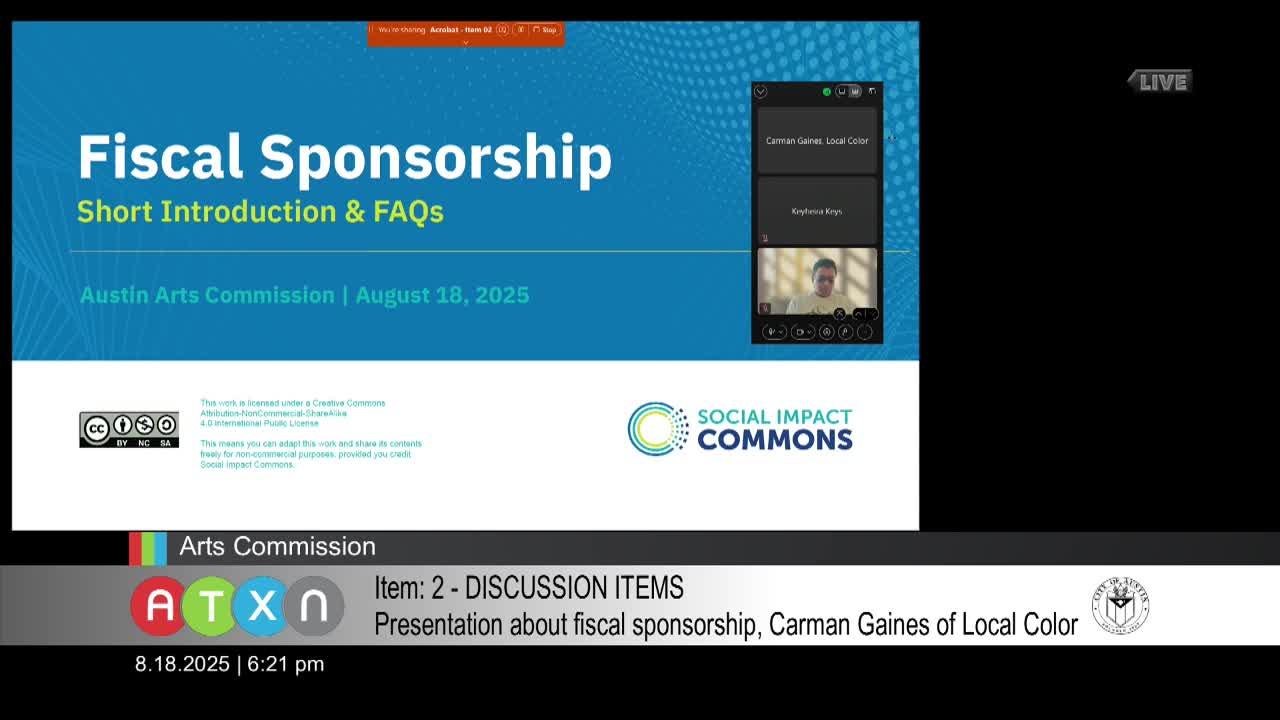
Representatives from two fiscal-sponsorship organizations told the Arts Commission on Aug. 18 that fiscal sponsors help artists and small projects access grant funding, reduce administrative burden and provide compliance oversight.
Carmen Gaines of Local Color (San Jose) described Local Color's fiscal sponsorship program, which the group launched in 2020. Gaines said Local Color has managed "over $673,000 in public dollars on behalf of 29 fiscally sponsored members" and that 16 of those projects received city funding in San Jose. She said Local Color shares agreements, reporting templates and a resource hub with its members and funders.
Thaddeus Wier of Social Impact Commons (Philadelphia) summarized the field nationally and the commonly used legal models. Wier described two predominant models: a "pre-approved grant" or regranting model (often called Model C), and a comprehensive "bride A" model that integrates a project as an in-house program. He said Model A typically recovers 10'15% of revenue to cover back-office services, while Model C commonly allocates a larger share to cover grant-management compliance. As Wier put it, "Model c, on average, allocates between 48%, of revenue for, the grants, management and charitable compliance work that attached to model c, fiscal sponsorship." He added that a 2023 field scan of about 100 sponsors suggested the ecosystem supports thousands of charitable projects and billions in revenue.
Why it matters: The presentations addressed a recurring concern in Austin's arts funding debates: artists who cannot receive direct individual stipends (for example, because of disability benefit rules) can still receive support through a fiscal sponsor that manages funds and pays a controlled stipend. Local Color and Social Impact Commons said fiscal sponsorship can reduce overhead for new organizations and increase access to funders that require a 501(c)(3) fiscal agent.
Questions and examples Commissioners asked several practical questions. A staff member from Local Color described an example where a model-A sponsor received a grant for an artist with a disability, then disbursed a smaller stipend and paid project costs to avoid disrupting the artist's disability benefits. Gaines said fiscal sponsors frequently share agreements with funders and that national organizations such as Social Impact Commons and Social Impact Commons partners have been foundational in sharing templates and standards.
Presenters also said fiscal sponsors vary in cost and business model: some sponsors are subsidized by philanthropy and charge no fee to artists; others recover a portion of costs through fees or allocations. Wier emphasized that fiscal sponsorship agreements should be formal written agreements that outline responsibilities and exit rights.
Quote "Local Color is a 5 0 1 c 3 with the mission to to create equitable pathways for artists and creatives to thrive," Carmen Gaines said in her presentation. Thaddeus Wier said, "We surveyed a 100 fiscal sponsors and found that there were over 12,000 charitable projects represented, by those that small sample and, about 2 and a half billion in revenue."
Ending Commissioners and public commenters welcomed the presentations and asked ACME staff to clarify whether fiscal sponsorship would remain an accessible option across the new City of Austin funding tracks. Staff said fiscal sponsorship remains an option in two of the cultural funding programs but acknowledged the wording in draft guidelines had caused confusion and pledged to clarify program rules and applicant guidance.