Get Full Government Meeting Transcripts, Videos, & Alerts Forever!
Get email alerts on the Water Planning topic
No spam. Unsubscribe anytime.
Wake County officials preview 50-year “1 Water” plan, call for public review in September
Summary
County water staff outlined a draft Wake 1 Water plan that ties water supply, stormwater, groundwater and wastewater into a regional, 50-year strategy, announced a September public comment period and asked commissioners to help publicize the plan and join a site visit to Walnut Creek Wetland Park.
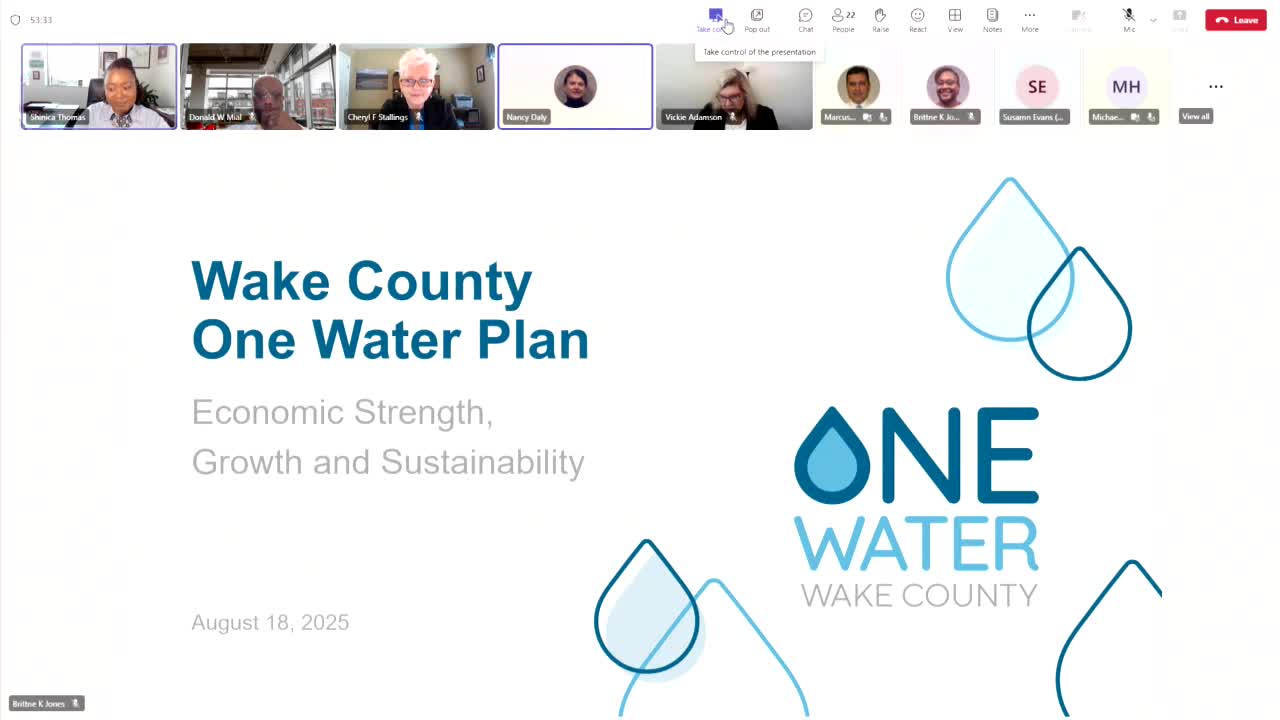
Wake County water officials presented an update on the Wake 1 Water plan on Aug. 18, saying the plan takes a 50-year, countywide approach to surface water, groundwater, stormwater and wastewater and will be released as a draft for public comment in September.
Nancy Daley, water resources program manager in Wake County Environmental Services, told the Board of Commissioners Growth and Economic Strength Committee that the plan seeks to align water strategies with the county’s Plan Wake growth framework and municipal partners to ensure water availability, water-treatment capacity and flood resilience as the county grows.
"This plan really highlights how water touches every part of our lives," Daley said. "We are very fortunate in Wake County ... but we can't take that for granted. It's not an unlimited resource." She asked commissioners to help share the draft widely and to join a planned site visit to Walnut Creek Wetland Park to see partnership projects on the ground.
Why it matters: Daley said Wake County’s population is projected to double by 2070 and that growth, combined with more extreme weather events, rising treatment needs (including emerging contaminants) and the water demands of new technologies and industries, will require coordinated regional planning and investment. The plan, she said, builds on technical assessments completed in 2022–24, stakeholder workshops and two countywide public surveys that together captured more than 2,800 responses.
Key details: Daley outlined four strategy buckets in the draft plan: optimized water supply (for example, rainwater capture and reuse), water quality and hydrology improvements (including nature-based stormwater solutions), land conservation and preservation, and flood resilience (including flood mapping and dam evaluations). She said the plan recognizes that water management in Wake County is handled by many entities — county programs (wells, septic, county stormwater), municipal water and wastewater utilities, private water providers and conservation partners — and that coordination across jurisdictions is essential because "it's all the same water source."
Eastern Wake concerns: Committee members pressed for details affecting Eastern Wake County residents. Daley said naturally occurring radiological contaminants affect about 20% of private wells in parts of Eastern Wake and described ongoing outreach and a county financial-assistance fund to support well testing and repairs administered through the county's On-site Water Protection Program. She said the plan will build on existing county programs and aim to sustain outreach and financial assistance for private well owners.
Process and next steps: Daley said the county expects a draft plan to be posted for public review in September, with the final plan returned to the Board in early 2026 for endorsement and implementation support. She also invited commissioners to attend an organized site visit to Walnut Creek Wetland Park in southeast Raleigh to view demonstration projects and programming.
Context and constraints: Daley repeatedly emphasized that the plan requires collaboration among the county, municipalities, private water providers, agricultural stakeholders and residents. Commissioners asked for follow-up data on open-space preservation goals referenced in Plan Wake and for confirmation of municipal representation on the Wake County Water Partnership (Daley said Roseville and Zebulon had recently been hard to fill but that Wendell and other partners remain engaged).
Ending: County staff said they will post the draft in September and return to the board in early 2026; the presentation and the calls for public comment aim to give communities and municipal partners time to review strategies and suggest implementation priorities.