Get Full Government Meeting Transcripts, Videos, & Alerts Forever!
Get email alerts on the Cultural Funding topic
No spam. Unsubscribe anytime.
ACME unveils new cultural funding guidelines; commissioners debate fiscal sponsorship and creative-space rules
Summary
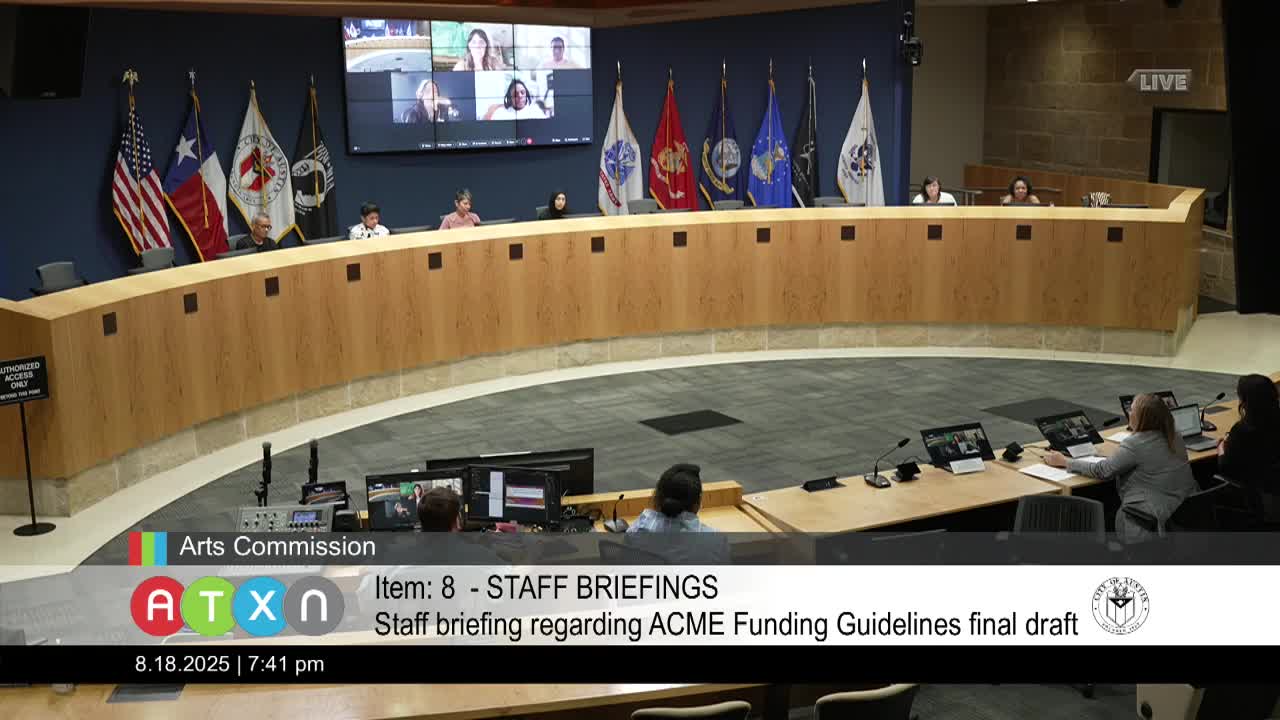
The City of Austin's Office of Arts, Culture, Music, and Entertainment presented final draft cultural funding guidelines on Aug. 18, asking the Arts Commission for a recommendation as staff moves toward a Sept. 25 City Council request for action.
The City of Austin's Office of Arts, Culture, Music, and Entertainment presented final draft cultural funding guidelines on Aug. 18, asking the Arts Commission for a recommendation as staff moves toward a Sept. 25 City Council request for action.
ACME assistant director Morgan Messick told commissioners the new approach consolidates program documents, groups applicants so similar organizations compete against one another and launches applications through a single "stacked" intake. Messick said the office plans an application opening Oct. 21 with panels and awards processed in January and funding distributed as soon as contracts are finalized in February or March. "We have grouped together like applicants so that similar applicants can compete against 1 another," Messick said.
The guidelines propose three principal cultural funding tracks: Thrive (multi-year operating support for established nonprofit arts organizations), Elevate (annual project and operating grants for a range of applicants), and Nexus (entry-level awards). Messick said some programs will include fiscal sponsorship as an option; ACME staff described a pilot cadence for CSAP, the Creative Space Assistance Program, and an outreach plan to post final materials and scoring rubrics publicly.
Why it matters: The guidelines represent ACME's attempt to standardize hundreds of pages of prior program rules under one set of definitions and to make launches easier for applicants. The changes will affect how much funding different artists, venues and nonprofits can apply for and how panels score applications. Commissioners and many stakeholders said clarity on eligibility and perceived fairness will determine whether the changes help or hinder Austin's creative ecosystem.
Key details - Timeline: intake form and applicant profiles opening later this month; eligibility checks in September; full applications Oct. 21'Dec. 1; review and panels in January; awards and contracts targeted for February/March. ACME plans repeat launch windows in future years. - Program highlights: Thrive (two-year awards for established nonprofits; maximum two-year award up to $250,000 for organizations with creative space); Elevate (annual awards, multiple budget brackets for nonprofits and individuals); Nexus (entry-level awards of $5,000 or $10,000, open twice a year). - User experience changes: a single intake profile, discipline-aligned reviewers, Olympic-style panel scoring (drop highest and lowest), universal appeals process, and "stacked" application intake developed with the Long Center.
Commissioner and public concerns Commissioners repeatedly pressed staff about two issues that emerged in public comment earlier and during the presentation: fiscal sponsorship and CSAP eligibility. - Fiscal sponsorship: During the meeting several commissioners and public commenters asked whether artists who would benefit from fiscal sponsorship'for example, artists on disability benefits who cannot receive certain direct stipends'would still have access to funding through ACME. Messick said fiscal sponsorship remains available in two cultural funding programs but acknowledged the document language had caused confusion and pledged follow-up communications and training. The issue drew explicit support from public speakers who had described fiscal sponsorship as an access tool. Commissioner Schmalbach told staff that the disability scenario raised by presenters illustrated a concrete benefit. - CSAP eligibility and purpose: Commissioners and several public speakers objected that the proposed CSAP rules excluded many nonprofit-owned and multiuse creative spaces (studios, workshops and rehearsal facilities). Commissioner Kuchenny told staff the rules risk privileging commercially operated venues over nonprofit organizations that provide space and services for artists. Messick and other staff said CSAP is intended to prioritize support for spaces facing high rent and operating pressure that do not own their property; they noted CSAP has a modest budget (about $500,000 per fiscal year) and cannot solve all space-affordability needs. Commissioners asked staff to clarify definitions and to reconsider exclusionary language that might disqualify long-standing community venues.
Engagement and next steps ACME interim chief administrative officer Candace Cooper and assistant director Messick reviewed an extensive public engagement process conducted during the Creative Reset. Cooper described thousands of comments and focus-group inputs used to draft the guidelines and said a public "win/win" response log showing how input was handled would be published. Messick said the office will bring the guidelines to the Music Commission Sept. 8 and to the Economic Opportunity Committee Sept. 19 before the Sept. 25 City Council request for action.
What commissioners asked staff to do - Clarify and standardize the definition of "creative space" across the guideline appendices and program rules. - Provide a clear statement of which programs allow fiscal sponsorship and how applicants can use that option. - Return with legal counsel at the next Arts Commission meeting to answer conflict-of-interest and recusal questions raised by commissioners. - Provide a clearer CSAP eligibility explanation and reconsider whether nonprofit-owned creative spaces should be eligible or have a separate pathway.
Quote "We painted the mural while the gallery was already open," Candace Cooper said, describing ACME's decision to extend engagement as community feedback continued to arrive.
Ending ACME staff said they will post finalized guidelines, rubrics and sample applications once Council action is secured. Commissioners asked staff for clearer eligibility language, more explicit handling of fiscal sponsorship, and a legal briefing on recusals before any formal commission recommendation is forwarded to City Council.