Get Full Government Meeting Transcripts, Videos, & Alerts Forever!
Get email alerts on the Public Safety Budget topic
No spam. Unsubscribe anytime.
Jacksonville Sheriff's Office presents FY26 budget, emphasizes staffing and technology costs
Summary
Director Ed Cayenne told the True Commission the Jacksonville Sheriff’s Office proposed $638 million FY26 budget is driven by negotiated salary/benefit costs, technology investments and grant funding; commissioners requested district‑level staffing and response‑time data.
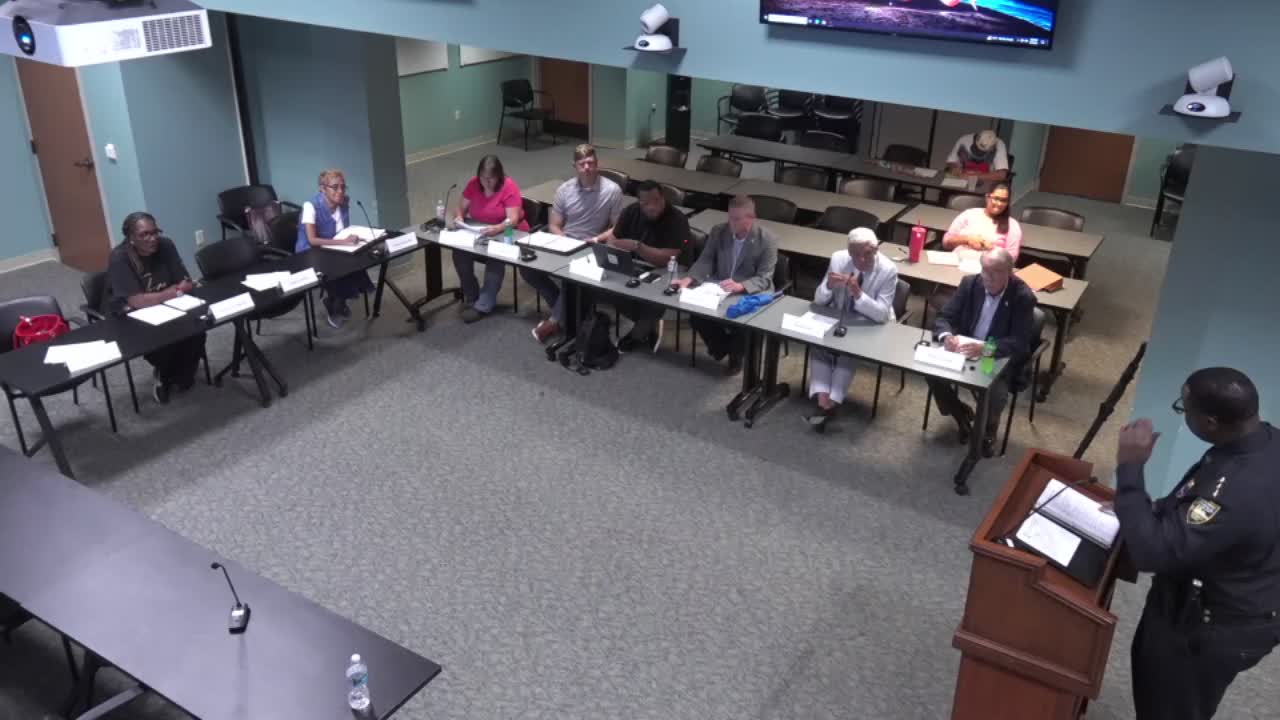
Director Ed Cayenne of the Jacksonville Sheriff’s Office presented the JSO proposed fiscal year 2026 budget to the True Commission on Aug. 7, saying the agency requested $638,000,000 — an increase of $4,800,000 from FY25.
Cayenne told commissioners the increase is largely tied to contractual obligations, including a negotiated agreement with the city and the Fraternal Order of Police. He said about 80% of the JSO budget is dedicated to salaries and benefits; roughly 20% covers ongoing operational costs such as software licenses, equipment maintenance and other non‑discretionary items. Cayenne said only a small portion of the budget remains for new crime‑prevention projects and innovation such as the real‑time crime center and advanced forensics.
The presentation highlighted several ongoing investments: a citywide real‑time crime center that aggregates camera feeds, fleet license plate readers and expanded computer forensics capacity. Cayenne said these technologies accelerate investigations and improve probable cause for prosecutors. He described Operation Jacob's Ladder, a multistate narcotics investigation supported by grant funding, which the speaker said produced 14 arrests and seized “over 75 kilograms of cocaine, over 3 grams of fentanyl, 74 pounds of marijuana, 734 grams of MDMA, $212,000 in cash, five handguns, eight rifles, a tractor trailer and two vehicles.”
Cayenne said JSO pursues federal and state grants to ease taxpayer cost and cited a SAFE grant from the Florida Department of Law Enforcement and 40 positions funded through a COPS grant. He said JSO has more than 3,000 employees and that internal budget development begins roughly a year in advance, with needs aggregated from five deputy divisions before being consolidated by the budget chief and sheriff.
Commissioners asked several operational questions. Commissioner Raymond Day asked for district‑level data: for patrol districts 1–6, the number of patrol officers, calls for service and average response time for FY2023–24 and FY2024–25 (the latter when data are available). Cayenne agreed to provide the data and said his crime analysis unit would work with commission staff; Cayenne asked that the request go to Miss Hemingway for coordination. The director also agreed to follow up on questions about leasing costs related to JSO's planned move from the Police Memorial Building to the Florida Blue building; he said the lease terms were worked out with the city and “not going to add unburdened stress to the taxpayers” but offered to provide precise figures when staff could confirm them.
On patrol vehicles, Cayenne said the shift from sedans to SUVs reflects changes in vehicle production (Ford no longer producing sedans) and operational needs—flood resilience and equipment capacity—and that the change did not increase purchase costs to taxpayers. He acknowledged citizen concerns that darker gray SUVs can be harder for the public to visually identify as police vehicles and said he would relay that feedback to Sheriff Waters.
Cayenne described the department's reorganization into smaller patrol districts intended to equalize officer distribution and reduce response times, and he discussed use of AI and other technologies in the fusion center to accelerate intelligence sharing statewide. He said JSO is exploring federal funding opportunities for AI tools and planning projects to use AI to disseminate information among jurisdictions more efficiently.
The director clarified that the hazardous devices unit operates as a regional, Tier‑1 unit and that costs for ordnance disposal are not passed to citizens. He estimated recent homicide reductions and violent crime declines but offered to provide exact crime‑trend numbers on request.
The presentation closed with Cayenne saying the sheriff is committed to stewardship of public funds and to crime‑reduction strategies that combine personnel and technology. Commissioners and staff agreed to follow up on the data requests and on specific budget and lease cost details.
Ending: Commissioners used the presentation to identify specific follow‑up items (a district staffing/response matrix and cost details on the Florida Blue lease) for staff. Cayenne said JSO would supply the requested data through the established staff contacts.