Get Full Government Meeting Transcripts, Videos, & Alerts Forever!
Get email alerts on the Comprehensive Plan Ear topic
No spam. Unsubscribe anytime.
Indian River County delays final action on comprehensive plan review, schedules Sept. 9 continuation
Summary
County staff presented the Evaluation and Appraisal Report (EAR) and draft comprehensive plan amendments; commissioners and residents asked for more time and additional advisory-board review. The board continued the public hearing to Sept. 9 for further review and comment.
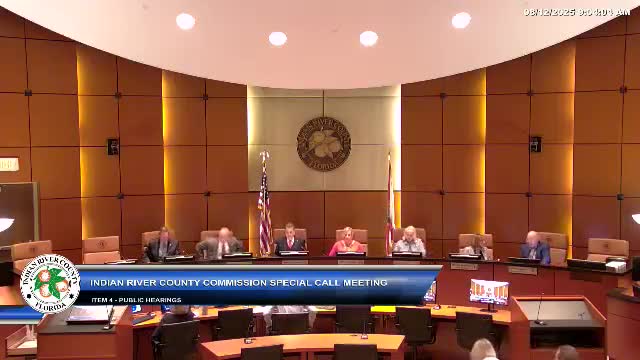
Indian River County commissioners reviewed the Evaluation and Appraisal Report (EAR) and proposed amendments to the county comprehensive plan on a presentation from Patrick Murphy, the county’s chief of long‑range planning, but did not adopt final amendments. The board voted to continue the public hearing to Sept. 9 to allow additional review by Planning & Zoning and other advisory bodies and to gather more public input.
Murphy told the board the EAR is a state‑mandated way to evaluate the comprehensive plan’s goals, objectives and policies and identify updates needed after recent changes to Florida law. “The evaluation and appraisal report is a way of looking at our comprehensive plan and taking a look at all the things that we need to update,” Murphy said, describing the plan’s 13 elements from transportation and housing to coastal management.
Why it matters: the comprehensive plan sets land‑use policy for development, coastal protection, infrastructure and housing in the unincorporated county. Changes in state statutes or county priorities can trigger updates that affect permitting, resource protection and where development is allowed.
Staff and consultant work: county staff and consultant Kimley‑Horn conducted six public workshops (day and evening sessions across the county) and online outreach; Murphy said more than 250 participants provided input used to shape recommended changes. The Planning & Zoning Commission held a public hearing June 26 and forwarded a recommendation to the Board of County Commissioners. Under the state review process, staff will transmit the draft EAR/amendments to the Florida Department of Commerce (the state land‑planning agency) and a set of state reviewing agencies; those agencies typically have 30 days to comment and Florida Commerce may issue an objections/recommendations report within 60 days of receipt.
Commissioners and procedure: several commissioners said the draft is lengthy and they needed more time to absorb it. “You would need weeks, not days to review it,” one commissioner said of the Planning & Zoning packet; another noted the county can return to any element later and that the state review is meant to identify statutory changes. County staff and the county attorney clarified a legal procedural point: after the board adopts final amendments, the county must transmit the adopting ordinance to Florida Commerce within 10 days, and the EAR transmission from this hearing is subject to a 10‑day transmittal requirement if the board finishes action.
Public comments and topics raised: members of environmental and conservation groups asked the board to strengthen protections and clarify implementing rules. - Jeriana Jones of the Gopher Tortoise Alliance urged changes to a local development regulation (LDR 927.06 as cited by the speaker) to avoid accidental take of protected gopher tortoises on parcels of less than one acre. - Donna Halloran of Pelican Island Audubon urged stronger county policy on annexations, faster septic‑to‑sewer conversions to benefit the Indian River Lagoon, alignment with the lagoon’s basin management plans, and clearer cross‑references between the comprehensive plan and implementing land‑development regulations. - Bob Adair, chairman of the Indian River Soil & Water Conservation District, pushed for an updated countywide geohydrology study (USGS) to better understand groundwater withdrawals and saltwater intrusion; he noted permitted withdrawals have increased since earlier studies.
Next steps: the board agreed to continue the public hearing to its regularly scheduled meeting on Sept. 9 to give commissioners, Planning & Zoning and community groups more time to review the staff memorandum and summary matrix. Staff said the state is not forcing an immediate deadline; the EAR process is iterative and staff will collect public comments, address state and agency feedback, and return for final adoption.
Ending: commissioners directed staff to notify advisory boards and to post the staff report and matrix used to summarize proposed changes so residents and boards can focus on the items staff identified as revised, removed or unchanged.